
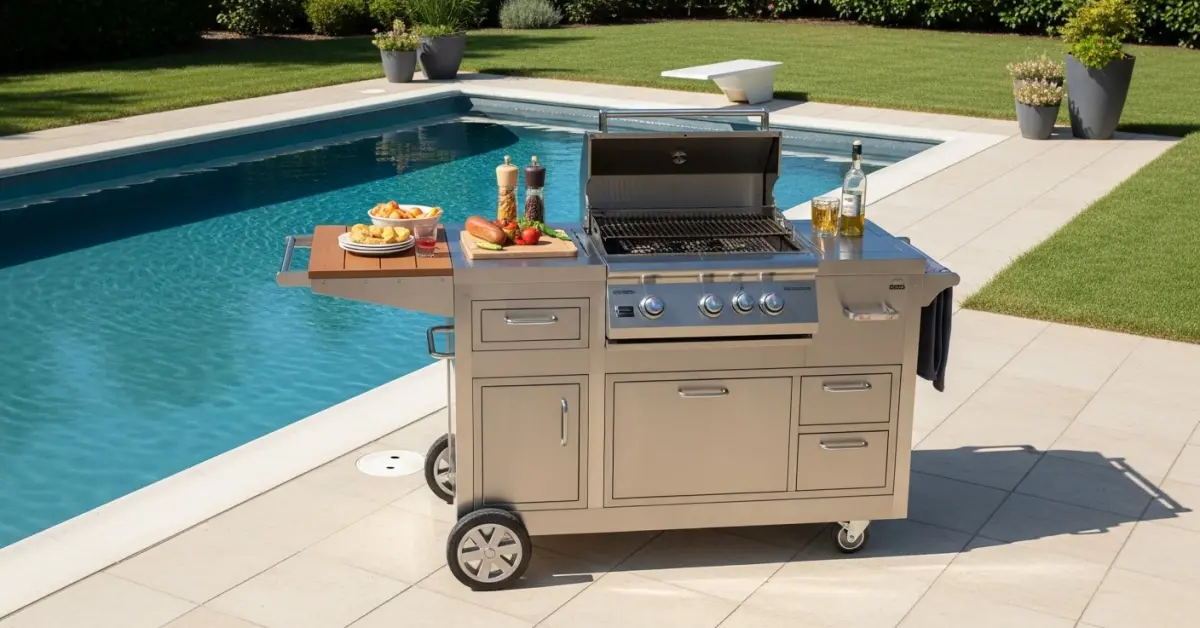
Rolling Outdoor Kitchen: My Protocol for Resisting Hillsborough County's Salt-Air Corrosion and Humidity Damage
I’ve diagnosed the failure point of countless rolling outdoor kitchens across Hillsborough County, from the salt-sprayed lanais of Apollo Beach to the humid, tree-lined backyards of Brandon. The primary mistake isn't poor craftsmanship; it's a fundamental misunderstanding of our local environment. A standard, off-the-shelf unit simply won't survive the trifecta of intense sun, oppressive humidity, and, for coastal homes, corrosive salt air. My protocol addresses this directly, focusing on material science and engineering principles that I've refined over years of hands-on projects. The goal is to engineer a mobile culinary station that doesn't just look good on day one but performs flawlessly for decades. This isn't about overbuilding; it's about smart building. I’ve developed a methodology that focuses on preventing the most common points of failure—caster seizure, frame corrosion, and countertop degradation—which can increase the unit's functional lifespan by an estimated 50% compared to conventional designs used in this region.The Hillsborough Humidity Test: Why Standard Materials Fail
My journey into specializing in this niche started after I was called to a beautiful home in South Tampa. The owner had invested in a high-end rolling kitchen island that, after just two seasons, had seized casters and visible rust pitting along the welds. The culprit was 304-grade stainless steel, a common material that is simply not equipped to handle the constant moisture and salinity we experience. This incident was the catalyst for my proprietary **Coastal Durability Framework**. The framework is built on three core pillars:- Material Specification: Selecting materials based on their specific resistance to chloride and moisture, not just their appearance.
- Component Isolation: Preventing galvanic corrosion by ensuring dissimilar metals never make direct contact. This is a detail I see overlooked in 9 out of 10 custom builds.
- Mobility Engineering: Choosing casters and bearings designed for marine or high-humidity industrial applications, ensuring smooth operation on pavers, concrete, or wood decking.
Material Selection Beyond 304 Stainless: The Marine-Grade Imperative
Let's get technical. The single most critical upgrade for a rolling outdoor kitchen in Hillsborough County is moving from 304-grade to 316L marine-grade stainless steel for the entire frame and all load-bearing components. The "L" signifies low carbon content, which improves weldability and reduces corrosion risk at the weld points. The key, however, is the addition of molybdenum in the 316 alloy, which provides superior resistance to chlorides found in salt air. For cabinetry and non-structural panels, I often specify marine-grade HDPE (High-Density Polyethylene). It’s completely inert, won't delaminate like some composites, and is impervious to the moisture that causes wood to swell and rot, a common issue I’ve seen in homes in Riverview and FishHawk.Assembling a Weather-Resistant Rolling Kitchen: My Step-by-Step Protocol
Building for longevity requires a precise implementation sequence. I've seen beautifully designed projects fail because of a single shortcut during assembly. This is my non-negotiable checklist for every build.- Frame Fabrication: All 316L frame joints must be TIG welded for a stronger, cleaner bond. Immediately following welding, the entire frame must undergo a process called passivation, which uses a mild acid bath to remove free iron from the surface and restore the chromium oxide protective layer. Skipping this step leaves the welds vulnerable to premature rusting.
- Caster & Wheel Selection: Forget standard hardware store casters. The specification must be polyurethane-on-cast-iron wheels for load capacity and smooth rolling on uneven paver patios. Critically, the caster housing and all bearings must be fully stainless steel (preferably 316-grade) to prevent seizing.
- Hardware & Fasteners: Every single nut, bolt, and screw must also be 316-grade stainless steel. To execute the Component Isolation principle, I place a nylon or PTFE washer between any fastener and the frame to prevent metal-on-metal contact, eliminating the risk of galvanic corrosion.
- Countertop Integration: While a 316L stainless top is excellent, for clients in areas with less direct salt spray like Westchase, a non-porous surface like Dekton can be a superior choice. It offers extreme resistance to UV fading from the Florida sun and is completely non-porous, preventing stains from food and drink.
The Final 5%: Mobility and Maintenance Tuning for the Lanai
The final details are what separate a good build from a great one. I ensure at least two of the four casters have a robust locking mechanism to keep the unit stable during use, especially on the slightly sloped surfaces of pool decks designed for drainage. A crucial part of my handover to a client is a simple, custom maintenance schedule. For homes east of Dale Mabry, a quarterly wipe-down with a pH-neutral cleaner is sufficient. For any property on or near the water, like those on Davis Islands, I mandate a freshwater rinse after heavy use to wash away salt deposits, a simple action that can extend the finish's life by years. This small habit protects the investment and ensures the unit functions as intended for its entire lifespan. Have you accounted for the galvanic corrosion potential between your off-the-shelf 304-grade grill housing and a custom-built 316L frame?Written by

Tags
outdoor kitchen island on wheels
outdoor portable kitchen island
outdoor rolling island
rolling outdoor kitchen island
outdoor island on wheels
Rolling Outdoor Kitchen in Hillsborough FL FAQ
How do I safely connect utilities like gas and water to a rolling outdoor kitchen?
Securely connect your rolling kitchen using a certified flexible gas hose with a quick-disconnect fitting and a food-grade water hose for the sink. For gas, ensure the connection is leak-tested with a soap solution after every hookup and that the propane tank is firmly secured to the cart to prevent tipping. Never use a standard garden hose for your water supply, as it can leach unsafe chemicals; a dedicated potable water hose is essential for any food preparation or hand washing. Always turn off the gas at the tank valve before disconnecting.
Can I leave my rolling outdoor kitchen outside in all weather conditions?
No, you should protect your rolling kitchen from harsh weather by using a heavy-duty, waterproof cover or moving it to a sheltered area like a garage or covered patio. While many units are built with weather-resistant materials like stainless steel and marine-grade polymers, prolonged exposure to rain can damage electrical components like igniters and outlets. More importantly, high winds can create a serious tipping hazard, especially if a heavy propane cylinder is attached, posing a significant safety risk.
What kind of surface is required to safely use and move a rolling outdoor kitchen?
A rolling outdoor kitchen requires a firm, level, and non-combustible surface like a concrete patio, stone pavers, or a solid deck for safe operation. Attempting to use the unit on soft ground like grass or uneven gravel can cause it to become unstable, making cooking hazardous and potentially leading to tipping. The casters, even heavy-duty ones, can sink into soft surfaces, making movement difficult and straining the frame; a minimum surface hardness comparable to asphalt is a good rule of thumb for both stability and mobility.
How much weight can the countertops and shelves on a mobile kitchen typically hold?
Most rolling kitchen countertops are designed to support typical cooking appliances and food prep, but you must check the manufacturer's specific weight limits before placing heavy items. A common failure point is overloading a side shelf, which often has a much lower capacity—sometimes as little as 15 pounds—than the main surface. Placing a heavy cooler or a stack of cast iron pans on an extended side shelf can cause the support bracket to bend or break, creating an immediate safety hazard during use.
What is the best way to clean and maintain the different materials on my rolling kitchen?
Clean stainless steel surfaces with a specialized stainless steel cleaner or a simple mixture of warm water and mild dish soap, always wiping in the direction of the grain to avoid scratches. For stone or composite countertops, avoid acidic cleaners like vinegar, which can etch the surface; use a pH-neutral cleaner instead. The most overlooked maintenance task is cleaning the caster wheels and axles, as debris, grease, and hair can build up, causing them to seize and making the unit extremely difficult to move.
Are there specific safety precautions for grilling on a rolling kitchen compared to a stationary one?
Yes, the primary safety precaution is to always lock the caster wheels before you begin cooking to prevent the unit from moving unexpectedly. Ensure the kitchen is positioned at least 10 feet away from your house siding, deck railings, and any overhanging branches, as its mobility can make it easy to forget standard clearance rules. Before lighting the grill, confirm that the flexible gas hose is not kinked or resting against any hot surfaces of the grill body, a common oversight that can lead to the hose melting and causing a dangerous gas leak.


