
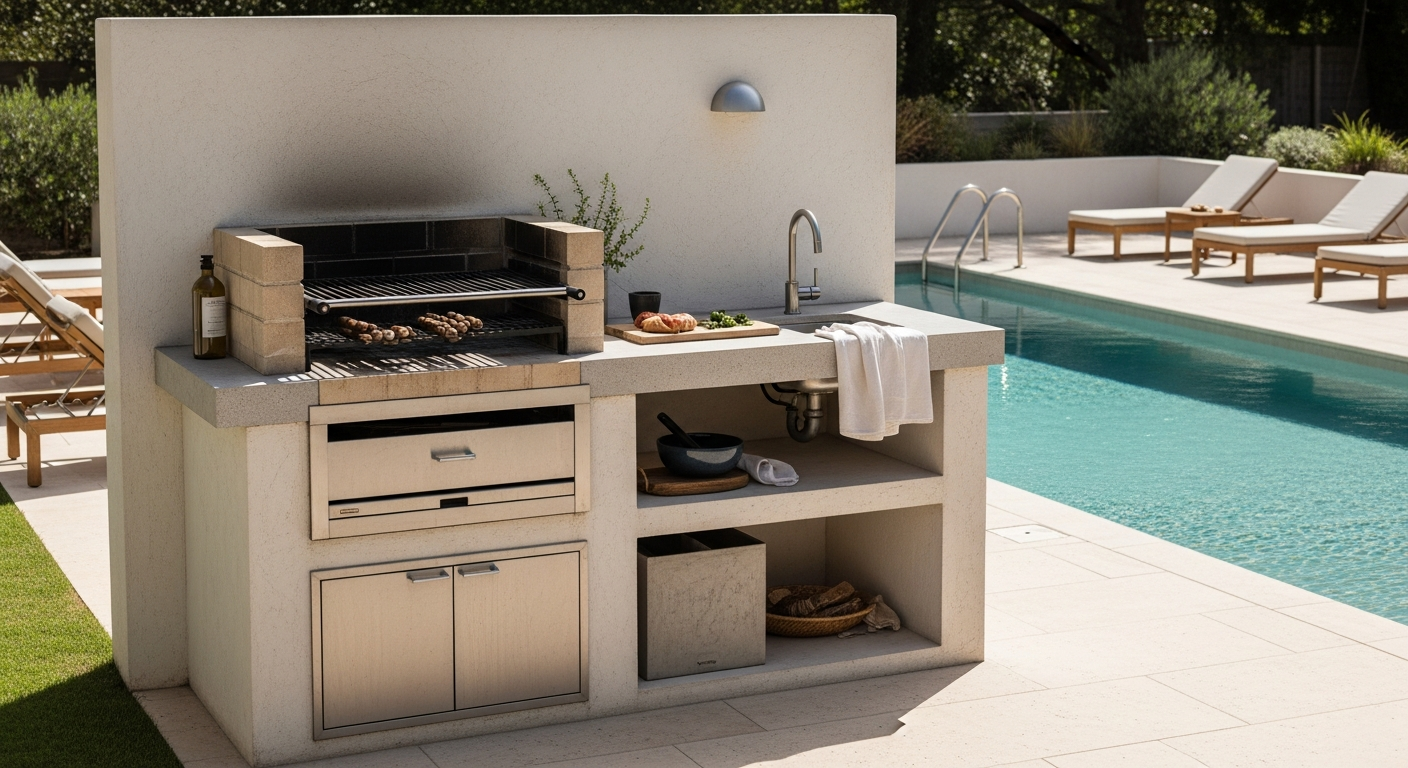
Small Outdoor BBQ Kitchen in Hillsborough County: A Framework for Maximizing Space and Defeating Humidity
Designing a small outdoor BBQ kitchen in Hillsborough County isn't about shrinking a larger design; it's a completely different discipline. I've been called in to fix countless projects in areas from South Tampa to FishHawk where beautiful, expensive setups began to fail within two years. The primary culprit is almost always a fundamental misunderstanding of our specific subtropical climate. The combination of intense UV exposure, torrential rain, and, above all, pervasive humidity creates a uniquely hostile environment for building materials. My approach isn't based on generic best practices; it's a proprietary framework I developed after diagnosing consistent failure points in high-end residential projects. The core principle is to treat every small outdoor kitchen, especially those on a compact lanai in a newer development like Waterset or a historic bungalow's backyard in Seminole Heights, as a marine-grade installation. This shift in mindset from "backyard addition" to "coastal-grade fixture" is the single most important factor in achieving a 15+ year operational lifespan.The Hillsborough Climate Failure Point: My Diagnostic Approach
The first thing I do on-site isn't measure for the grill. I assess the micro-environment. A lanai in Brandon facing west gets a different kind of punishment than a north-facing patio in Carrollwood. My diagnostic focuses on three critical vectors: moisture intrusion, UV degradation, and thermal expansion. Most designers only solve for the first, using standard stainless steel and granite. This is a critical error. The intense sun heats materials, causing them to expand, while the evening humidity introduces moisture into newly opened micro-fissures. This cycle is what causes delamination, rust blooms on non-marine grade steel, and persistent mildew in porous stone.Material Selection Beyond 304 Stainless: The Core of My System
The most common mistake I see is the over-reliance on 304-grade stainless steel. While marketed as "outdoor-grade," it has a lower nickel and higher carbon content, making it susceptible to pitting and surface rust in our salt-tinged, humid air, even miles from Tampa Bay. My material specification is non-negotiable on this front.- Cabinetry & Structure: Forget wood or stucco-wrapped frames. I exclusively use HDPE (High-Density Polyethylene) or marine-grade polymer board. This material is inert, waterproof, and impenetrable to termites. It will not warp, swell, or delaminate. It forms the core structural box, ensuring stability.
- Hardware & Fasteners: All hinges, screws, and drawer slides must be 316L stainless steel. The "L" stands for low carbon, providing superior corrosion resistance. It's a small detail that prevents the entire structure from being compromised by a single rusted hinge. This is the same grade used on yachts.
- Countertops: I advise clients against porous materials like granite or concrete, which can harbor mildew. My preference is for sintered stone (like Dekton) or non-porous quartzite. These materials have near-zero water absorption, preventing stains and microbial growth, and they are completely UV stable, so the color won't fade under the relentless Florida sun.
Step-by-Step Implementation for a Compact, Resilient BBQ Station
Building for a small footprint requires precision. There is no room for error. My implementation protocol is designed to maximize every square inch while embedding durability into the foundation of the project.- Site & Airflow Assessment: Before a single paver is moved, I map the prevailing breezes and sun exposure. The goal is to orient the kitchen to promote cross-ventilation. For compact lanais, this often means ensuring the back of the grill cabinet isn't flush against a wall, leaving a 3-inch ventilation gap to prevent heat and moisture buildup.
- Foundation & Drainage Protocol: The concrete pad must be properly graded with a slope of at least 1/4 inch per foot away from the house. I also specify the installation of a channel drain if the kitchen is positioned in a way that could trap water during one of our summer downpours, a common issue in low-lying areas.
- Utility & Safety Compliance: All electrical runs must be in conduit and all outlets must be outdoor-rated, in-use covered GFCI outlets. This isn't just code; it's a critical safety measure. Gas lines are pressure-tested at 1.5x the operating pressure to ensure zero leaks.
- Appliance Integration: For small kitchens, I favor high-performance, multi-function appliances. The key is specifying a grill with a high-quality insulated jacket. This allows for a tighter, zero-clearance installation against the HDPE cabinetry without creating a fire hazard, saving precious inches of counter space.
Fine-Tuning for Longevity: Sealing, Ventilation, and Maintenance
The final phase is what separates a good build from a great one. Once the structure is in place, the focus shifts to sealing every potential point of failure. I use a high-grade marine sealant, not standard silicone, at the junction between the countertop and the house wall. Cabinetry doors are designed with slight gaps or integrated vents to prevent stagnant, humid air from being trapped inside, which is the primary cause of musty odors and mildew. The maintenance routine I provide is simple: a quarterly wipe-down of all stainless steel surfaces with a recommended cleaner to remove surface contaminants and a check of all drainage paths. This simple process can add years to the kitchen's life. Instead of asking how big your outdoor kitchen can be, have you considered how resilient it must be to outlast its first Hillsborough summer?Written by

Tags
small outdoor kitchen design
small outdoor kitchen sink
small l shaped outdoor kitchen
small space outdoor kitchen
small outdoor kitchen with roof


