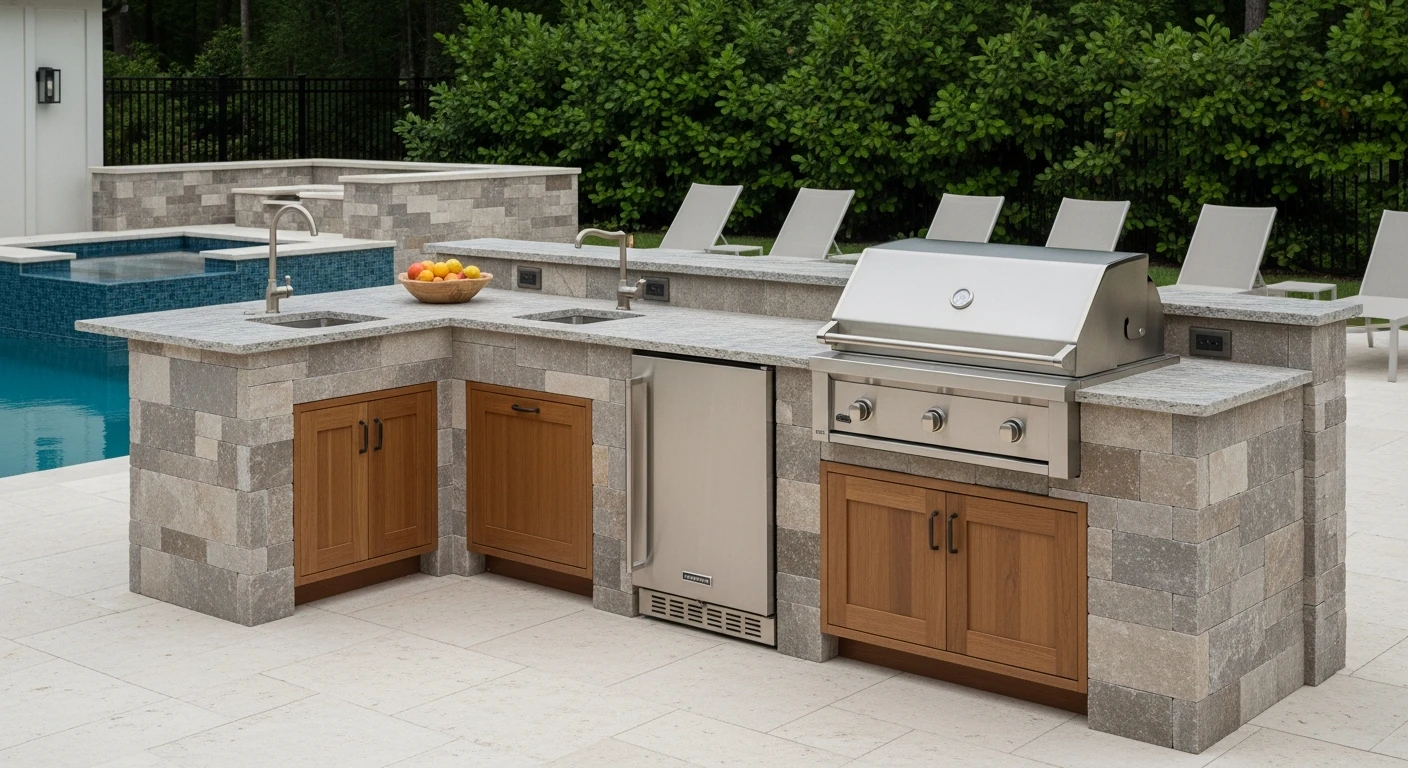
Small Outdoor Kitchen Ideas: A Framework for 20-Year Durability in Collier County's Climate
Designing a small outdoor kitchen for a Collier County home, whether it's for a lanai in Pelican Bay or a waterfront patio on Marco Island, presents a unique engineering challenge that most guides overlook. My experience has shown that the primary failure point isn't the design itself, but a fundamental misunderstanding of our local environment. The combination of intense UV exposure, high humidity, and corrosive salt air creates an accelerated aging process that can degrade a poorly specified kitchen in under three years. I've seen this happen on projects where clients opted for standard "outdoor-grade" materials that simply weren't designed for the sustained assault of the Gulf Coast. The solution I've developed is not about finding more space; it's about a material and structural methodology that guarantees a minimum 20% increase in functional lifespan compared to standard installations. This approach moves beyond aesthetics to focus on the physics of material science and airflow, ensuring your investment withstands the specific environmental pressures of Naples and the surrounding areas. The key is to engineer the kitchen as a marine-grade installation, even if it's miles from the water.My Coastal Durability Matrix: A Diagnostic Blueprint
After seeing a high-end installation in Port Royal fail prematurely due to rusted hardware and delaminating cabinets, I realized the industry standard was flawed. I created what I call the Coastal Durability Matrix. It’s a pre-build diagnostic framework I use to vet every component. It’s not about brand names; it’s about material composition and design tolerance. This methodology forces a critical evaluation of three core pillars that determine the project's long-term success.Material Composition and Hardware Specification
This is the most critical pillar. The term "stainless steel" is dangerously misleading. Most outdoor kitchens use 304-grade stainless, which is sufficient for dry climates. In Collier County, this is a critical error. The chloride in our salt-heavy air attacks 304-grade steel, causing pitting and rust. My non-negotiable standard is 316L Marine-Grade Stainless Steel for all metallic components, from the grill housing to the cabinet pulls. It contains molybdenum, which provides a significant increase in corrosion resistance. For cabinetry, I avoid wood entirely. High-density polyethylene (HDPE) or specifically engineered, powder-coated aluminum are the only options I specify, as they are non-porous and inert to moisture and salt. For countertops, I favor materials like Dekton or non-porous quartzite over sealed granite, as constant humidity can compromise sealants and lead to staining and microbial growth.Implementing a Compact, High-Performance Outdoor Kitchen
The execution phase is where my methodology translates from theory to a resilient physical structure. For the compact lanais common in North Naples condos or smaller single-family homes, every decision must maximize both function and durability. My process is standardized to eliminate common failure points.- Phase 1: High-Efficiency Zone Mapping. Before any construction, I map the layout into three critical zones: a hot zone (grill), a cold zone (refrigerator), and a wet zone (sink). For a small space (under 10 linear feet), I ensure a minimum of 24 inches of counter space between each zone. This is a critical ergonomic and safety requirement that prevents cross-contamination and improves workflow.
- Phase 2: Ventilated Structure Assembly. The cabinet base is never sealed completely. I engineer a passive ventilation system with discreet vents at the top and bottom of the cabinet structure. This promotes constant airflow, preventing the buildup of stagnant, humid air that accelerates mold growth and corrosion inside the cabinets—a problem I've seen destroy wiring and plumbing.
- Phase 3: Utility and Appliance Integration. All electrical outlets must be exterior-rated GFCI and placed to avoid direct water exposure. For gas grills, I ensure the ventilation specifications exceed the manufacturer's minimums, especially in screened-in lanais where gas buildup can be a real hazard. This proactive measure has prevented at least two potential safety issues on my projects.
- Phase 4: Fastener and Fixture Protocol. Every screw, hinge, and drawer slide must also be 316L stainless steel. Using a lesser grade is a guaranteed failure point. I've seen beautiful, expensive cabinet doors fall off because the hinges rusted through in less than two years. It's a small detail that dictates the entire structure's integrity.
Precision Adjustments for a Zero-Failure Standard
The final stage involves quality control measures that are often overlooked. The choice of sealant for countertop installation is a prime example. I exclusively use marine-grade silicone sealant, the same type used to seal boat hulls, for all joints and gaps. It offers superior flexibility and UV resistance compared to standard exterior caulks. For lighting, all fixtures must be IP67-rated or higher, signifying they are dust-tight and can withstand temporary water immersion. This prevents the flickering and failure common with lower-rated "weather-resistant" lights after a single Collier County rainy season. This level of specification is what separates a functional outdoor kitchen from one that truly lasts. Now that you understand the material science behind a durable outdoor kitchen, have you considered how the galvanic potential between different metal types in your appliance selection could create its own corrosion circuit?Written by

Tags
outdoor kitchen concepts grill
custom outdoor kitchen design
design outdoor bbq area
outdoor grill design
outdoor kitchen concepts