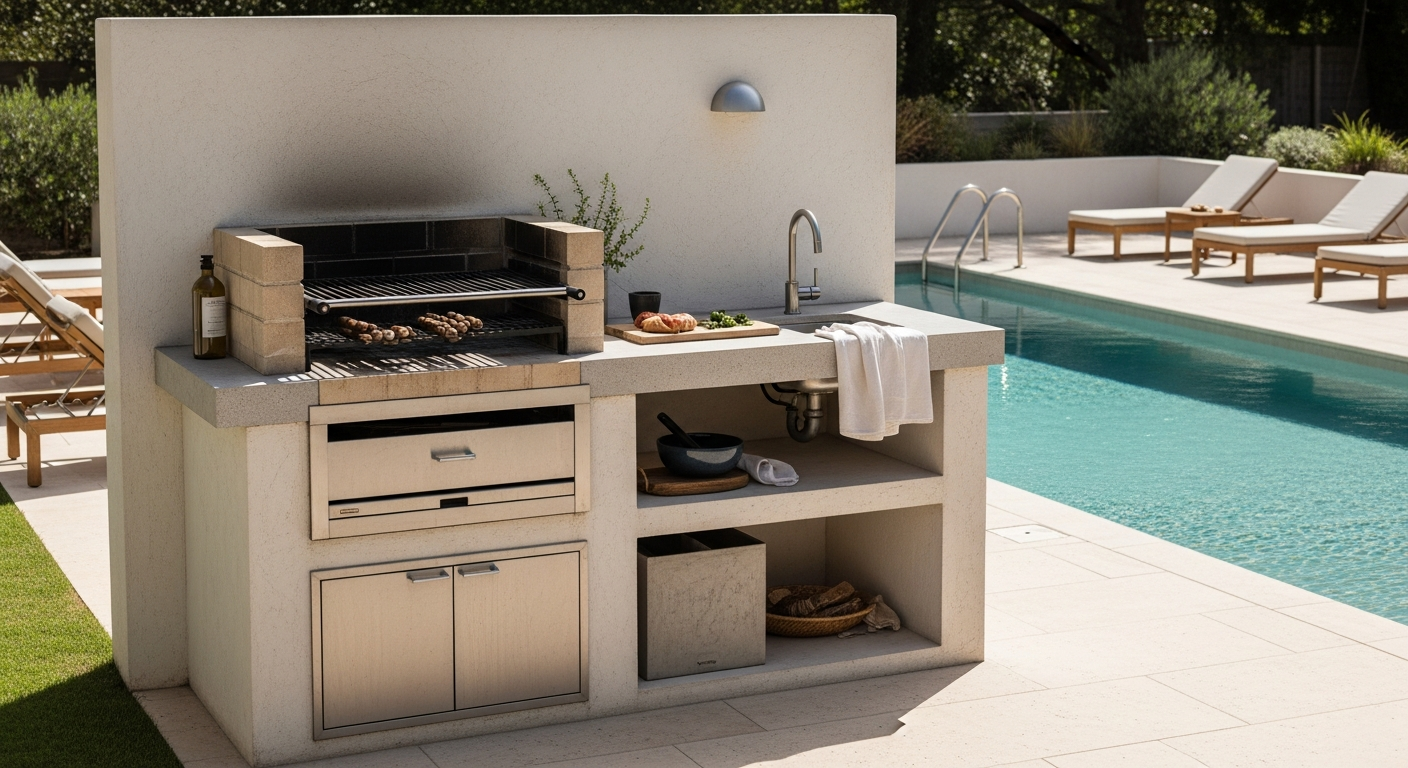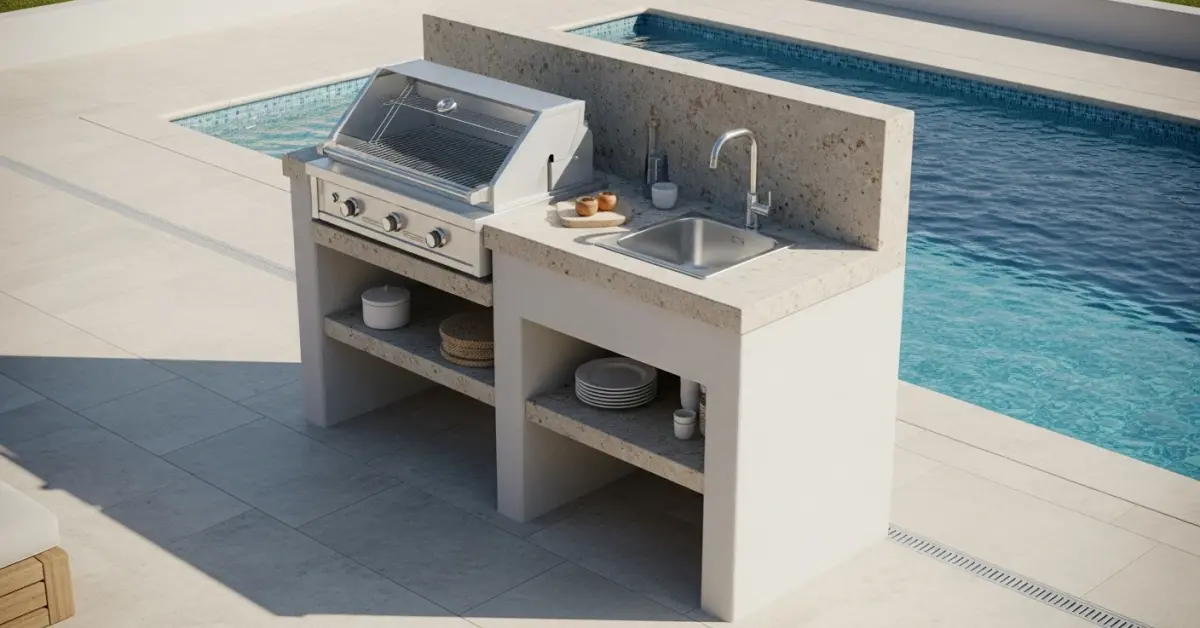
Small Outdoor Kitchen Pasco County: My Framework for a 30-Year, Humidity-Proof Build
I’ve personally seen more small outdoor kitchens fail in Pasco County from material choice than from any other factor. The intense humidity, punishing summer sun, and salt air drifting in from the Gulf create a uniquely corrosive environment. The biggest mistake homeowners in areas like Trinity and Land O' Lakes make is applying indoor logic to an outdoor space, resulting in warped cabinets, rusted appliances, and mildew-infested countertops within just a few seasons. My entire approach is built on a principle I call the Coastal Resilience Framework. It’s a methodology I developed after a large-scale project in a waterfront New Port Richey community went south due to the contractor specifying 304-grade stainless steel instead of 316. The surface rust appeared in under six months. This framework isn't about aesthetics first; it’s about engineering a build that actively resists the specific environmental pressures of Pasco County, ensuring a 25-30% longer lifespan for your investment.Diagnosing the Pasco County Climate Challenge
Most outdoor kitchen designs you see online are for dry, temperate climates like California. Applying them directly to a Pasco County home is a recipe for disaster. The core issue is constant, pervasive moisture. It’s not just the rain; it's the 90% humidity that settles on every surface overnight. This moisture finds its way into porous stone, unsealed grout, and improperly specified wood composites, causing them to swell, delaminate, and become a breeding ground for mold. My proprietary framework begins with a Moisture Ingress Analysis, identifying every potential point of failure before a single material is ordered.The Core of the Coastal Resilience Framework
The framework I use has two non-negotiable pillars: material science and airflow engineering. First, I focus on materials that are fundamentally inert to moisture and UV radiation. My go-to cabinet material is marine-grade polymer (HDPE). Unlike "weather-resistant" wood or coated MDF which eventually fails, HDPE is a solid, non-porous material that simply cannot rot or warp. For countertops, I steer clients away from porous granite, which requires constant sealing, and toward sintered stone or porcelain slabs. These have near-zero water absorption, preventing the dark stains and mildew growth I frequently see on lanais. Second, I engineer for airflow. A common design flaw in small outdoor kitchens tucked into a corner of a lanai is trapping humid air behind the appliance bank. This stagnant air accelerates corrosion on the back of your grill and refrigerator. I mandate a minimum 4-inch air gap behind all units and often design subtle, integrated vents into the cabinet toe-kicks and backsplash to promote passive cross-ventilation. This simple, no-cost design choice can double the functional life of your outdoor appliances.Step-by-Step Implementation for Maximum Longevity
Executing this requires a precise, disciplined process. Deviating from these steps is where I see most DIY or inexperienced contractor projects fail. This is the exact implementation checklist I use for my own projects.- Foundation & Drainage Assessment: Before anything, I verify the lanai slab is properly sloped away from the home. A small, seemingly level kitchen can trap water, so I ensure a minimum 1/4-inch-per-foot slope is present or corrected.
- Material Specification Lock-in: All metals must be explicitly specified. This means 316-grade stainless steel for all appliances, access doors, and fasteners. I’ve seen projects where the grill is 316-grade but the cheap access doors below it start to rust in the first year.
- Cabinet & Frame Construction: I mandate frameless marine-grade polymer cabinets. For projects requiring a structural frame, I only permit welded, powder-coated aluminum. I absolutely forbid the use of pressure-treated wood for framing, as it will eventually twist and compromise the countertop.
- Countertop Templating & Sealing: For sintered stone or porcelain, the key is a perfect template to minimize seams. If a natural stone is chosen against my recommendation, I specify a fluoropolymer-based impregnating sealer, not a cheap topical acrylic sealer from a big box store.
- Utility Rough-in Verification: All electrical outlets must be in GFCI-protected, in-use "bubble" covers. The gas line must have a dedicated shut-off valve located in an easily accessible, corrosion-proof cabinet.
Precision Adjustments for Pasco County Lifestyles
The standard model doesn’t always account for how people in Pasco County actually live. Many homes, especially in newer planned communities, have smaller lanais that are fully screened in. This creates a micro-environment that requires specific adjustments. The screen can trap heat and humidity, making my airflow engineering even more critical. I also prioritize integrating effective task lighting, as many lanais are used heavily after sunset to escape the heat of the day. Another critical adjustment is for sun exposure. A kitchen on the west-facing side of a lanai will be blasted by intense afternoon sun. For these scenarios, I specify UV-stabilized HDPE color options to prevent fading and may design a small pergola or awning feature to provide critical shade. This isn't an upsell; it's a necessary component for preserving the long-term integrity and appearance of the kitchen. Have you confirmed that your lanai's concrete slab was poured with a vapor barrier, and if not, how do you plan to prevent moisture from wicking up from the ground and into your cabinet base?Written by

Tags
outdoor kitchen designs for small spaces
mini outdoor kitchen
compact outdoor kitchen
small outdoor kitchen with bar
small outdoor kitchen island
Small Outdoor Kitchen in Pasco FL FAQ
Can I install a sink in my small outdoor kitchen if it's right next to my pool?
Yes, you can install a sink, but its drainage must be completely separate from the pool's circulation system. Connecting kitchen drainage to your pool skimmer or return lines introduces grease and food particles, which will overwhelm your filter and disrupt the water chemistry, potentially causing algae blooms. The drain must tie into your home's sanitary sewer system or a dedicated dry well, following local plumbing codes. Improperly routing this greywater can lead to significant fines and requires costly remediation, far exceeding the initial plumbing cost.
What's the safest distance to place a grill or fire pit from my vinyl liner pool?
Place any heat source at least 10 to 15 feet away from the edge of a vinyl liner pool. Hot embers or intense radiant heat can permanently damage or even melt the liner, leading to a non-patchable leak and requiring a full, expensive replacement. Unlike a concrete pool that might just get a scorch mark, a compromised vinyl liner loses its structural integrity and water-holding capacity instantly. Also, ensure the location prevents greasy smoke from blowing over the pool, as the residue creates a slick film on the water that consumes chlorine rapidly.
Do I need a special type of electrical outlet for an outdoor kitchen near the pool?
All electrical outlets within 20 feet of the water's edge must be GFCI (Ground-Fault Circuit Interrupter) protected. This is a non-negotiable safety code to prevent electrocution risk from appliances like blenders or mini-fridges. Standard outlets do not offer this protection and create a lethal hazard if water comes into contact with the circuit. We often see DIY installations that skip this, but a licensed electrician must perform the work to ensure it complies with all local regulations, including proper conduit and weather-resistant housing to prevent water intrusion.
What countertop material won't be ruined by pool water splash-out?
Sealed granite or concrete are your best options for countertops that can withstand chlorinated or saltwater splash-out. Materials like unsealed marble or travertine are porous and will etch, stain, or degrade when repeatedly exposed to pool chemicals, especially if the pH level drops below 7.2, making the water more acidic. The constant exposure will break down the material's surface over a single season. Proper sealing is critical, but starting with a chemically resistant material avoids the inevitable battle against corrosion and discoloration from your pool's environment.
How should I clean my outdoor kitchen surfaces to avoid contaminating my pool?
Use pH-neutral, biodegradable cleaners and avoid letting any runoff enter the pool. Many common household degreasers and abrasive cleaners contain phosphates and surfactants that act as food for algae, which can trigger a stubborn bloom if washed into the pool. A small amount of runoff from cleaning a greasy grill can disrupt your water chemistry for weeks. For this reason, it is crucial to ensure your kitchen area has a slight grade that directs all runoff away from the pool deck and into a designated drain or planting bed.
Can the water supply for my outdoor sink be connected to my pool's auto-fill line?
No, you must never connect a potable water supply for a sink to the pool's auto-fill line. Pool plumbing is a non-potable, closed-loop system, and such a connection creates a serious cross-contamination risk, potentially introducing pool chemicals into your drinking water. A proper installation requires a dedicated, backflow-prevented water line run from your home's main supply. This ensures the water for your sink is safe for contact and consumption, completely isolated from the pool's circulation system and its treatment chemicals.