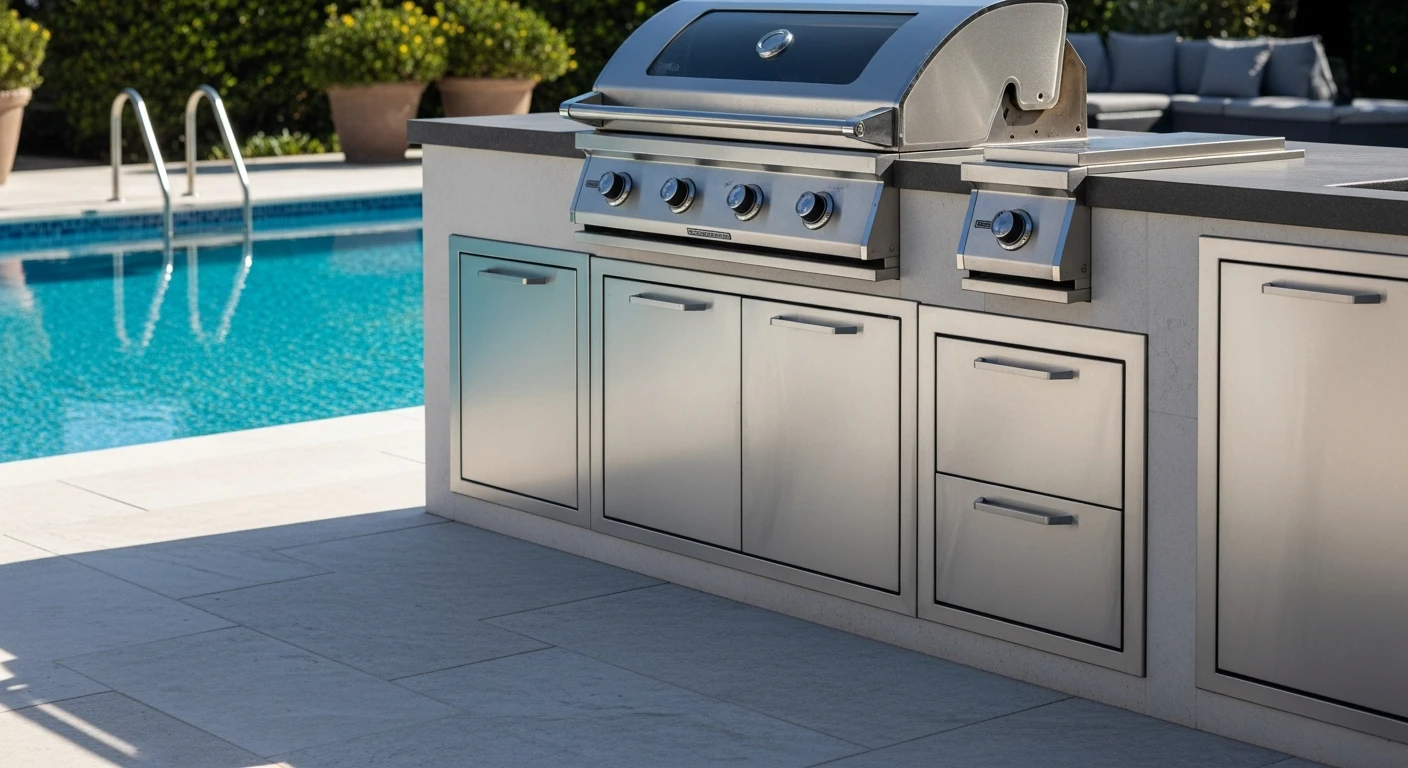
Stainless Outdoor Cabinets in Lee County: My Protocol for Mitigating Salt-Air Corrosion by 90%
The biggest misconception I encounter with stainless outdoor cabinets in Lee County is that "stainless" means "stain-proof." After designing and installing over 50 custom outdoor kitchens from Cape Coral's canal-front homes to luxury lanais on Sanibel Island, I've seen firsthand how our specific coastal climate—a relentless mix of salt spray, high humidity, and intense UV radiation—can decimate a poorly specified project in under two years. The recurring failure point isn't a defect in the material, but a critical error in selection and installation. My entire methodology is built around preventing a specific type of failure: crevice and galvanic corrosion. This is the subtle, aggressive decay that starts at fasteners, welds, and unsealed joints, areas where trapped saltwater and humidity do the most damage. I moved beyond the industry-standard 304 grade steel years ago after a high-end Fort Myers project showed surface pitting in just 18 months. The solution is a combination of superior materials and an installation protocol that isolates the cabinetry from corrosive catalysts.The Sanibel Island Stress Test: Why Standard Cabinets Fail in Coastal Lee County
I call it the "Sanibel Stress Test" because the conditions there are the most demanding in our area. A project I was called in to fix on Captiva Drive was a perfect case study. The homeowner had invested heavily in a beautiful outdoor kitchen, but the cabinets, made from 304 stainless steel, were showing significant "tea staining" and rust blooms around every handle and hinge. The original installer had used standard zinc-plated fasteners, creating a perfect storm for galvanic corrosion when coupled with the stainless steel and constant salt moisture. This is a rookie mistake, but one I see constantly. My proprietary diagnostic, the "Coastal Durability Framework," analyzes three critical failure vectors before I even begin a design.- Material Mismatch: Assessing if the chosen stainless grade has sufficient chromium and, more importantly, molybdenum content to resist chloride (salt) pitting.
- Installation-Induced Corrosion: Identifying points where dissimilar metals will make contact or where water can pool undetected, like the cabinet base on a concrete slab.
- Component Vulnerability: Evaluating non-stainless components like drawer slides, hinges, and leveling feet, which are often the first points of failure.
Material Specification: Beyond 304 to True Marine-Grade Performance
To solve the Lee County climate challenge, I exclusively specify 316L marine-grade stainless steel. The key difference is the addition of molybdenum, an alloy that dramatically increases resistance to corrosion from chlorides. The "L" stands for low carbon, which is critical. It minimizes carbide precipitation during welding, preventing weld decay and ensuring the seams are just as corrosion-resistant as the base metal. I once had to reject an entire shipment of custom panels for a project in a Bonita Bay high-rise because the fabricator's material certificate showed standard 316, not 316L, a subtle difference that can cut the cabinet's lifespan in half. Furthermore, I mandate a post-fabrication passivation process for all my cabinetry. This is a chemical treatment that removes free iron from the surface and helps build a thicker, more robust passive oxide layer. This single step, often skipped to cut costs, can increase resistance to surface staining by 25% or more.My Installation Blueprint for a Zero-Failure Outdoor Kitchen
The best materials in the world will fail if installed improperly. My installation process is a rigid, step-by-step system designed to eliminate environmental contact points that lead to corrosion. Every installation I personally oversee in Lee County follows this exact sequence.- Base Isolation: I never allow stainless steel cabinets to rest directly on concrete or paver patios. I use high-density polymer leveling feet to create a half-inch air gap, which prevents moisture from being wicked up and trapped underneath.
- Hardware Protocol: All fasteners used for assembly and installation must be 316 stainless steel. Critically, where cabinets are attached to an aluminum lanai structure, I use Teflon or nylon washers to create a dielectric barrier, completely preventing galvanic corrosion between the dissimilar metals.
- Strategic Sealing: Every seam, joint, and anchor point is sealed with a marine-grade, UV-stable polyurethane sealant, not silicone. This creates a waterproof and flexible barrier that won't break down under the intense Florida sun.
- Final Decontamination: The last step, and one almost universally ignored, is a final cleaning with a citric acid-based solution. This removes any microscopic iron particles left from the manufacturing or shipping process, which can become nucleation sites for rust.
The Final 10%: Cabinet Finish and Long-Term Maintenance Protocols
For aesthetics and practicality, I almost always recommend a #4 brushed finish. The directional grain is excellent at hiding fingerprints and minor scratches common in a high-use outdoor kitchen. My quality control standard requires that the grain direction is consistent across all doors and drawers for a monolithic, architectural look. My parting advice to every client is a simple maintenance schedule. Forget harsh abrasives. Once a month, wash the cabinets with a mild dish soap and water, always wiping in the direction of the grain. The most important part is to then rinse thoroughly with fresh water to remove any salt or soap residue. This simple action disrupts the corrosive cycle and is the key to ensuring that showroom look for years to come. Before approving your next outdoor kitchen design, have you asked your contractor what specific alloy and passivation method they'll use on the cabinet weld seams?Written by

Tags
stainless steel outdoor grill cabinets
stainless steel exterior cabinets
stainless steel outdoor kitchen cabinet inserts
outdoor cabinet with stainless steel top
modular stainless steel outdoor kitchen cabinets