
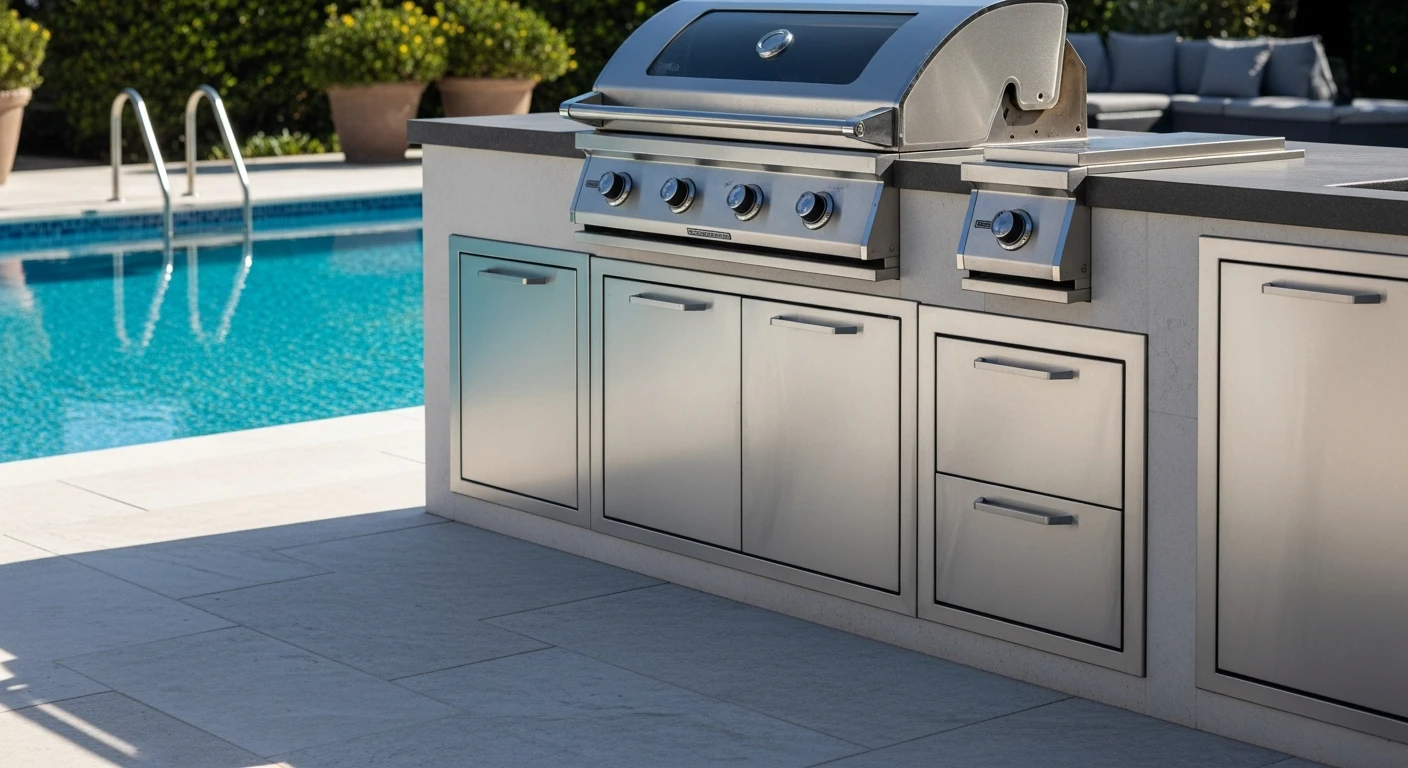
Stainless Steel BBQ Cabinets in Lee County: My Protocol for 316L Grade Selection to Prevent Salt-Air Corrosion
Choosing stainless steel BBQ cabinets for your Lee County home seems straightforward, but it's a critical decision where most homeowners make a costly mistake. The pervasive high humidity and salt spray, especially in waterfront areas from Fort Myers Beach to the canals of Cape Coral, will aggressively attack and corrode standard 304-grade stainless steel. I’ve seen beautiful, expensive outdoor kitchens show rust pitting within 18 months because the wrong material was specified. My entire approach is built on preventing this exact scenario. The solution isn't just "stainless steel," but specifying 316L marine-grade stainless steel for every component. This specific alloy contains molybdenum, an element that provides a dramatic increase in resistance to chloride corrosion—the exact type of damage caused by our Gulf Coast air. This isn't an upgrade; for a long-term investment in Lee County, it's the only viable starting point.The Coastal Durability Audit: My Diagnostic Framework
Before I even consider a cabinet layout, I perform what I call the "Coastal Durability Audit." It’s a methodology I developed after seeing a high-end project on Sanibel Island fail prematurely. The client had paid a premium for a "top-tier" outdoor kitchen, but the supplier used 304-grade steel with 316L doors, assuming that would be enough. The cabinet boxes and frames, hidden from immediate view, began to corrode from the inside out. My audit focuses on three often-overlooked failure points: material composition, weld integrity, and hardware specification. It prevents these mismatches by treating the entire cabinet system as a single, cohesive unit exposed to a harsh marine environment.Deep Dive: Material and Fabrication Integrity
The core of the audit is a non-negotiable material standard. The difference between 304 and 316L steel is scientifically significant for our climate. 304 stainless steel contains 18% chromium and 8% nickel, which is fine for inland applications. However, 316L stainless steel adds 2-3% molybdenum. This single addition is the game-changer, forming a protective layer that actively repels chloride ions from salt spray. The "L" designation signifies low carbon content, which is critical for preventing corrosion at the weld points after fabrication, a phenomenon known as weld decay. I insist on seeing material certification sheets from the manufacturer to verify the alloy's composition, ensuring my clients get the genuine protection they are paying for.Implementation: The 3-Point Marine-Grade Protocol
When executing an outdoor kitchen project in areas like Bonita Springs or Pine Island, I follow a strict protocol. This isn't just about ordering the right parts; it's about ensuring the entire assembly maintains its anti-corrosion properties. A single weak link can compromise the whole system.- Step 1: Specify 100% 316L Construction. This is the foundation. I mandate that not only the doors and drawer fronts but also the cabinet boxes, frames, legs, and toe kicks are made from certified 316L stainless steel. Any deviation creates a weak point for corrosion to begin.
- Step 2: Scrutinize Welds and Fasteners. All welds must be clean, full-penetration TIG welds, which are then passivated. Passivation is a chemical process that removes free iron from the surface and strengthens the steel's natural chromium-oxide protective layer. Furthermore, all fasteners—screws, bolts, and rivets—must also be 316-grade stainless steel. Using cheaper 304 or zinc-plated fasteners will cause galvanic corrosion, where the less noble metal sacrifices itself and rusts rapidly, staining and weakening the cabinet structure.
- Step 3: Mandate Proper Ventilation and Drainage. Lee County's intense rain and humidity mean water will get inside cabinets. I require weep holes or drainage channels in the cabinet bottoms and ensure the design includes proper ventilation panels, especially for cabinets housing grills or refrigeration. Trapped moisture, even on 316L steel, will accelerate staining and potential crevice corrosion over time.
Precision Adjustments for Longevity and Performance
Beyond the core material, I focus on the components that experience the most wear. Cabinet hardware is a common point of failure. I specify heavy-duty, full-extension drawer slides made from 316L steel. Standard slides will seize and rust within a few seasons. Similarly, hinges and handles must be of the same marine-grade material. On a recent build in a Fort Myers lanai, I rejected the contractor's initial hardware submission because, while it was stainless, it was not the specified 316L grade. This level of detail-checking is what guarantees a 20+ year lifespan instead of a 5-year replacement cycle. The goal is to achieve a uniform material composition to eliminate any potential for galvanic reactions and ensure consistent performance across the entire installation. Given the intense sun and heat, are you also ensuring the cabinet design incorporates an insulated jacket that is properly vented to prevent both heat damage to the structure and unsafe temperature buildup?Written by

Tags
stainless steel patio cabinets
steel outdoor kitchen cabinets
stainless steel outdoor kitchen cabinets
stainless outdoor kitchen cabinets
stainless steel outdoor kitchen units


