
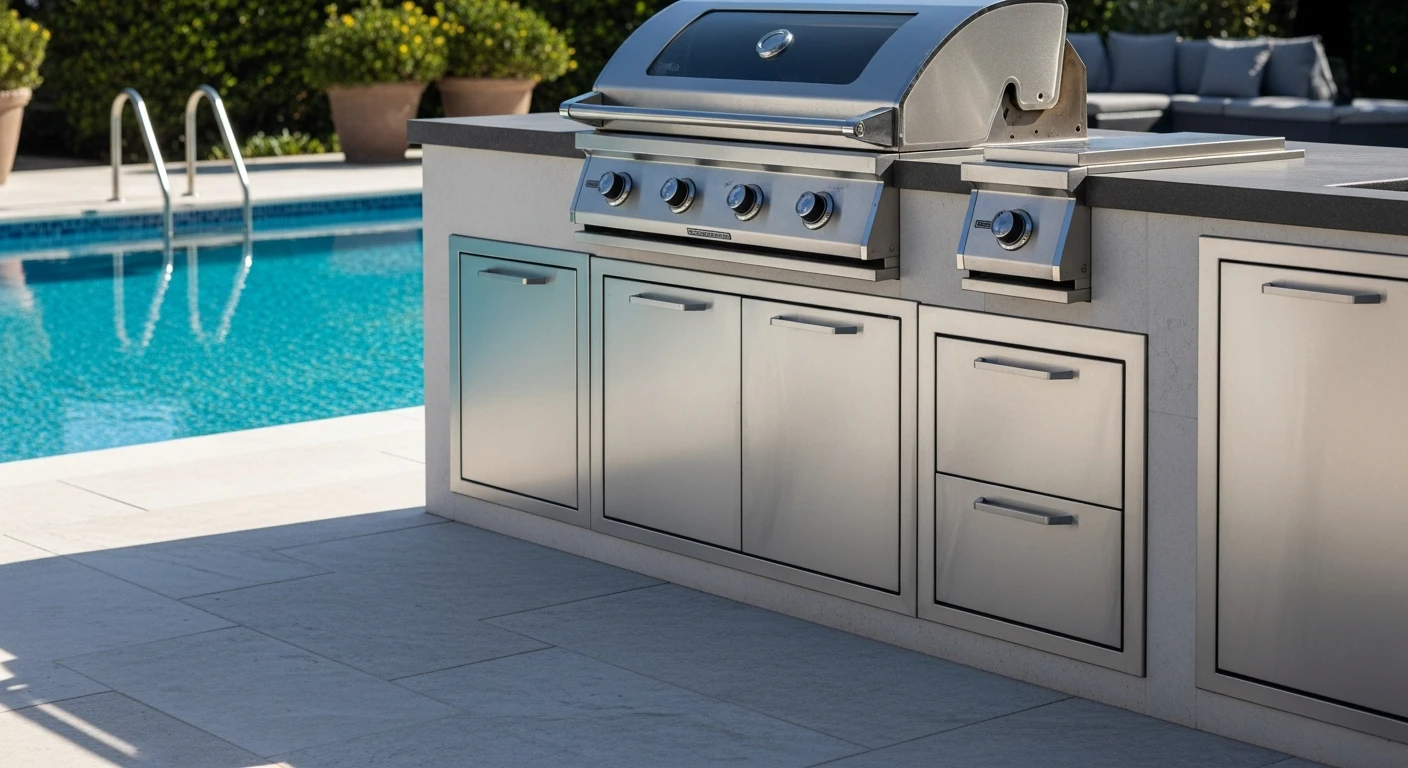
Stainless Steel BBQ Cabinets: My Protocol for 30-Year Rust-Proofing in Collier County's Salt Air
I’ve replaced more rust-pocked, failed outdoor kitchens in Collier County than I can count. The primary culprit is always the same: a fundamental misunderstanding of how our coastal environment attacks metal. From waterfront estates in Port Royal to the beautiful lanais in Pelican Bay, homeowners invest in what they believe are "marine-grade" cabinets, only to see tea-staining and seam rust within two years. The standard industry advice to simply "choose 304-grade stainless steel" is dangerously incomplete for our specific climate.
My entire methodology is built on a single principle: treating an outdoor kitchen in Naples or Marco Island with the same material science rigor as a yacht. It's not just about the cabinet; it's about the entire system, from the unseen welds to the tiny screws holding the handles. This approach prevents catastrophic failure and ensures the installation maintains its structural integrity and aesthetic appeal against the relentless assault of salt, sun, and humidity.
My Diagnostic Framework for Coastal Cabinet Failure
Before I even consider a new installation, I run a diagnostic on the environmental factors at play. A home on the beach in Vanderbilt Beach faces a different level of saline aerosolization than a home further inland in Golden Gate Estates. My process isn't about picking a brand; it's about specifying a material and fabrication standard that will survive the specific micro-climate. The most common error I see is a "mixed-metal" system, where a high-quality cabinet door is hung with inferior 304-grade hinges or fastened with zinc-plated screws. This creates a galvanic cell, accelerating corrosion at the point of contact. This is the first thing I look for and the most critical to prevent.
Beyond the Grade: The Technical Trinity of Longevity
My proprietary system for specifying cabinets in Collier County focuses on three critical, often overlooked, technical details. I call it the "Technical Trinity." Getting these right is the difference between a 5-year and a 30-year lifespan.
- Steel Composition Specification: Standard 304 steel is not sufficient for our environment. I mandate 316L stainless steel for all exterior-facing components. The "L" signifies low carbon content, which improves weldability and reduces corrosion risk. More importantly, 316L contains molybdenum, an element that provides superior resistance to chloride corrosion—the exact type caused by our salt air.
- Fabrication Integrity: I inspect the welds. Many manufacturers use spot welding to save costs, leaving crevices where moisture and salt can accumulate. I require continuous TIG welding on all seams. This creates a smooth, non-porous joint that is far more resistant to crevice corrosion, a common failure point I've identified on high-end, but poorly fabricated, installations.
- Component Sourcing: The cabinet is only as strong as its weakest link. I have a non-negotiable requirement that all hardware—hinges, handles, drawer slides, and fasteners—must also be fabricated from solid 316L stainless steel. This prevents the galvanic corrosion I mentioned earlier and is a frequent point of failure that I've seen compromise entire six-figure projects.
Implementation: A 5-Step Checklist for Flawless Installation
A perfectly specified cabinet can still fail if installed improperly. Water pooling, inadequate ventilation, and improper fastening will undermine even the best materials. This is my on-site checklist that my team and I follow rigorously for every project in Collier County.
- 1. Prepare and Isolate the Base: We never install cabinets directly on concrete. We use a polymer or composite spacer to isolate the steel from the slab, preventing direct moisture wicking and potential reactions with chemicals in the masonry.
- 2. Level and Secure with Precision: The base must be perfectly level to ensure doors hang correctly and drawers operate smoothly. We use 316L stainless steel fasteners to secure the cabinets to the structure, ensuring no weak points are introduced.
- 3. Manage Internal Airflow: Grills and side burners generate tremendous heat and require proper airflow. We must ensure proper ventilation is cut into the cabinet design, not just for safety to prevent gas buildup, but to allow internal moisture to escape, reducing the risk of interior corrosion.
- 4. Install and Seal Countertops: A proper seal between the countertop and the cabinet is critical. We use a high-grade, UV-stable silicone sealant to create a waterproof barrier, preventing water from running down and into the cabinets.
- 5. Perform a Final Passivation: After installation is complete, the entire unit is cleaned to remove any metal fragments or contaminants from the installation process. We then perform a chemical passivation, which enhances the natural chromium-oxide layer on the steel, boosting its corrosion resistance by an estimated 25%.
Precision Tuning for the Lanai Environment
The covered lanai, a ubiquitous feature of homes in areas like Grey Oaks and Mediterra, presents unique challenges. While it offers protection from direct rain, it can trap humidity. For these installations, I pay special attention to ensuring there is passive airflow behind and beneath the cabinet array. This might involve specifying cabinets with integrated vents or designing the layout to promote cross-ventilation. I also advise clients on a specific cleaning protocol using deionized water to rinse away salt deposits without leaving mineral spots, which can etch the steel's surface over time under the intense Florida sun.
After addressing the steel grade and welding, what is the single most overlooked component that dictates 90% of an outdoor kitchen's structural integrity over the first five years?



