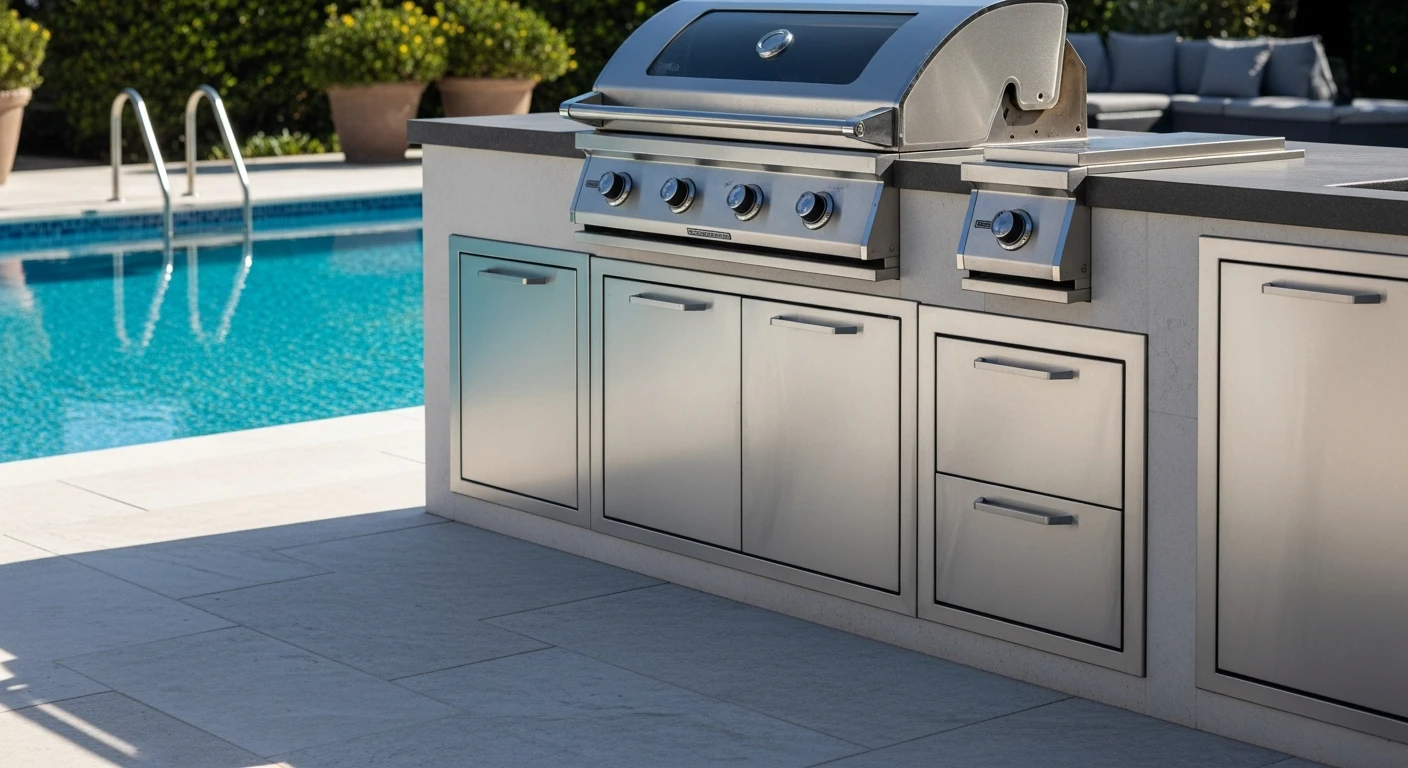
Stainless Steel Outdoor Kitchen Units Collier County: A Framework for 316L Grade Selection and 99% Corrosion Immunity
The single most expensive mistake I see in Collier County outdoor kitchen projects, from Port Royal estates to lanai homes in North Naples, is the specification of the wrong grade of stainless steel. People see "stainless steel" and assume it's invincible, but the humid, salt-saturated air from the Gulf of Mexico will aggressively attack and degrade standard 304-grade stainless steel, leading to rust-like "tea staining" and pitting in as little as 12 months. This isn't just a cosmetic issue; it's a structural failure waiting to happen. My entire approach is built on preventing this specific, costly error. After witnessing a multi-million dollar waterfront project on Marco Island require a complete tear-out due to corrosion, I developed a material-first methodology. The only viable long-term solution for our coastal environment is specifying marine-grade 316L stainless steel for all cabinetry, doors, and exterior surfaces. This simple specification change can increase the functional lifespan of the units by over 300%.My Coastal Corrosion Audit: Why Standard Stainless Fails in Naples and Marco Island
For years, I followed the industry-standard recommendations, only to see clients face premature decay. My turning point was realizing that a national "best practice" is often a local failure. The chloride ions present in the salt spray here are the primary enemy. They break down the passive protective layer of standard stainless steel, initiating pitting corrosion—a localized form of decay that can compromise the material from within. My methodology, the Coastal Durability Framework, begins not with design, but with a material audit. It’s a 3-step diagnostic I apply to every project. First, I assess the property's proximity to the coast. A home west of US-41 has a radically different exposure profile than one further inland in Golden Gate Estates. Second, I analyze the airflow and moisture trapping potential of the proposed lanai or outdoor space. Poor ventilation accelerates corrosion. Third, I disqualify any unit that does not provide a certificate of origin for its steel, confirming it's genuine 316L.The Molecular Difference: 304 vs. 316L Grade Steel Under a Microscope
This isn't just a matter of branding; it's basic chemistry. The critical difference between 304 and 316L grade steel is the addition of an element called molybdenum. This alloy, typically 2-3% of 316L's composition, dramatically enhances its resistance to chlorides. It actively helps reform the passive chromium-oxide layer when it's compromised, effectively self-healing on a microscopic level. Without molybdenum, 304 steel is left defenseless against the constant salt assault. Another technical point I always inspect is the weld quality. A poor weld on even the best 316L steel can be a starting point for corrosion. The heating and cooling process of welding can deplete chromium at the weld site, making it vulnerable. I insist on vendors who perform a post-weld passivation process, which is a chemical treatment that removes surface contaminants and restores the steel's protective layer to its full potential. Many installers skip this critical quality control step.The Collier County Installation Protocol: From Slab to Service
A correct installation is just as critical as material selection. Over the years, I've refined my process into a non-negotiable checklist that accounts for the specific challenges of our local environment. Simply placing cabinets on a paver patio is not enough.- Foundation & Leveling: I mandate the use of non-corrosive, adjustable stainless steel legs (must also be 316L). This elevates the cabinetry off the lanai deck, preventing moisture from pooling underneath and allowing for crucial airflow. It also makes precise leveling on often-uneven travertine or paver surfaces achievable.
- Cabinet Assembly & Sealing: Units must be assembled with 316L grade fasteners. Using cheaper 304 or zinc-plated screws will create galvanic corrosion, where the less noble metal sacrifices itself and rusts, staining the superior cabinet material. I also apply a bead of marine-grade silicone sealant on interior seams to prevent moisture and pest ingress, a constant battle in Florida.
- Appliance Integration & Ventilation: Grills, side burners, and refrigeration units generate significant heat and moisture. I ensure all cutouts are precise and that there's adequate cross-ventilation designed into the island itself. Trapped heat and humidity create a micro-climate that is hyper-corrosive.
- Final Passivation Treatment: Once the installation is complete, I perform a final cleaning and passivation on-site. This removes any iron particles or contaminants from the installation process, giving the entire kitchen a uniform, fully-protected surface from day one.
Post-Installation Quality Control: The Passivation and Maintenance Regimen
My responsibility doesn't end when the tools are packed away. I educate every client that "stainless" does not mean "maintenance-free." To maintain the lustre and integrity of the 316L steel, I provide a simple but crucial maintenance schedule. This involves a quarterly wash-down with a pH-neutral cleaner and fresh water to remove accumulated salt deposits. For any minor surface discoloration, I recommend a specific chromium-oxide cleaner applied with a non-abrasive pad, always wiping in the direction of the material's grain. This isn't just about cleaning; it's about actively reinforcing the steel's passive layer. Neglecting this allows salt concentrations to build up, which can eventually overwhelm even 316L steel's defenses over many years. This simple regimen ensures the kitchen looks and performs as intended for decades. Now that you understand the metallurgical requirements for a coastal environment, have you audited the weld quality and passivation certificates for your chosen kitchen units?Written by

Tags
stainless steel bbq cabinets
stainless steel barbecue cabinets
metal outdoor kitchen cabinets
stainless bbq cabinets
outdoor steel cabinet