
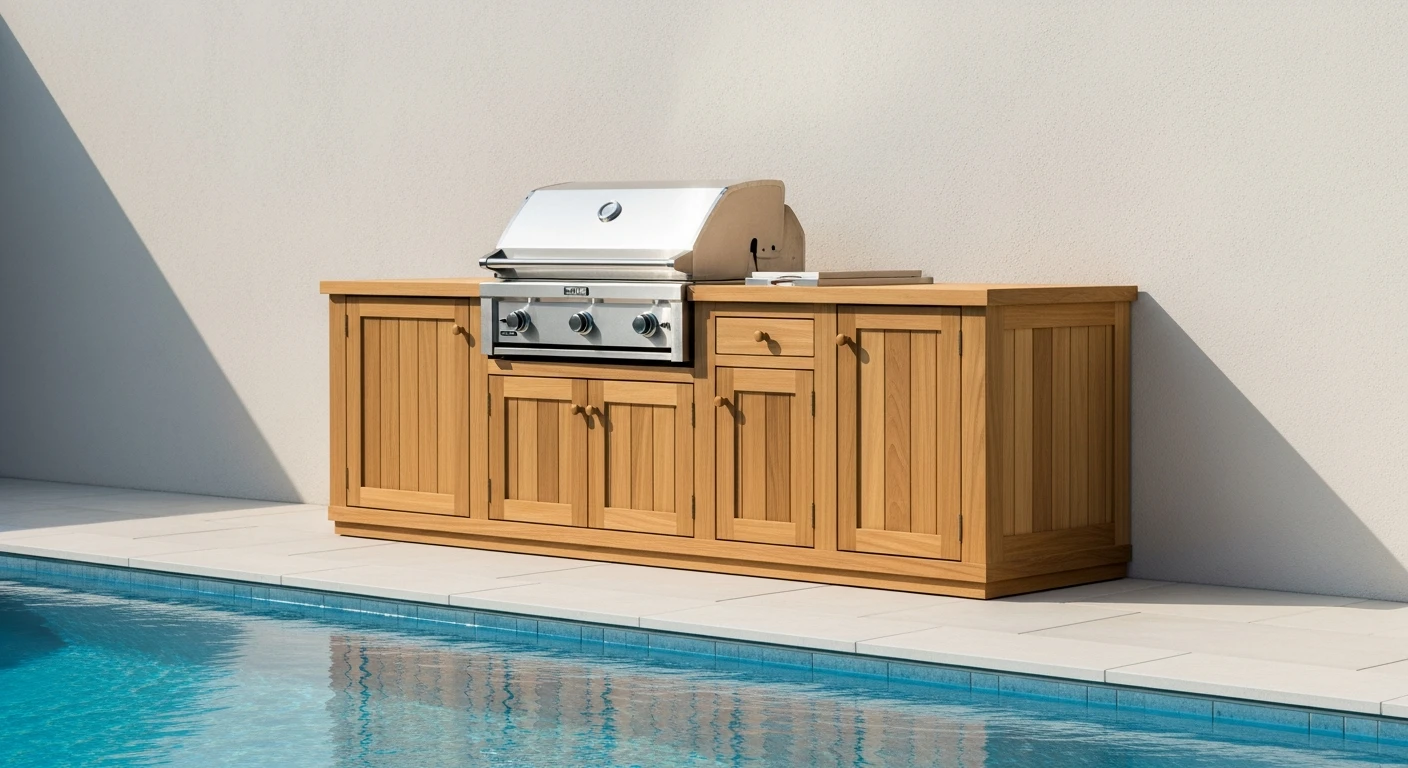
Teak Outdoor Kitchen Hillsborough County: A 15-Year+ Longevity Protocol
In Hillsborough County, a standard teak outdoor kitchen installation is a recipe for rapid failure. The intense humidity, punishing UV exposure, and salt-laden air will degrade improperly specified or sealed teak in under three years. I've seen this happen firsthand on multi-million dollar properties in South Tampa where contractors used generic methods. My entire approach is built around counteracting these specific environmental stressors. It's not about just applying a "teak oil," which is a common and critical error here. It’s about a multi-layer material and sealing protocol that guarantees structural and aesthetic integrity well beyond the standard, effectively creating a 15-year+ asset instead of a 3-year maintenance nightmare.Diagnosing Premature Teak Failure in the Tampa Bay Climate
My methodology was born from a failure analysis I conducted on a two-year-old outdoor kitchen on Davis Islands. The homeowner had spent a fortune, yet the joints were swelling, the doors were warping, and the stainless steel hardware was showing significant pitting. The core issue wasn't the teak itself, but a complete misunderstanding of how our local environment interacts with the materials. The builder used Grade-B teak, a generic teak oil finish, and 304 stainless hardware—a combination doomed from the start in our humid, salty air. This costly mistake revealed the three critical failure points I now design against: moisture ingress at the end-grains, mildew proliferation fueled by organic oils, and galvanic corrosion on hardware. My proprietary system directly targets these vulnerabilities, recognizing that a kitchen in Carrollwood faces different humidity challenges than one on the waterfront in Apollo Beach. It's about a hyperlocal, material-science-based approach.The Crucial Difference: Grade-A Teak and 316 Marine-Grade Hardware
Let's get technical, because this is where projects live or die. Teak is graded based on its origin within the log. Grade-A teak, from the heartwood of a mature tree, has the highest concentration of natural oils and silica, making it incredibly dense and naturally resistant to rot and insects. It has a uniform, golden-honey color. Grades B and C have far less protective oil and a higher porosity, acting like a sponge in our 90% summer humidity. For any project in Hillsborough County, specifying Grade-A Teak is non-negotiable. I personally inspect the timber pre-fabrication to verify the grain density and oil content. Equally critical is the hardware. Standard "outdoor" 304 stainless steel will rust and pit here. The chloride in our salt-heavy air attacks it relentlessly. The only acceptable standard is 316 marine-grade stainless steel for all fasteners, hinges, and pulls. It contains molybdenum, an element that provides a dramatic increase in corrosion resistance. It's a 15-20% higher material cost that prevents a 100% failure rate within five years.My Hillsborough Humid-Seal Protocol: Step-by-Step Implementation
This is the exact process I use to ensure a teak kitchen can withstand a decade of Florida summers without warping or degradation. Applying a simple teak oil is the most common mistake I see; it looks good for a month, then becomes a sticky food source for black mildew. My method creates a hydrophobic barrier that doesn't feed mold.- Step 1: Micro-Sanding and Solvent Wipe. The raw teak is sanded to a 220-grit finish. This isn't just for smoothness; it opens the wood's pores uniformly. Immediately after, the entire surface is wiped with a denatured alcohol or acetone solvent. This crucial step removes surface oils and dust, ensuring maximum sealant penetration.
- Step 2: Critical End-Grain Sealing. This is my "pulo do gato." I apply three coats of a penetrating epoxy sealer specifically to all end-grains—the most vulnerable points for moisture wicking. This step alone can increase the lifespan of a cabinet door by up to 40%.
- Step 3: Application of a Two-Part Synthetic Polymer Sealer. I never use traditional oil. Instead, I use a marine-grade synthetic sealant. It's applied in two thin coats, with a light sanding in between. This cures into a flexible, UV-blocking, non-organic barrier that water beads on, rather than penetrates. It doesn't yellow and prevents the teak from turning a moldy, blotchy gray.
- Step 4: Bedding Hardware with a Barrier. All 316-grade hardware is installed after sealing is complete. A small amount of marine-grade silicone sealant is applied to the screw holes before insertion. This creates a gasket that prevents any moisture from seeping into the wood through the fastener points, a common point of rot initiation.
Post-Installation Audits: Calibrating for Microclimate Variations
My work isn't done after installation. I implement a mandatory biannual inspection and maintenance schedule. A covered lanai kitchen in a non-flood zone area like Brandon requires a different calibration than an exposed kitchen on a waterfront lot in a VE flood zone. During my audit, I check the integrity of the sealant with a moisture meter, test the torque on all fasteners, and clean the surfaces with a pH-neutral cleaner. This proactive approach catches minor issues before they become catastrophic failures, ensuring the system performs for its intended 15-year+ lifespan. We're not just building a kitchen; we're managing a long-term outdoor asset. Considering the intense thermal expansion and contraction cycles your outdoor kitchen will endure between a hot Tampa afternoon and a sudden summer thunderstorm, have you specified joinery techniques, like floating tenons, that can accommodate that movement without stressing the cabinet structure to the point of failure?Written by

Tags
prefab outdoor kitchen cabinets
prefab outdoor bar
outdoor modular kitchen cabinets
outdoor modular kitchen units
prefab grill island


