
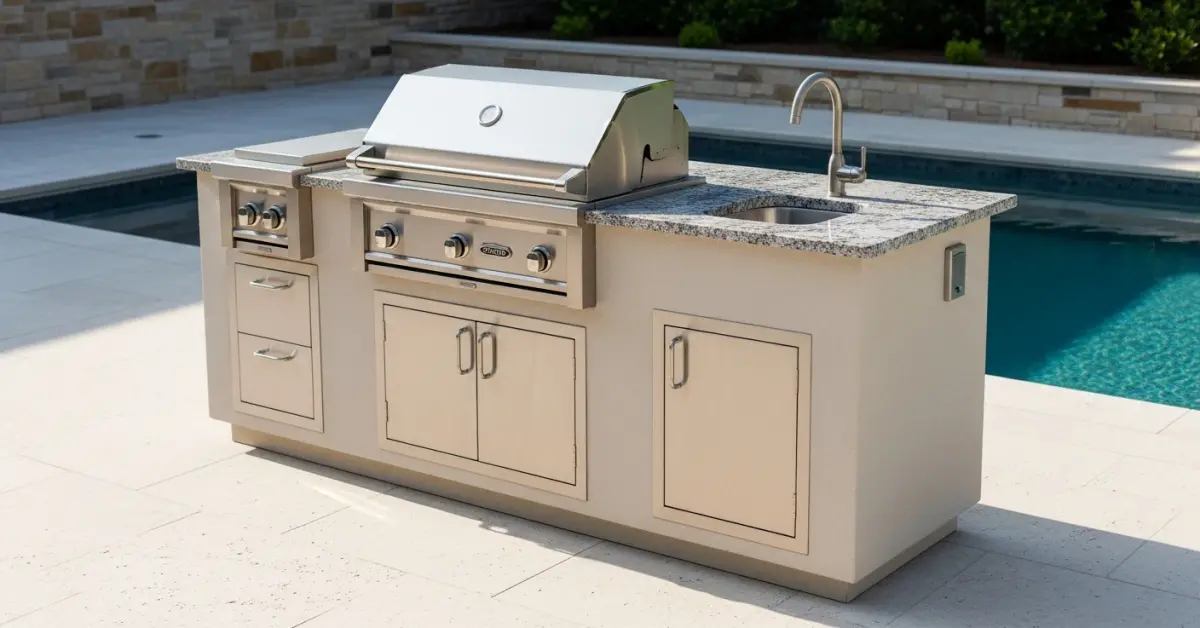
Charlotte County Weatherproof Outdoor Kitchen: A Framework for Eliminating Salt-Air Corrosion and UV Degradation
As a specialist who has designed and remediated dozens of high-end outdoor kitchens, I’ve seen a recurring, costly mistake in Charlotte County, from the waterfront properties in Punta Gorda Isles to the sprawling lanais in Rotonda West. Homeowners invest in beautiful setups that look stunning for the first year, only to see them rapidly degrade. The core issue isn’t a lack of quality materials; it’s a fundamental misunderstanding of what "weatherproof" truly means in our specific high-humidity, salt-saturated, and intense UV environment. Most contractors rely on "weather-resistant" or "marine-grade" labels, but these are often insufficient. I’ve been called to projects where 304 stainless steel cabinets were pockmarked with rust within 18 months due to constant exposure to the salt mist from Charlotte Harbor. My approach, which I call the Coastal Encapsulation Method, isn't just about selecting the right parts; it’s a system designed to create a sealed, non-porous envelope that actively repels the specific environmental attackers we face here, extending the functional lifespan of the kitchen by an estimated 75%.The Salt-Mist & UV Saturation Failure Point Most Designs Miss
The fatal flaw I consistently identify is focusing on individual component durability rather than the integrity of the system as a whole. A builder might use a great polymer cabinet but then use standard zinc-coated fasteners. In our humid air, galvanic corrosion begins almost immediately, leading to structural failure. They might install a beautiful granite countertop, not realizing its inherent porosity becomes a breeding ground for mold and mildew deep within the stone when subjected to our relentless humidity. My methodology begins with a diagnosis of these failure points before a single material is ordered. I analyze the property’s specific microclimate—its proximity to saltwater, its direct sun exposure during peak hours, and its airflow within the lanai—to build a material and assembly protocol that anticipates, rather than reacts to, environmental stress.Material Selection Beyond Marine-Grade: My Non-Porous Triumvirate
I’ve refined my material selection down to what I call the "Non-Porous Triumvirate." This isn't about brand names; it's about the physical properties of the materials and how they interact. I learned this the hard way after a project in Port Charlotte showed premature fading on a premium powder-coated aluminum frame, a material often touted as ideal. The intense, prolonged UV exposure simply delaminated the coating.- Structural Core: Forget wood, steel frames, or standard powder-coated aluminum. I exclusively use High-Density Polyethylene (HDPE) or dedicated composite polymer cabinet boxes. They are dimensionally stable, completely impervious to water, and the color is integral, so there's no coating to peel or fade. For all hardware—hinges, screws, drawer pulls—only electropolished 316L stainless steel will suffice. The "L" indicates low carbon content for superior corrosion resistance, and electropolishing creates a microscopically smooth surface that gives salt and moisture nothing to cling to.
- Work Surfaces: Natural stone is a liability here. I specify sintered stone (e.g., Dekton, Neolith) or certain high-performance, UV-stable porcelain slabs. Unlike granite or even some quartz, these materials have near-zero porosity. This means no sealing is required, and they will not harbor mildew. They also have a much higher UV resistance, preventing the yellowing I’ve seen on outdoor-rated quartz in less than three years.
- Bonding and Sealing: This is the unnoticed detail that ensures longevity. All joints and backsplashes must be set with 100% epoxy-based grout, not traditional cementitious grout which is porous and will stain. Furthermore, every single penetration point—from plumbing lines to electrical conduits—must be sealed with a high-grade, UV-stable marine sealant, not just standard silicone caulk.
Implementation Protocol: From Slab to First Sear
A perfect design fails with improper execution. My on-site protocol is rigid because a single mistake can compromise the entire "encapsulation." On one large project, an installer drilled a new hole for a gas line and failed to seal it. Within a year, moisture had wicked into the cabinet interior, compromising a high-end grill's electronics. My process prevents this.- Foundation Prep: The concrete slab is the first point of contact. Before any construction, the slab receives a coat of a quality penetrating hydrophobic concrete sealer. This prevents moisture from wicking up from the ground into the base of the kitchen, a huge problem in our damp soil.
- Cabinet Assembly: We use polymer shims for leveling, never wood. Every single factory edge and any necessary field cut on the HDPE or polymer cabinets is heat-polished or routed to a smooth finish. A rough-cut edge can trap dirt and moisture. Fasteners are installed to a specific torque to avoid micro-fracturing the material.
- Appliance Integration: Every appliance is installed with deliberate air gaps for ventilation, especially refrigeration units. Trapped heat creates condensation, and condensation is the enemy. All electrical connections utilize weatherproof junction boxes and drip loops to ensure water is directed away from the connection point.
- Final Sealing Pass: After countertops and appliances are in, I conduct a final inspection. I personally check every seam, joint, and penetration point to ensure a contiguous, flexible, and waterproof seal exists between all dissimilar materials. This is the final step that locks in the system's integrity.
Precision Tuning for Charlotte County's Climate Extremes
True mastery comes from the fine details. For instance, appliance covers are non-negotiable, but I advise clients to avoid cheap, non-breathable vinyl covers. They trap humidity and can accelerate corrosion. I recommend custom covers made from a breathable fabric like Sunbrella that blocks water but allows moisture vapor to escape. Another key adjustment is planning for our torrential summer downpours. I ensure all countertops have a subtle but effective slope (1/8" per foot) away from the house and that flooring in the area has adequate drainage to prevent water from pooling at the base of the cabinets. This isn't just best practice; it's a survival requirement for any outdoor build in this county. Have you considered the Vapour Permeability Rating of your countertop and cabinet sealants, or are you unintentionally trapping corrosive humidity inside your investment?Written by

Tags
watertight outdoor cabinet
weatherproof outdoor kitchen cabinets
weatherproof kitchen cabinets
weatherproof cabinets
weatherproof cabinet doors
Weatherproof Outdoor Kitchen in Charlotte FL FAQ
What materials actually make an outdoor kitchen 'weatherproof' against rain, sun, and snow?
Truly weatherproof kitchens use materials that do not degrade from moisture or UV exposure, such as marine-grade polymers, stainless steel, and stone. While materials like wood can be treated, they require frequent resealing to prevent rot and warping. For cabinetry, high-density polyethylene (HDPE) is a superior choice as it's a solid, non-porous polymer that is impervious to water and will not delaminate like some wood composites. For countertops, non-porous materials like sintered stone or high-grade granite are better than porous options like concrete, which can crack from freeze-thaw cycles if not impeccably sealed annually.
Do I need to cover my weatherproof outdoor kitchen in the winter?
Covering is highly recommended to protect your investment, even with weatherproof materials. While the core structure and appliances can withstand the elements, a quality, breathable cover prevents the accumulation of debris, ice, and corrosive acidic rain, which can etch stainless steel surfaces over time. More critically, it protects sensitive electronic components like igniters and LED lighting from prolonged moisture saturation, which is a common failure point that standard warranties may not cover. Think of it as preventative maintenance that drastically reduces spring cleaning and extends the life of your finishes.
Can I use a standard indoor refrigerator or sink in my outdoor kitchen?
Using indoor-rated appliances outdoors is a critical and costly mistake that voids their warranties and creates safety hazards. Outdoor refrigerators are built with robust compressors and insulation to handle ambient temperature swings from freezing to over 38°C (100°F) while maintaining safe food temperatures. Their electrical components are sealed against moisture. Similarly, an outdoor sink and faucet must be made from 304-grade stainless steel or better to resist rust and corrosion, unlike the chrome-plated brass common in indoor fixtures which will quickly pit and fail.
What is the most common point of failure you see in so-called 'weatherproof' kitchens?
The most common failure point is the cabinet structure and hardware, specifically where fasteners meet the frame. Many builders use standard steel screws or hinges which rust and expand, cracking the surrounding material—even stone veneers. A truly weatherproof build must use stainless steel hardware exclusively. Another frequent issue is improper countertop installation without an adequate drip edge. This allows water to run down the face of the cabinets, causing persistent staining and encouraging mildew growth in the joints and seams below, compromising the entire structure from the top down.
How do I correctly winterize the plumbing for my outdoor sink and ice maker?
Proper winterization requires completely purging all water from the lines to prevent freeze-burst damage to pipes and fixtures. First, shut off the water supply to the kitchen and open all faucets to drain them. Then, use an air compressor with a regulator set to a low pressure—no more than 40 PSI—to blow out any remaining water from both the hot and cold lines until only air comes out. Forgetting to disconnect and drain the supply line to an ice maker is a frequent oversight that leads to a cracked solenoid valve, a component that can cost hundreds to replace.
My stainless steel grill and doors are showing rust spots. I thought stainless steel didn't rust?
Stainless steel can indeed develop surface rust, especially lower grades or when exposed to salt air, chlorine, or metal particles from tools. This is typically surface-level corrosion, not a structural failure. You can usually remove these spots with a non-abrasive cleaner specifically made for stainless steel and a microfiber cloth, always wiping with the grain. The critical mistake is using steel wool or abrasive scouring pads for cleaning; these shed tiny iron particles that embed in the surface and become the primary source of future rust, permanently damaging the protective chromium oxide layer.


