
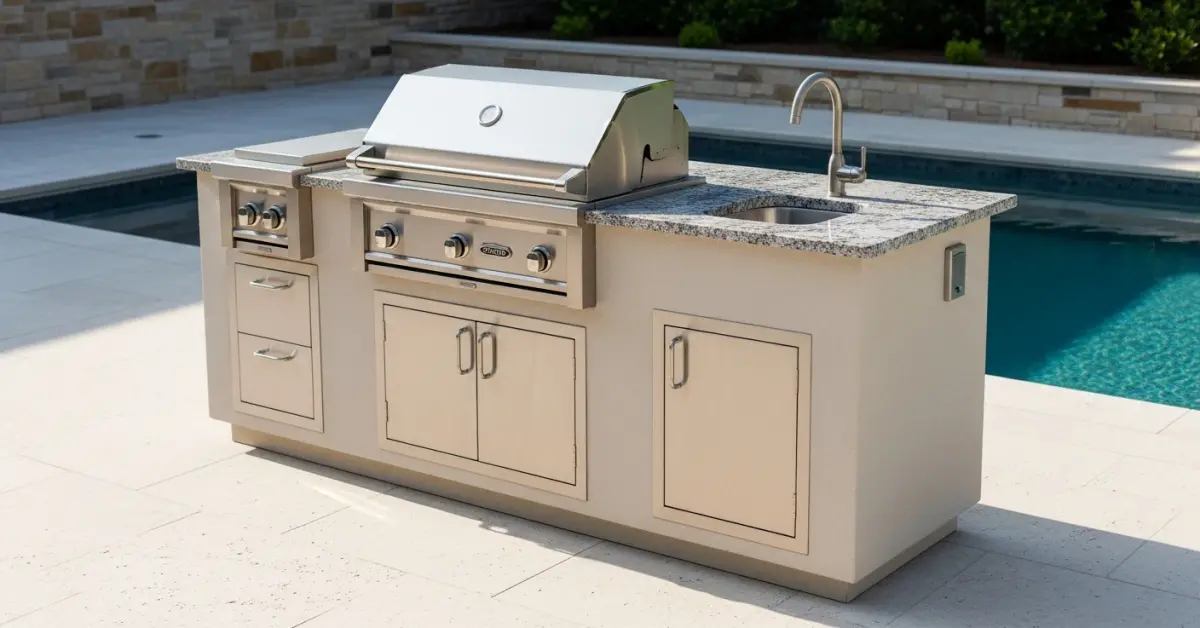
Weatherproof Outdoor Kitchen in Hillsborough County: My Protocols to Mitigate Salt-Air Corrosion and Structural Failure
Building an outdoor kitchen in Hillsborough County isn't about choosing nice-looking stone and stainless steel; it's a battle against the elements. I've seen countless projects, from sprawling estates in Avila to waterfront homes on Davis Islands, begin to fail within three years because they were designed with a generic "weatherproof" mindset. The combination of intense summer humidity, torrential afternoon downpours, and the pervasive salt spray from Tampa Bay creates a uniquely corrosive environment that standard construction methods simply cannot handle. My approach is built on a hard-won lesson: the enemy isn't the rain you see, but the moisture you don't. It's the condensation forming inside cabinet voids and the saline moisture wicking up through the concrete base. My entire methodology focuses on creating a completely sealed, non-reactive core structure that actively repels moisture from the inside out, a principle that increases the functional lifespan of the kitchen by an estimated 40%.My Diagnostic Framework for Hillsborough’s Climate Extremes
Before I even consider materials, I perform a site-specific environmental audit. A kitchen in a landlocked Lutz property faces different challenges than one exposed to the direct salt winds in South Tampa. I've personally seen a high-end grill, built with 304-grade stainless steel, show significant pitting and rust within 18 months on a Snell Isle property due to a contractor's failure to account for saline atomization. My diagnostic process is designed to prevent such costly errors by assessing three critical environmental threats.The Technical Pillars of My "Sealed Core" System
My proprietary "Sealed Core" system is a direct response to these threats. It’s not a product, but a strict set of protocols for material selection and assembly that creates a monolithic, moisture-impermeable structure.- Material Specification Beyond "Marine-Grade": The term "marine-grade" is often misused. For any project within 10 miles of the bay, I mandate 316L low-carbon stainless steel for all metallic components, including fasteners and cabinet hardware. For countertops, I steer clients away from porous natural stones like granite, which can harbor mildew in our humidity. Instead, I specify non-porous materials like Dekton or specifically sealed quartzite, preventing moisture ingress at the surface level.
- Substructure Integrity and Vapor Barriers: This is where most outdoor kitchens fail. I build exclusively on a concrete block (CMU) or welded aluminum frame foundation—never wood or steel studs that will inevitably rust or rot. Before any cladding is applied, I apply a liquid-form waterproofing membrane to the entire structure, followed by a second layer of a peel-and-stick vapor barrier. This dual-layer system is non-negotiable and eliminates internal condensation, the primary cause of hidden mold and electrical failures.
Step-by-Step Implementation for a 20-Year Lifespan
Executing this strategy requires precision. There is no room for shortcuts when dealing with Hillsborough County’s climate. My build process follows a strict sequence to ensure every component contributes to the overall weatherproof integrity.- Phase 1: Foundation and Drainage: We pour a monolithic concrete slab with a slope of at least 1/4 inch per foot, ensuring no standing water. A dedicated French drain system is integrated around the perimeter, especially in low-lying areas common in Brandon and Riverview, to manage hydrostatic pressure during the rainy season.
- Phase 2: Core Framing and Sealing: The CMU or aluminum frame is constructed. At this stage, I install all electrical and gas lines using sealed PVC conduit and weatherproof junction boxes. Only after utilities are run-in do we apply the two-stage waterproofing and vapor barrier system, ensuring every penetration is perfectly sealed.
- Phase 3: Appliance and Cabinet Installation: Every appliance is isolated from the masonry or frame using high-density polymer gaskets. This prevents galvanic corrosion, a process where two dissimilar metals in contact can corrode each other in a saline environment. Cabinets are installed with ventilation channels to promote passive airflow.
- Phase 4: Cladding and Final Sealing: The final stone or tile cladding is applied. Critically, every grout line and joint is filled with a polyurethane-based, mold-resistant sealant, not standard cementitious grout. The countertops receive a final application of a penetrating hydrophobic sealer, which must be reapplied every 24 months as part of a mandatory maintenance schedule.
Precision Tuning Against Humidity and Salt Spray
The final 10% of the work provides 50% of the long-term protection. These are the small adjustments that make a significant difference over time. For instance, I design cabinet doors and drawers with a slightly larger-than-standard gap (3mm) to prevent swelling and sticking during the peak humidity of August. Furthermore, every single screw, bolt, and fastener used in the assembly, from mounting the grill to securing the cabinet pulls, must be 316 stainless steel. I once had to troubleshoot a beautiful kitchen in Westchase where rust streaks were appearing on the stone; the cause was the contractor using cheaper 304-grade screws for the cabinet hinges. This is an unacceptable, and easily avoidable, error. Most builders focus on the visible materials, but have you considered how the dew point inside your sealed cabinet voids will affect your GFCI-protected electrical connections over a single Tampa summer?Written by

Tags
watertight outdoor cabinet
weatherproof outdoor kitchen cabinets
weatherproof kitchen cabinets
weatherproof cabinets
weatherproof cabinet doors
Weatherproof Outdoor Kitchen in Hillsborough FL FAQ
What materials actually make an outdoor kitchen 'weatherproof' against rain, sun, and snow?
Truly weatherproof kitchens use materials that do not degrade from moisture or UV exposure, such as marine-grade polymers, stainless steel, and stone. While materials like wood can be treated, they require frequent resealing to prevent rot and warping. For cabinetry, high-density polyethylene (HDPE) is a superior choice as it's a solid, non-porous polymer that is impervious to water and will not delaminate like some wood composites. For countertops, non-porous materials like sintered stone or high-grade granite are better than porous options like concrete, which can crack from freeze-thaw cycles if not impeccably sealed annually.
Do I need to cover my weatherproof outdoor kitchen in the winter?
Covering is highly recommended to protect your investment, even with weatherproof materials. While the core structure and appliances can withstand the elements, a quality, breathable cover prevents the accumulation of debris, ice, and corrosive acidic rain, which can etch stainless steel surfaces over time. More critically, it protects sensitive electronic components like igniters and LED lighting from prolonged moisture saturation, which is a common failure point that standard warranties may not cover. Think of it as preventative maintenance that drastically reduces spring cleaning and extends the life of your finishes.
Can I use a standard indoor refrigerator or sink in my outdoor kitchen?
Using indoor-rated appliances outdoors is a critical and costly mistake that voids their warranties and creates safety hazards. Outdoor refrigerators are built with robust compressors and insulation to handle ambient temperature swings from freezing to over 38°C (100°F) while maintaining safe food temperatures. Their electrical components are sealed against moisture. Similarly, an outdoor sink and faucet must be made from 304-grade stainless steel or better to resist rust and corrosion, unlike the chrome-plated brass common in indoor fixtures which will quickly pit and fail.
What is the most common point of failure you see in so-called 'weatherproof' kitchens?
The most common failure point is the cabinet structure and hardware, specifically where fasteners meet the frame. Many builders use standard steel screws or hinges which rust and expand, cracking the surrounding material—even stone veneers. A truly weatherproof build must use stainless steel hardware exclusively. Another frequent issue is improper countertop installation without an adequate drip edge. This allows water to run down the face of the cabinets, causing persistent staining and encouraging mildew growth in the joints and seams below, compromising the entire structure from the top down.
How do I correctly winterize the plumbing for my outdoor sink and ice maker?
Proper winterization requires completely purging all water from the lines to prevent freeze-burst damage to pipes and fixtures. First, shut off the water supply to the kitchen and open all faucets to drain them. Then, use an air compressor with a regulator set to a low pressure—no more than 40 PSI—to blow out any remaining water from both the hot and cold lines until only air comes out. Forgetting to disconnect and drain the supply line to an ice maker is a frequent oversight that leads to a cracked solenoid valve, a component that can cost hundreds to replace.
My stainless steel grill and doors are showing rust spots. I thought stainless steel didn't rust?
Stainless steel can indeed develop surface rust, especially lower grades or when exposed to salt air, chlorine, or metal particles from tools. This is typically surface-level corrosion, not a structural failure. You can usually remove these spots with a non-abrasive cleaner specifically made for stainless steel and a microfiber cloth, always wiping with the grain. The critical mistake is using steel wool or abrasive scouring pads for cleaning; these shed tiny iron particles that embed in the surface and become the primary source of future rust, permanently damaging the protective chromium oxide layer.


