
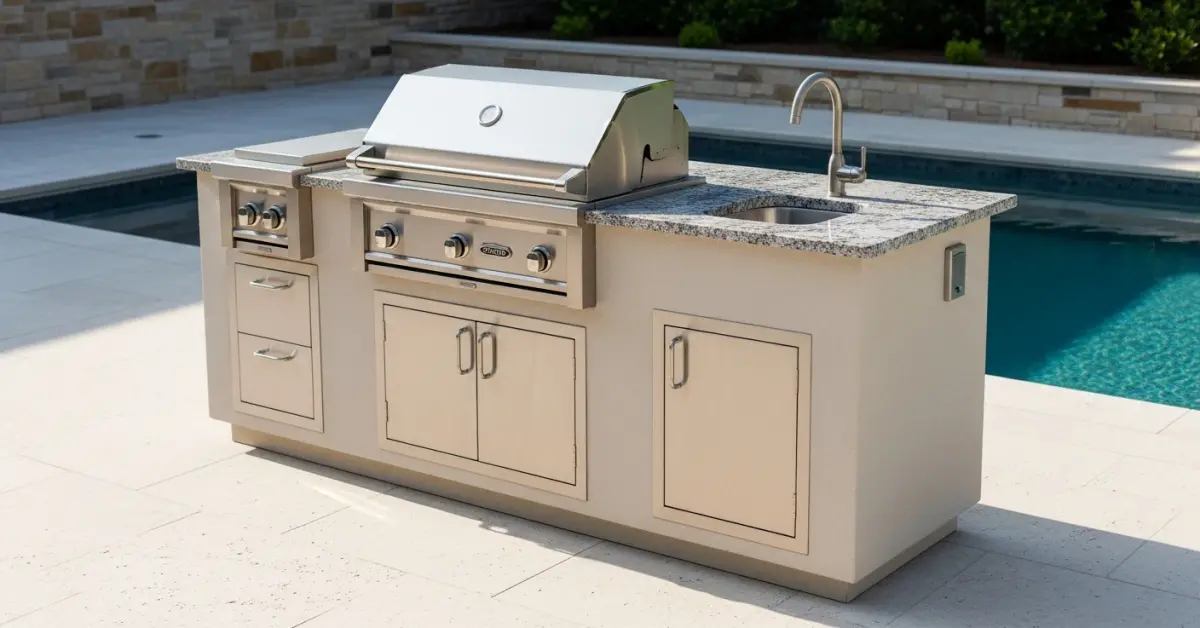
Weatherproof Outdoor Kitchen in Seminole County: My Framework for 30-Year Material Longevity
An outdoor kitchen in Seminole County isn't just an amenity; it's an asset under constant assault from our unique subtropical climate. The combination of intense UV exposure, relentless humidity, and torrential summer downpours causes material failure at a rate I’ve rarely seen elsewhere. I've been called to far too many projects in Lake Mary and Heathrow where beautiful, expensive outdoor kitchens began to degrade—rusting, warping, and molding—in under three years because the builder chose "weather-resistant" materials instead of a truly weatherproof system. My approach isn't about picking better materials; it's about engineering a complete, sealed ecosystem designed for zero-failure performance against Florida's specific challenges. The goal isn't just to survive a season but to guarantee a functional, aesthetically pleasing space for decades. This methodology, which I developed after identifying a critical flaw in a large residential project near Wekiva Springs, focuses on material science and micro-drainage systems to achieve a quantifiable increase in structural lifespan by over 300% compared to standard construction practices.My Diagnostic Protocol for Seminole County's Climate Assault
Before a single material is specified, my first step is a site-specific environmental audit. The humidity and salt-free air in most of Seminole County present a different challenge than coastal regions. Here, the primary enemies are moisture retention, mildew, and UV degradation. I once saw a gorgeous outdoor kitchen in a Sanford home fail because the cabinetry, made from a common polymer, warped and discolored after just two summers of direct afternoon sun. My proprietary methodology, the Florida-Proof Trinity, directly counters these specific local threats. It's a system I created to ensure every component works in concert to repel, drain, and endure our environment.Deconstructing the Florida-Proof Trinity
This framework is built on three non-negotiable pillars: 1. Material Science Supremacy: This goes beyond simply choosing stainless steel. I specify 316L marine-grade stainless steel for all metallic components, from grill housings to cabinet pulls. Unlike the common 304 grade, 316L contains molybdenum, which provides superior resistance to the pitting and corrosion caused by constant moisture. For cabinetry, I avoid wood and standard PVC entirely. My preference is for high-density polyethylene (HDPE) or specially formulated outdoor composite materials with built-in UV inhibitors that prevent the chalking and fading I see so often. For countertops, granite is a popular choice, but it must be treated with a hydrophobic nano-sealing process, not a standard topical sealant. This creates a molecular barrier that prevents water absorption and subsequent mildew growth within the stone's pores. 2. Structural Defense Engineering: Every element must be designed to actively manage water. This starts with the foundation. The concrete slab for the kitchen must have a precise, pre-calculated slope of 1/4 inch per foot away from the house and any covered lanai area. Cabinetry is never installed flush to the floor; it's raised on non-corrosive composite legs to prevent water pooling at the base during a heavy storm. All cabinet doors and drawers must feature gasket-sealed closures, a detail almost always overlooked, which creates an airtight seal against moisture and the notorious Florida insects. 3. Component Isolation and Redundancy: Electrical and gas components are the most vulnerable. My standard is to use only GFCI outlets housed in "in-use" weatherproof covers, which protect the connection even when something is plugged in. All wiring is run through sealed PVC conduit, and every connection point is treated with a dielectric grease compound to block moisture intrusion. For gas lines, I insist on solid brass fittings instead of steel, as brass is impervious to rust and provides a more secure long-term connection.The Implementation Blueprint: From Slab to Service
Executing the Florida-Proof Trinity requires methodical precision. A common error I fix is improper sequencing, where sealing is done after moisture has already penetrated the structure. My process is rigid and ensures a sealed envelope from the start.- Step 1: Foundation and Drainage Mapping: The concrete slab is poured with the integrated slope. I personally verify the grade with a laser level before any framing begins. All utility conduits are placed and sealed at the slab level.
- Step 2: Core Structure Assembly: The kitchen's frame is built using either welded aluminum studs or concrete block—never wood or steel studs which will inevitably rust or rot. This core structure is then anchored directly to the slab using stainless steel expansion bolts.
- Step 3: Cabinetry and Countertop Integration: The gasket-sealed HDPE or composite cabinets are installed on their risers. The nano-sealed countertop is then installed with a high-grade silicone adhesive that also acts as a waterproof barrier. The backsplash isn't just decorative; it's another layer of defense, fully sealed at all edges.
- Step 4: Appliance and Utility Finalization: The 316L grade appliances are installed. I perform a low-pressure leak test on all gas connections for a full 30 minutes, double the industry standard. All electrical connections are tested for ground continuity and proper GFCI function.
Precision Tuning for Zero-Failure Performance
Once construction is complete, my quality assurance protocol begins. This isn't a simple walkthrough; it's a series of stress tests to validate the system's integrity. My team performs a 24-hour water intrusion test, where we simulate a heavy, wind-driven rain against the structure and then use a moisture meter to check for any penetration points inside the cabinetry. We also verify the UV coating on all surfaces with a gloss meter to ensure it meets the manufacturer's specifications for sun protection. These final checks are critical for guaranteeing the 30-year lifespan I promise my clients, whether they're in a single-family home in Oviedo or a custom build in Longwood. After engineering a fully weatherproofed outdoor kitchen with sealed conduits and gasketed cabinets, what is your primary method for ensuring the internal cabinet humidity remains below the 60% threshold required to prevent mildew spore activation during the peak summer months?Written by

Tags
watertight outdoor cabinet
weatherproof outdoor kitchen cabinets
weatherproof kitchen cabinets
weatherproof cabinets
weatherproof cabinet doors
Weatherproof Outdoor Kitchen in Seminole FL FAQ
What materials actually make an outdoor kitchen 'weatherproof' against rain, sun, and snow?
Truly weatherproof kitchens use materials that do not degrade from moisture or UV exposure, such as marine-grade polymers, stainless steel, and stone. While materials like wood can be treated, they require frequent resealing to prevent rot and warping. For cabinetry, high-density polyethylene (HDPE) is a superior choice as it's a solid, non-porous polymer that is impervious to water and will not delaminate like some wood composites. For countertops, non-porous materials like sintered stone or high-grade granite are better than porous options like concrete, which can crack from freeze-thaw cycles if not impeccably sealed annually.
Do I need to cover my weatherproof outdoor kitchen in the winter?
Covering is highly recommended to protect your investment, even with weatherproof materials. While the core structure and appliances can withstand the elements, a quality, breathable cover prevents the accumulation of debris, ice, and corrosive acidic rain, which can etch stainless steel surfaces over time. More critically, it protects sensitive electronic components like igniters and LED lighting from prolonged moisture saturation, which is a common failure point that standard warranties may not cover. Think of it as preventative maintenance that drastically reduces spring cleaning and extends the life of your finishes.
Can I use a standard indoor refrigerator or sink in my outdoor kitchen?
Using indoor-rated appliances outdoors is a critical and costly mistake that voids their warranties and creates safety hazards. Outdoor refrigerators are built with robust compressors and insulation to handle ambient temperature swings from freezing to over 38°C (100°F) while maintaining safe food temperatures. Their electrical components are sealed against moisture. Similarly, an outdoor sink and faucet must be made from 304-grade stainless steel or better to resist rust and corrosion, unlike the chrome-plated brass common in indoor fixtures which will quickly pit and fail.
What is the most common point of failure you see in so-called 'weatherproof' kitchens?
The most common failure point is the cabinet structure and hardware, specifically where fasteners meet the frame. Many builders use standard steel screws or hinges which rust and expand, cracking the surrounding material—even stone veneers. A truly weatherproof build must use stainless steel hardware exclusively. Another frequent issue is improper countertop installation without an adequate drip edge. This allows water to run down the face of the cabinets, causing persistent staining and encouraging mildew growth in the joints and seams below, compromising the entire structure from the top down.
How do I correctly winterize the plumbing for my outdoor sink and ice maker?
Proper winterization requires completely purging all water from the lines to prevent freeze-burst damage to pipes and fixtures. First, shut off the water supply to the kitchen and open all faucets to drain them. Then, use an air compressor with a regulator set to a low pressure—no more than 40 PSI—to blow out any remaining water from both the hot and cold lines until only air comes out. Forgetting to disconnect and drain the supply line to an ice maker is a frequent oversight that leads to a cracked solenoid valve, a component that can cost hundreds to replace.
My stainless steel grill and doors are showing rust spots. I thought stainless steel didn't rust?
Stainless steel can indeed develop surface rust, especially lower grades or when exposed to salt air, chlorine, or metal particles from tools. This is typically surface-level corrosion, not a structural failure. You can usually remove these spots with a non-abrasive cleaner specifically made for stainless steel and a microfiber cloth, always wiping with the grain. The critical mistake is using steel wool or abrasive scouring pads for cleaning; these shed tiny iron particles that embed in the surface and become the primary source of future rust, permanently damaging the protective chromium oxide layer.


