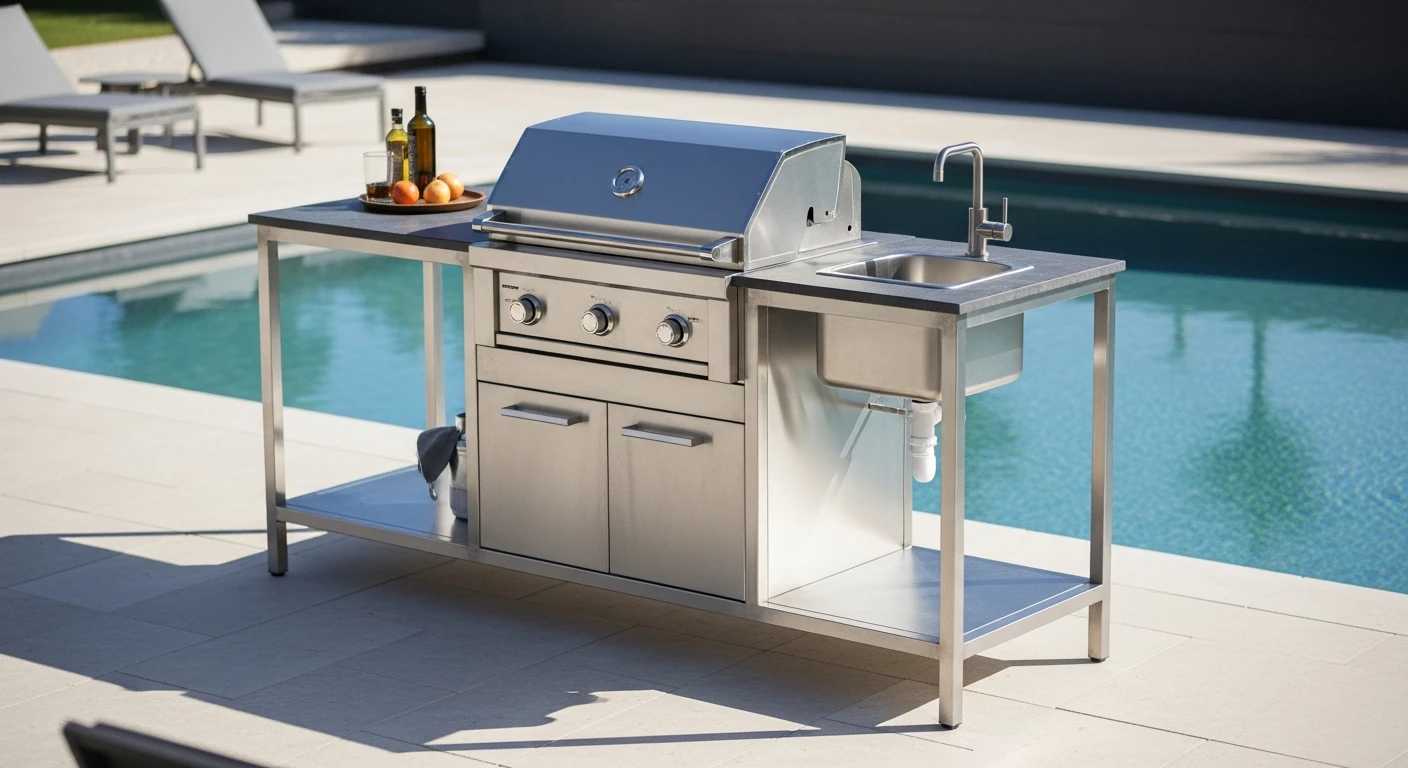
Outdoor Metal Kitchen: My Protocol for a 15-Year Corrosion-Free Lifespan in Lee County
I’m often called to properties in Fort Myers and Cape Coral to diagnose the same issue: a beautiful, expensive outdoor metal kitchen that’s showing signs of rust and pitting after just two or three years. The owners are frustrated, having been sold on the promise of "durable stainless steel." The core problem isn't the concept; it's the widespread failure to account for Lee County’s specific atmospheric conditions—the relentless humidity and, most critically, the high-salinity air, especially in waterfront homes along the Caloosahatchee River or on Sanibel Island.
My entire approach is built on a single, non-negotiable principle: standard materials and installation practices that work inland are guaranteed to fail here. The solution is a material-first methodology that treats an outdoor kitchen not as an appliance set, but as a marine-grade installation. This involves specifying a precise steel grade and implementing a proprietary assembly process that eliminates the common points of failure I’ve documented in dozens of local projects.
The Core Diagnostic Flaw in Standard Installations
The single biggest mistake I see contractors make in Lee County is a cost-driven material specification. They’ll install kitchens made from 304-grade stainless steel. On paper, it's "stainless." In a dry climate, it's adequate. But in the salty, humid air of a Cape Coral lanai, 304-grade steel has an Achilles' heel: it lacks sufficient resistance to chloride-induced corrosion. The salt in the air, even miles from the coast, aggressively attacks the passive layer of the steel, leading to unsightly and structurally compromising rust, especially at welds and connection points.
My diagnostic methodology begins with identifying the environmental stress level of the specific property. A home in a dense Lehigh Acres neighborhood has a different risk profile than a waterfront estate on Captiva Island. Based on this, I apply my "Coastal Durability Matrix," which dictates not just the primary material but also the grade of every single component, down to the last screw.
Material Science: Why 316L Marine-Grade Steel is Non-Negotiable
This is where the technical gain lies. The critical difference between the failing 304 steel and the resilient 316L marine-grade steel is an element called molybdenum. This addition, typically 2-3% of the alloy's composition, dramatically increases resistance to chlorides. It’s the reason 316L is used for boat railings and marine hardware. For an outdoor kitchen in Lee County, I consider it the absolute baseline requirement, not an upgrade.
Furthermore, the "L" in 316L designates low carbon content. This is crucial for preventing a phenomenon called "weld decay," where the areas around welds become susceptible to corrosion after fabrication. I've seen beautifully designed kitchens fail within a year because the fabricator used 316 steel but not the low-carbon variant, causing rust to bloom precisely at the seams. This is a detail most clients and even some builders completely miss.
The Lanai-Specific Fabrication & Assembly Protocol
A successful Lee County outdoor kitchen is built twice: once in the workshop and once on-site. My implementation protocol is rigid and focuses on preventing corrosion at every stage.
- Component Sourcing Mandate: This is a critical checkpoint. It’s not enough for the cabinets to be 316L. I mandate that all fasteners, hinges, and drawer slides must also be 316L. A common cost-cutting measure is to use cheaper 304 or even 400-series stainless hardware. This creates a weak link and is where I first find rust 90% of the time.
- Weld Passivation Treatment: After fabrication, every single weld must be chemically cleaned and passivated. This process removes any free iron from the surface and rebuilds the chromium oxide passive layer, making the weld as corrosion-resistant as the base metal. Skipping this post-fabrication step is a major error I've had to correct on high-end projects.
- Electrical Isolation: I ensure all metal components are isolated from direct contact with dissimilar materials, like the galvanized steel base of a grill or aluminum framing. This prevents galvanic corrosion, an electrochemical reaction that accelerates the degradation of the less noble metal. I use high-density polymer spacers as a buffer.
- Site-Specific Anchoring: We don't just place the kitchen. We anchor it to the concrete slab of the lanai, taking into account drainage and potential water pooling during heavy summer rains. The anchoring hardware, again, must be 316L stainless steel.
Precision Adjustments for Lee County's Hurricane Season
Durability here isn't just about corrosion; it's about structural integrity. The standard outdoor kitchen isn't designed to withstand the wind loads experienced during a tropical storm or hurricane. My quality standard requires a design that is either massively heavy or, more practically, features robust structural anchoring points.
For homes in high-velocity hurricane zones, which covers much of Lee County, I engineer the kitchen's frame to be directly tied into the structure of the lanai. This involves more than just a few bolts; it's a calculated system designed to resist uplift forces. All removable elements, like doors and drop-in ice chests, must have secure latching mechanisms to prevent them from becoming projectiles in high winds. This is a level of detail that provides genuine peace of mind when the storm warnings begin.
Have you considered the galvanic corrosion risk between your grill's zinc-plated feet and your stainless steel countertop?