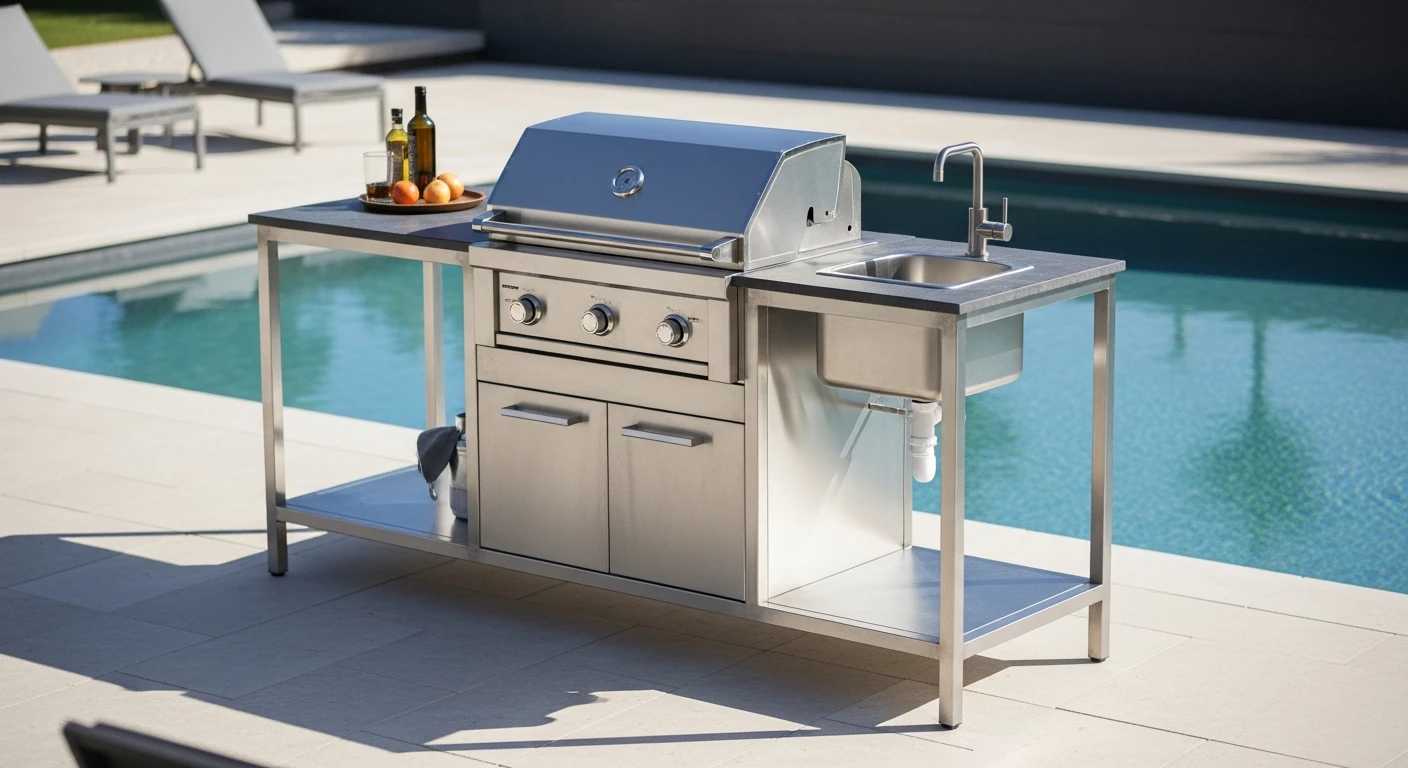
Outdoor Metal Kitchen Pinellas County: A Framework for 99.9% Corrosion Resistance
For years, I've designed and troubleshot outdoor metal kitchens across Pinellas County, from the waterfront estates in Tierra Verde to the coastal bungalows in Dunedin. The single most expensive mistake I see homeowners make is not understanding that our local environment—the constant salt spray from the Gulf, the oppressive humidity—is an accelerated corrosion chamber. An outdoor kitchen that would last a decade in a drier climate can show significant pitting and rust here in under two years if not specified correctly. My entire methodology is built around one core principle: treating your outdoor kitchen not as a piece of furniture, but as a marine-grade installation. The beautiful, sunny Florida lifestyle demands a level of material science that standard big-box store solutions simply cannot provide. I've developed a system that focuses on material integrity at the molecular level, ensuring a 25-30 year lifespan instead of a 3-5 year replacement cycle.The Critical Flaw in Most Pinellas Outdoor Kitchens: Material Specification Failure
The fundamental error I consistently identify starts with the metal itself. A contractor might propose a "stainless steel" kitchen, which sounds durable. However, this term is dangerously vague. In a large project on Snell Isle, I was called in to diagnose why a brand new, six-figure outdoor kitchen was already showing rust spots around every weld and fastener. The cause was simple: the use of 304-grade stainless steel, an industry standard for indoor use, but a catastrophic failure for our coastal environment. My diagnostic process, which I call the Coastal Durability Audit, immediately flags this. It's a non-negotiable failure point.316L Marine-Grade Steel vs. 304 Stainless: The Molybdenum Difference
Here's the technical insight that saves my clients thousands in premature replacements. Standard 304 stainless steel lacks a key element: molybdenum. In our Pinellas County air, chloride ions from the salt spray are the primary corrosive agent. Molybdenum, present in 316L marine-grade stainless steel, actively resists chloride pitting and crevice corrosion. The "L" in 316L signifies low carbon content, which further improves weldability and reduces carbide precipitation—a primary cause of weld decay. Choosing 304 over 316L to save a marginal upfront cost is the definition of a false economy, a mistake I see repeated from Clearwater Beach to St. Pete Pier.My Proprietary 5-Step Coastal Metal Kitchen Installation Protocol
Executing the build is as critical as the material selection. My protocol ensures that the inherent benefits of the chosen materials are not compromised during assembly. I've refined this process after seeing countless installations fail due to simple, avoidable oversights.- Step 1: Frame and Fastener Specification. Every single component, from the main cabinet frames down to the smallest screw and drawer slide, must be 316L stainless steel. I've seen a pristine 316L cabinet door ruined by rust streaks originating from a cheap 304-grade hinge.
- Step 2: Weld Passivation. After welding, the heat-affected zone is vulnerable to corrosion. I mandate a chemical passivation process using a citric or nitric acid solution. This removes free iron from the surface and rebuilds the passive chromium-oxide layer, making the weld as corrosion-resistant as the parent metal.
- Step 3: Powder Coating Adherence. For colored finishes, the powder coating is the first line of defense. My process requires a zinc-rich primer base coat before the final color is applied. This provides a sacrificial layer of protection, preventing corrosion from creeping under the coating if it gets scratched.
- Step 4: Isolate Dissimilar Metals. A common error is mounting a grill made of one type of metal directly to the 316L frame. This can cause galvanic corrosion. I use high-density polymer or nylon washers and bushings to create a dielectric break, preventing the electrical current that drives this corrosive process.
- Step 5: Drainage and Ventilation Engineering. Standing water is the enemy. Every horizontal surface, even inside cabinets, is designed with a slight, imperceptible grade to promote water runoff. I also engineer specific cross-ventilation paths to combat the high humidity and prevent moisture from being trapped, especially around refrigeration units.
Post-Installation Calibration: Mitigating Thermal Expansion and Environmental Contaminants
Once installed, the work isn't finished. The intense Florida sun causes significant thermal expansion and contraction in metal. I design cabinetry with calculated expansion gaps (typically 1/8 inch) to prevent buckling and stress on the welds over time. Furthermore, I perform a final cleaning to remove any construction dust or free iron particles that could settle on the surface and initiate rust spots, a process known as "contaminant-induced corrosion." This final quality check is what ensures peak performance from day one. Are you accounting for the galvanic potential between your grill's 430-grade housing and the 316L stainless steel fasteners you've chosen for its mounting flange?Written by

Tags
outdoor kitchen steel
outdoor steel kitchen
outdoor kitchen stainless steel
outdoor stainless steel sink cabinet
outdoor stainless sink