
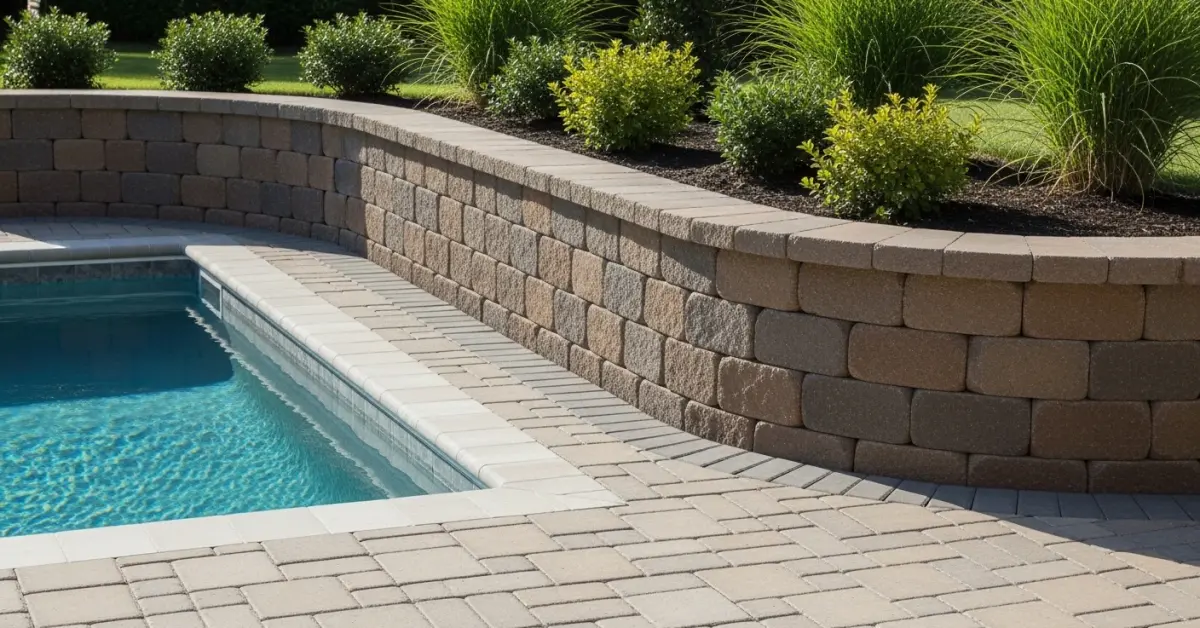
Paver Retaining Wall Osceola County: My Protocol for Eliminating Hydrostatic Pressure Failure
I’ve rebuilt more leaning paver retaining walls in Osceola County than I can count, and the culprit is almost always the same: a failure to manage Florida’s torrential rain and sandy soil. Most contractors use a standard base depth that simply can't handle the hydrostatic pressure that builds up after a typical Kissimmee afternoon thunderstorm. This leads to bulging, shifting, and eventual collapse within a few years. My entire approach is built around defeating this single point of failure. It starts with a base that's at least 50% deeper than the industry standard and incorporates a multi-layered drainage system designed specifically for the poor-draining soils we have from Celebration to St. Cloud. This isn't just about building a wall; it's about engineering a structure that remains perfectly plumb for decades, not just a few seasons.My Diagnostic Framework for Osceola's Unique Soil and Water Challenges
Before a single paver is laid, my process begins with a site analysis that goes far beyond simple measurements. I learned this the hard way after a project in a newer Harmony development where the soil composition varied dramatically across a single 50-foot stretch. The standard approach would have resulted in uneven settling. My methodology now involves a soil-specific assessment to prevent such failures. I focus on two critical factors unique to Osceola County properties. First is the soil percolation rate. Our notorious "sugar sand" seems like it would drain well, but it often sits atop a less permeable layer, creating a bathtub effect behind the wall. Second, I map the surface water flow during peak rain events. A beautiful terraced garden in a Poinciana backyard can inadvertently channel thousands of gallons of water directly against the wall's base if not properly accounted for. I identify these risks upfront to engineer the drainage system correctly from the start.Decoding Sandy Soil Compaction and Base Material Selection
This is where most projects go wrong. A 4-inch base of crushed concrete might work in clay soil, but in our sandy conditions, it's a recipe for disaster. My non-negotiable standard for any load-bearing retaining wall in this county is a 6-inch compacted aggregate base, minimum. For walls over 3 feet or those supporting a driveway, I increase this to 8 or even 10 inches. I insist on using a specific grade of clean, crushed stone (like #57 stone) for the primary base, as it compacts tightly yet allows for excellent drainage. The key is achieving a compaction level of at least 95% Standard Proctor Density. I personally check this with a dynamic cone penetrometer on site. This step prevents the subtle, long-term settling that causes the top courses of a wall to separate and lean. It’s an extra step, but it’s the difference between a 5-year wall and a 30-year wall.The Step-by-Step Implementation for a Zero-Failure Wall
Building a structurally sound paver wall is a sequence of critical actions. Missing or rushing a single step compromises the entire structure. This is the exact process I follow on every single project, from small garden walls to large, engineered structures.- Excavation and Trenching: I excavate a trench that is wide enough for the block plus at least 6 inches of drainage stone behind it and 6 inches in front of the base course. The depth is calculated to accommodate the full base material plus at least half the height of the first block buried below grade.
- Base Installation and Compaction: The aggregate base material is laid in 2- to 3-inch lifts. Each lift is moistened and compacted with a mechanical plate compactor until my density target is met. This is the most physically demanding part of the job, and it's absolutely crucial.
- Laying the Base Course: The first row of blocks is the most important. I use a transit level to ensure it is perfectly level side-to-side and front-to-back. An unlevel first course guarantees a flawed wall. I spend more time on this single course than on any other.
- Backfilling and Drainage: As each course is added, I backfill with clean drainage aggregate, not the native sandy soil. A perforated drain pipe is installed at the base, pitched to daylight away from the wall, to relieve all hydrostatic pressure.
- Geogrid Reinforcement: For any wall approaching 4 feet in height, or any wall with a slope or structure behind it, I integrate geogrid reinforcement. I learned on a large project near Lake Toho that failing to extend the geogrid far enough into the backfill makes it useless. My rule is the grid length must be at least 70% of the wall's total height.
- Capping and Sealing: The final step is securing the capstones with a high-strength concrete adhesive. This not only provides a finished look but also locks the top course together, adding significant structural integrity.
Precision Adjustments for Drainage and Geogrid Layers
The details make all the difference. I always encapsulate the entire drainage aggregate zone with a non-woven geotextile fabric. This fabric acts as a filter, preventing the surrounding sand and soil from migrating into the clean stone and clogging the drainage system. I saw a two-year-old wall in Kissimmee fail precisely because this fabric was omitted; the drainage zone was a solid block of mud. Furthermore, the placement of geogrid is a science. It should be laid flat and pulled taut, with the next course of blocks providing the tension. I see many installers leave slack in the grid, which completely negates its reinforcement capability. For taller walls, I vary the length and frequency of the geogrid layers based on soil engineer specifications, ensuring the reinforcement is strongest where the pressure is greatest. Are you certain your wall's design accounts for the specific surcharge loads of your property, or is the base depth simply a standardized guess?Written by

Tags
landscape paver retaining wall
landscape pavers retaining wall
patio paver wall
paver walls landscaping
paver block retaining wall
Paver Retaining Wall in Osceola FL FAQ
My paver retaining wall is leaning towards my pool. Is this an emergency?
Yes, a leaning wall is a sign of imminent failure and requires immediate attention to prevent catastrophic damage to your pool's structure. The pressure from a collapsing wall can easily crack a concrete pool shell or buckle the wall of a vinyl liner pool, leading to repairs costing thousands. This is often caused by failed geogrid reinforcement or improper soil compaction during the initial build. Do not attempt to push it back; the weight is immense. Cordon off the area and call a structural specialist, as the surcharge load from the soil and water is likely exceeding the wall's design capacity.
How close to my pool can I safely build a paver retaining wall?
A paver retaining wall should be built no closer than its own height from the pool's edge to avoid compromising the pool's structural integrity. For example, a 4-foot high wall must be at least 4 feet away from the pool shell. Placing it too close creates a massive surcharge load on the soil, which can exert enough lateral pressure to crack a gunite pool or bulge a fiberglass wall over time. This rule of thumb ensures the zone of influence from the wall's footing and the pool's structure do not dangerously overlap, preventing long-term stress and potential failure.
Water is weeping through the face of my paver wall after it rains. Is this normal?
Weeping is a sign that your wall's drainage system is overwhelmed or was improperly installed, and it is not a normal or desirable condition. A properly constructed wall uses a perforated pipe at the base and at least 12 inches of clean gravel backfill to channel water away, preventing hydrostatic pressure from building up. When water pushes through the face, it carries fine soil particles with it, creating voids behind the wall that lead to settling and eventual collapse. This is a critical issue that compromises the wall's stability and must be addressed by improving the drainage.
Can I use the same pavers for my pool deck and the retaining wall?
While you can use pavers from the same product family for aesthetic consistency, you cannot use thin deck pavers to build the actual retaining wall structure. Retaining walls require solid, heavy, interlocking segmental retaining wall (SRW) blocks designed to handle immense lateral earth pressure. Deck pavers are thinner, lack the interlocking mechanisms, and would quickly fail. You can, however, use matching capstones or even adhere a thin paver veneer to the face of a properly built block wall, but the core structure must be made from purpose-built SRW units.
Do I need a concrete footing for a paver retaining wall next to a pool?
No, a paver retaining wall must be built on a compacted gravel base, not a rigid concrete footing. A concrete footing does not allow for drainage and can trap water, leading to frost heave in colder climates that will destroy both the wall and potentially the nearby pool plumbing. The proper foundation is a trench filled with compacted aggregate, typically extending 6 inches deep and 12 inches wider than the base block. This flexible footing allows water to drain freely and lets the entire wall system settle uniformly without creating stress points.
What is the most common mistake that causes a paver wall near a pool to fail?
The single most common failure is inadequate or completely absent geogrid reinforcement within the backfill. Many builders treat a 4-foot wall near a pool the same as a 2-foot garden wall, but the proximity to the pool and saturated soil changes everything. Geogrid is a synthetic mesh laid in layers between the blocks and extending several feet back into the soil, effectively tying the wall to the earth behind it. Without it, the wall is just a heavy facade waiting for a single heavy rainstorm to push it over, with your pool being the first thing it falls into.


