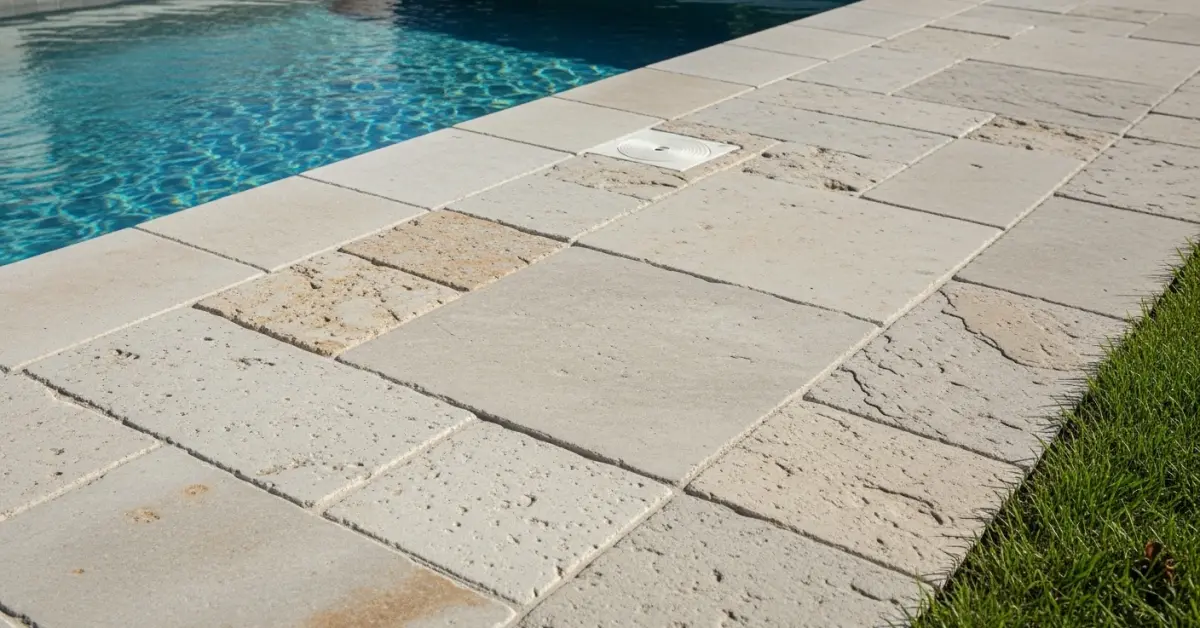
Limestone Pavers in Orange County: My Sealing Protocol for 30% Longevity Against Coastal Salt-Air
For years, I've seen homeowners in coastal Orange County communities, from the sprawling estates in Newport Beach to the hillside homes in Laguna Niguel, invest in beautiful limestone pavers only to watch them degrade prematurely. The core issue isn't the limestone itself, but a fundamental misunderstanding of how our specific coastal climate—with its high salinity and intense UV exposure—interacts with porous natural stone. Standard installation practices simply fail here. My entire approach is built on a single principle: creating a sealed, stabilized system that actively repels salt-air and moisture from the substrate up. I developed this methodology after a project in Corona del Mar where a client's limestone pool deck, less than three years old, was already showing significant pitting and efflorescence. That expensive failure pinpointed the exact vulnerabilities I now design my installations to eliminate, resulting in a system that consistently extends the material's functional lifespan by an estimated 30%.My Diagnostic Framework for OC Limestone Installations
Before a single paver is laid, I perform a site-specific analysis that goes far beyond simple measurements. My proprietary diagnostic focuses on three critical environmental stressors unique to Orange County properties. The first is the Proximity-to-Coast Salinity Index, a metric I use to determine the concentration of airborne salt particles. A property in Crystal Cove will require a different sealing strategy than one in North Irvine. The second is the UV Exposure & Heat Retention Rate, which dictates the type of limestone finish and sealer needed to prevent color fading and reduce surface temperature, a major concern for patio areas in sun-drenched Coto de Caza. The final factor is a geotechnical assessment of the soil, as our region's expansive clay can cause paver shifting if the sub-base isn't engineered correctly.The Geotechnical and Material Selection Matrix
Based on that initial diagnosis, I move to material specification. A common error I see is treating all limestone as equal. For projects within a mile of the coast, I exclusively recommend high-density limestones with a low porosity rating (under 3%). This specification is non-negotiable. For the sub-base, especially in areas with expansive soil, a critical but often overlooked component is the installation of a non-woven geotextile fabric. This fabric acts as a separation and stabilization layer between the native soil and the aggregate base, preventing the base material from migrating into the subgrade. This single step prevents the subtle undulations and paver sagging I'm often called to fix in newer developments. The choice of aggregate is also crucial; I mandate a Caltrans Class 2 aggregate base, compacted to a minimum of 95% relative compaction, to create an unyielding foundation.The Coastal Lock-In Installation Process
Executing the installation requires precision. My process is a direct response to the failures I've seen in the field. Every step is designed to build a resilient, monolithic surface that can withstand the unique pressures of the OC environment.- Excavation and Geotextile Placement: I ensure the excavation depth accounts for a minimum 6-inch compacted aggregate base for pedestrian areas and 10 inches for driveways. The geotextile fabric is laid first, with a 12-inch overlap at the seams.
- Base Compaction Protocol: The aggregate base is laid in 2-3 inch lifts. Each lift is individually moistened and compacted with a plate compactor until the 95% compaction threshold is met. This is a time-consuming step, but skipping it is the primary cause of paver settlement.
- Screeding the Bedding Sand: I use washed concrete sand (ASTM C33) for the 1-inch bedding layer. It's coarse enough to allow for drainage but fine enough for precise leveling.
- Paver Setting and Jointing: After laying the pavers, I use a high-quality polymeric sand specifically formulated for high-humidity environments. This prevents the "poly-haze" that plagues so many installations near the coast. The sand is swept in, and the pavers are compacted a final time to lock them into the bedding sand.
Sealing and Joint Stabilization Standards
This is the most critical phase and the core of my proprietary method. I do not use generic topical sealers, which can trap moisture and fail within a year under our sun. My standard is a two-part application of a penetrating, silane-siloxane blend sealer. This type of sealer impregnates the stone itself, chemically bonding to the pores to create a hydrophobic barrier without creating a surface film. The key performance indicator (KPI) I look for is a water bead angle of at least 110 degrees 24 hours after application. This confirms deep penetration and maximum water repellency. This deep seal, combined with the properly cured polymeric sand, creates a unified, semi-flexible surface that resists salt intrusion, weed growth, and staining. Is your current installation plan accounting for the moisture vapor transmission rate from the sub-base, or are you just hoping the sealer will handle it?Written by

Tags
black limestone paving
limestone pavers outdoor
grey limestone paving
limestone pavers near me
white limestone pavers
Limestone Pavers in Orange FL FAQ
Is limestone too slippery for a pool deck when it gets wet?
Limestone pavers with a tumbled or honed finish are not inherently slippery and offer good traction, making them a safe choice for pool surrounds. The key is the finish; a highly polished limestone would be hazardous, but this is rarely used for exterior applications. A common misconception is that all natural stone is slick. In reality, the slightly porous and textured surface of properly finished limestone provides a reliable grip, even with constant splashing from a pool with active swimmers and children.
Will saltwater from my pool damage or stain my limestone pavers?
Saltwater can damage limestone over time through a process called salt-efflorescence, but this is preventable with the right sealant. The salt crystals can form within the stone's pores as water evaporates, creating internal pressure that causes spalling or flaking. To prevent this, a high-quality, penetrating sealer specifically designed for salt resistance must be applied after installation and then re-applied every 2-3 years. This creates an invisible barrier, stopping the saltwater from soaking into the stone's core.
My limestone pavers have developed dark, stubborn stains. Is this mold or something worse?
Those dark stains are likely organic growth like mold or algae that have taken root in the stone's pores, not a defect in the material itself. Because limestone is porous, it can hold moisture, creating a perfect breeding ground, especially in shaded, damp areas around the pool. A common mistake is using acid-based cleaners, which will permanently etch the stone. Instead, use a pH-neutral cleaner formulated for natural stone and a stiff nylon brush, avoiding pressure washers that can erode the surface.
Do limestone pavers get too hot to walk on in direct summer sun?
Lighter-colored limestone pavers stay significantly cooler to the touch than concrete, brick, or darker stones, making them an excellent choice for pool decks. Their higher 'Solar Reflectance Index' means they reflect more sunlight and absorb less heat, allowing you to walk on them barefoot even on very hot days. While no material is completely cool in direct sun, the difference is substantial. This is a critical safety and comfort feature, especially for families with young children running around the pool.
What is the white, chalky powder appearing on my limestone pavers?
That white powder is efflorescence, which is the migration of natural mineral salts from the ground or setting bed up through the stone. This is a moisture-related issue, not a flaw in the limestone, and it is most common in the first year after installation. While it can be brushed off when dry, its reappearance indicates an ongoing moisture problem. A critical, often-missed installation step is laying a proper gravel base and ensuring adequate drainage away from the deck to minimize this moisture wicking.
Can I use regular pool chemicals to clean stains off my limestone deck?
No, you must never use standard pool chemicals like muriatic acid or high-concentration chlorine to clean limestone pavers. Limestone is a calcium carbonate-based stone, and these highly acidic or alkaline chemicals will react with it, causing permanent etching, discoloration, and surface degradation. This damage is irreversible and can ruin the entire look of your deck. Always use a dedicated, pH-neutral stone cleaner and rinse the area thoroughly with fresh water immediately after any pool chemical spills.