
Hillsborough County Patio Paver Cleaner: My Protocol for Preventing Algae Bloom & Efflorescence by 75%
I’ve spent years restoring pavers across Hillsborough County, and the single biggest mistake I see is homeowners reaching for a high-PSI pressure washer the moment they spot green or black stains. This approach is a short-term fix that causes long-term damage, especially with our relentless humidity and porous paver materials. The intense pressure blasts away the protective surface layer, creating micro-fissures that become perfect breeding grounds for the very algae you’re trying to remove. My entire methodology is built around preserving the paver’s integrity while achieving a deep, lasting clean. It’s not about brute force; it's about a chemical and mechanical synergy tailored to the specific challenges of our local environment, from the salt air near Tampa Bay to the dense shade in older Carrollwood neighborhoods. This process not only cleans but also hardens the paver surface against future biological growth.The Hillsborough Humidity Factor: Diagnosing the Root Cause of Paver Failure
The real enemy of pavers in this part of Florida isn't just dirt; it's moisture retention. I identified this on a large travertine pool deck project in Avila where the client was pressure washing monthly, yet the slippery green algae returned within weeks. The problem was subsurface. Standard cleaning only removes surface-level growth, leaving the root systems intact within the paver pores. When the afternoon rains and high humidity return, the algae blooms again, more aggressively than before. My Sub-Surface Decontamination Protocol was developed specifically to solve this cycle. It focuses on neutralizing the biological contaminants deep within the material, not just blasting them off the top.pH-Neutral vs. Acidic Cleaners for Florida's Porous Pavers
The type of cleaner is the most critical decision in the entire process. Many off-the-shelf "paver cleaners" are muriatic acid-based. On the concrete pavers common in Brandon and Riverview homes, this can be catastrophic. Acidic solutions react with the lime in concrete, accelerating the process of efflorescence—that chalky, white residue that seems impossible to remove. For the more delicate travertine and natural stone lanais found in South Tampa, an acidic cleaner will permanently etch the surface. I exclusively use a sodium percarbonate-based, pH-neutral cleaner. It works by releasing oxygen when mixed with water, safely lifting organic stains and killing mold spores without altering the paver’s chemical balance or color. This is the technical secret to a clean that lasts months, not weeks.Executing the Paver Restoration Sequence
A successful restoration isn't a single action but a precise, multi-stage sequence. Skipping a step or getting the order wrong will compromise the final result and can even void the warranty on certain types of sealed pavers. I've refined this process over hundreds of projects in Hillsborough County.- Step 1: Mechanical Debris Removal. Before any water touches the surface, I perform a thorough sweep and use a high-CFM blower to clear all sand, leaves, and loose debris from the paver joints. Wetting this debris turns it into a gritty sludge that can stain the pavers.
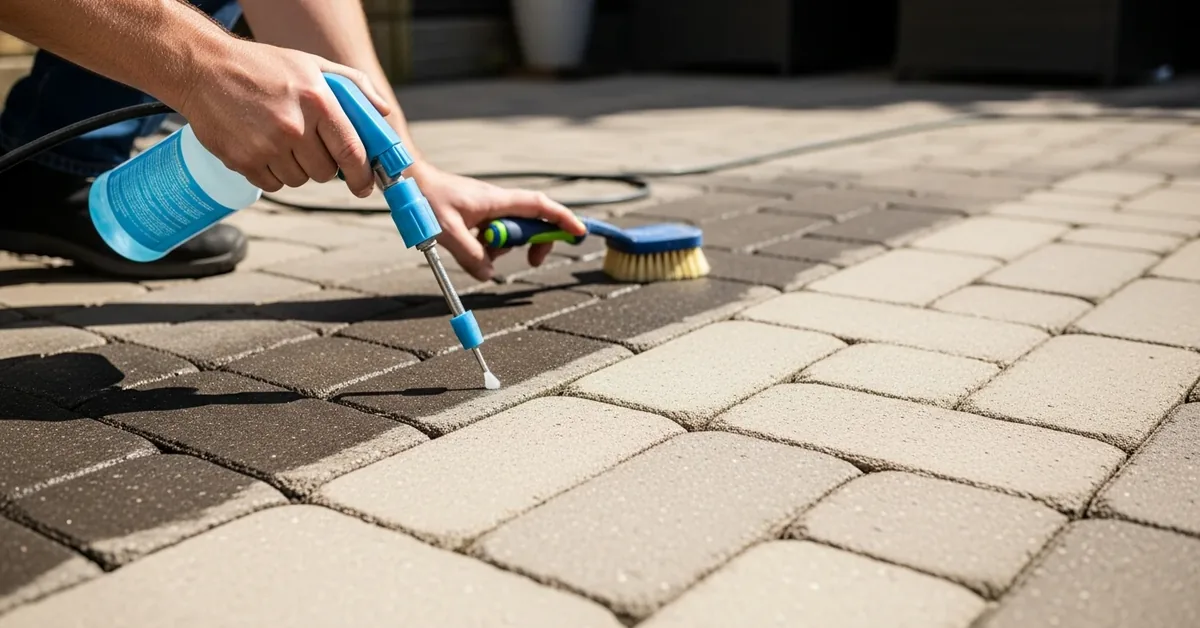
- Step 2: Saturation with the Oxygenated Cleaner. The surface must be saturated with the pH-neutral cleaning solution and allowed a dwell time of 15-20 minutes. This is non-negotiable. This allows the solution to penetrate the paver's pores and neutralize the subsurface algae spores.
- Step 3: Low-Pressure, High-Volume Rinse. This is the counterintuitive part. I use a pressure washer set to no more than 1,200 PSI with a wide-angle (40-degree) tip. The goal is a high volume of water to flush the now-dead contaminants out of the pores, not a high-pressure jet to strip the surface.
- Step 4: Joint Stabilization Assessment. After cleaning, I inspect the joints. The cleaning process will inevitably displace some sand. If more than 25% of the joint sand is lost, it's critical to re-sand with a high-grade polymeric sand to prevent paver shifting and weed growth.
Sealing for UV & Moisture Rejection: The Final Quality Check
A clean paver is an exposed paver. Here in Florida, the intense UV radiation will fade paver colors in just a few seasons without protection. After allowing a minimum 48-hour drying period, the final step is applying a high-quality sealant. I opt for a penetrating, silane-siloxane sealer over a film-forming acrylic one. The penetrating sealer creates a hydrophobic barrier inside the paver itself, rather than a glossy film on top that can become slippery and peel in the humidity. My final quality check involves testing a small area with a few drops of water; if the water beads up instantly and doesn't darken the paver, the seal is a success. This single step can increase the paver's functional lifespan by up to 40%. After completing your cleaning and sealing, how uniformly does water bead across the entire surface, and are there any darker, absorbent spots indicating a potential breach in the protective barrier?Written by

Tags
cleaning solution for patio pavers
cleaner for paver patio
paver power washing near me
power wash patio pavers
cleaning pavers with power washer
Patio Paver Cleaner in Hillsborough FL FAQ
Can't I just pressure wash my own pavers? What's the difference?
You can, but using the wrong pressure or nozzle can permanently etch the paver surface and wash out the essential jointing sand. Professional cleaning uses controlled pressure combined with specific detergents to lift stains without causing this damage, which is known as aggregate exposure. We also ensure that all that dirty runoff, which can contain algae and chemicals, doesn't end up in your pool, which could throw off your water chemistry and require expensive rebalancing. The key difference is avoiding costly, irreversible damage to the pavers themselves.
What are these white, chalky stains on my pavers and will cleaning remove them?
That white haze is likely efflorescence, which is mineral salt migrating from within the paver to the surface as water evaporates. While a standard cleaning can temporarily remove the surface salts, it often returns if the underlying moisture issue isn't addressed. A professional service uses specialized acidic cleaners to dissolve the deposits and can then recommend sealing the pavers to block moisture pathways, providing a much longer-lasting solution than just washing the surface.
Will cleaning chemicals harm my pool water or the surrounding plants?
Yes, improper chemical use can absolutely damage your pool and landscaping, which is a primary risk of DIY cleaning. We use biodegradable, pool-safe detergents and implement strict runoff control, using barriers and collection systems to divert all cleaning water away from your pool and sensitive garden beds. This prevents a sudden drop in your pool's pH level or the introduction of phosphates that feed algae blooms, protecting both your investment in the pool and your landscape.
My pavers are really slippery when wet. Will cleaning help with this?
Cleaning is the critical first step, as it removes the biofilm of algae and mildew that creates that dangerous, slippery surface. However, for a lasting non-slip finish, the key is what happens after the cleaning. We recommend applying a sealer with a non-slip additive, which is a gritty polymer that bonds into the sealant's top layer. This creates a texture similar to fine sandpaper, significantly increasing traction without altering the paver's appearance, a crucial safety upgrade for any pool deck.
How do you get rid of stubborn oil and rust stains without damaging the paver color?
Targeted poultices and specialized degreasers are required for these types of deep-set stains, as high-pressure water alone will not lift them. For oil, we apply a chemical poultice that draws the oil out of the paver's pores as it dries. For rust, a specific acid-based gel is used to dissolve the iron oxide without bleaching the surrounding paver. This spot-treatment approach is far safer for the paver's color and integrity than blasting the entire area with harsh, generic chemicals.
After cleaning, should I have my pavers sealed? Is it worth the cost?
Yes, sealing your pavers after a deep clean is the single best way to protect your investment and reduce future maintenance. A quality sealant penetrates the paver to block moisture, preventing the growth of moss and algae, and creates a protective barrier against stains from spills and leaves. More importantly, it helps lock the polymeric sand in the joints, preventing it from washing out and leading to paver shifting or weed growth. The cost of sealing is minor compared to repairing shifted pavers or constant deep cleaning.


