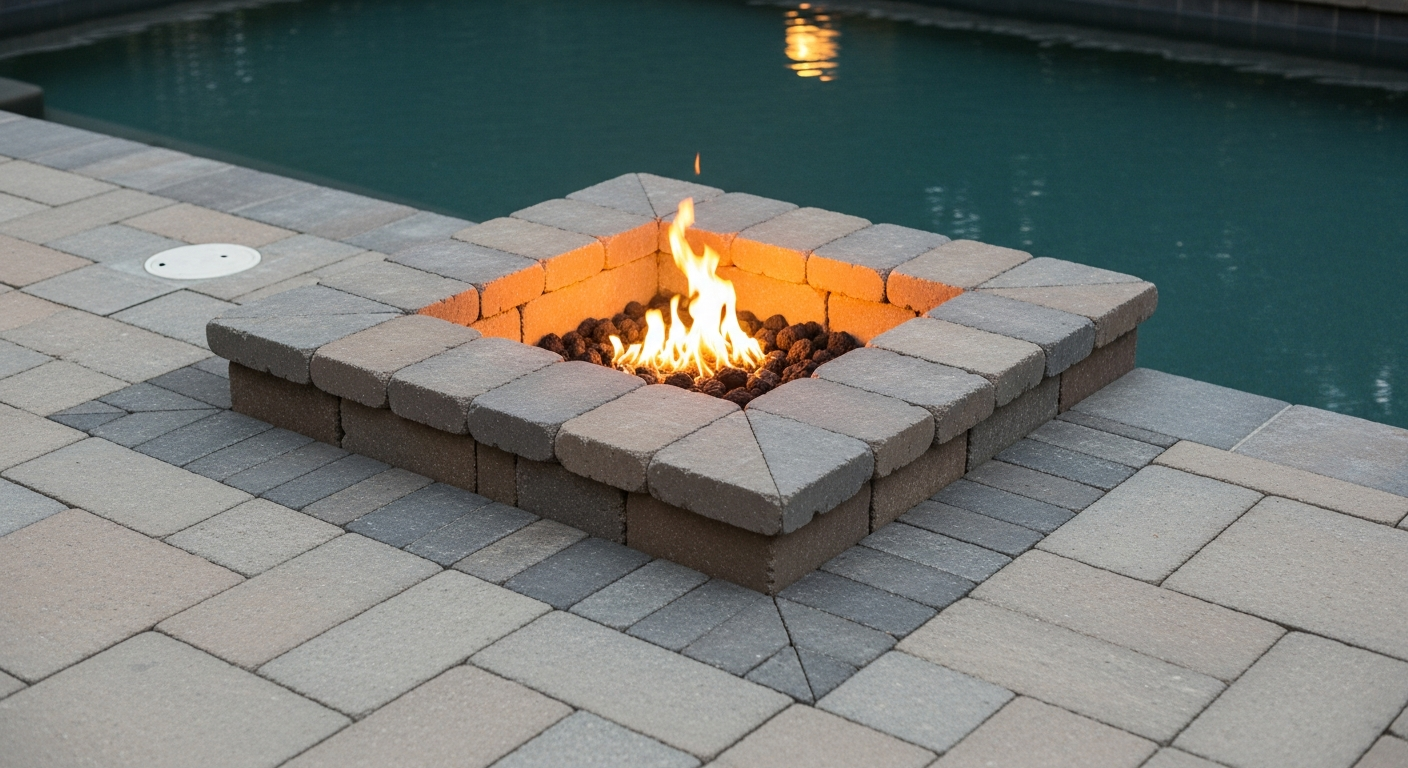
Paver Stone For Fire Pit: My Protocol to Eliminate Thermal Spalling Risk
When I get called to inspect a failed fire pit project in Hillsborough County, the root cause is almost always the same. The homeowner, or even a less-experienced contractor, used standard concrete patio pavers for the entire structure. This is a critical error. Standard pavers, the kind you see in driveways in Tampa Palms or on patios in Brandon, are not rated for the direct, intense heat of a fire. The trapped moisture inside the concrete turns to steam and expands, causing the paver to crack or violently explode—a phenomenon known as thermal spalling. My approach isn't just about avoiding this failure; it's about engineering a fire feature that withstands our specific Florida climate—from the intense summer sun to the torrential downpours. The key is to stop thinking of the fire pit as one single structure and to start treating it as a system of three distinct thermal zones. This granular view is what separates a fire pit that lasts three years from one that lasts twenty.Diagnosing the Core Failure: My Hillsborough Thermal Zone Methodology
After seeing a catastrophic failure on a high-end project in South Tampa where the entire inner wall of a fire pit crumbled after one season, I developed what I call the Hillsborough Thermal Zone Method. It's a simple framework for material selection based on proximity to the heat source. Most guides miss this nuance, leading to material mismatch and inevitable structural failure. The entire safety and longevity of your fire pit hinges on correctly specifying materials for each zone.A Technical Deep-Dive into the Three Zones
My methodology breaks the fire pit down into three critical areas, each with its own material requirements:- Zone 1: The Inner Wall (Direct Contact Zone). This is the area that faces the fire directly. Standard concrete pavers have a zero-percent success rate here. You have two professional-grade options: install a heavy-gauge steel fire pit ring insert to act as a heat shield, or build the inner wall with fire brick (also known as refractory brick) and high-heat mortar. Fire brick is specifically designed to withstand and dissipate extreme temperatures without spalling. Using anything else is a non-starter.
- Zone 2: The Capstone (Transition Zone). This is the top ledge of the fire pit wall. It gets hot, but not as intensely as the inner wall. Here, you need a material with higher density and thermal resistance than standard patio pavers. I often specify dense natural stones like granite or slate, or a high-PSI (pounds per square inch) wet-cast concrete paver specifically rated for capstone use. This piece provides both a critical thermal buffer and a finished aesthetic.
- Zone 3: The Surround Patio (Ambient Zone). This is the patio area around the fire pit. Here, standard, high-quality concrete pavers are perfectly acceptable. The main challenge in Hillsborough County for this zone isn't heat, but our sandy soil and water. Proper base preparation is non-negotiable to prevent pavers from sinking and shifting during our rainy season.
Implementation Protocol for a Zero-Failure Fire Pit Surround
Building a fire pit surround that won't sink or separate in our local soil requires a rigorous approach to the base construction. I've refined my process over years of working on projects from Lutz to Riverview, and it all comes down to controlling water and ensuring maximum compaction.- Step 1: Base Excavation. For our sandy soil, I mandate a minimum excavation of 7 to 8 inches for the paver surround. This is deeper than in clay-based soils and is crucial for stability.
- Step 2: Geotextile Fabric. Before any aggregate is laid, I install a geotextile separation fabric. This is a "pulo do gato" many skip. It prevents the aggregate base from mixing with the sand below over time, which is the primary cause of paver sinking in Florida.
- Step 3: Aggregate Base & Compaction. I use a 4- to 5-inch layer of #57 stone, compacted in 2-inch lifts (layers) with a plate compactor. Each lift must be compacted until the machine starts to bounce. This achieves a 98% compaction rate, which is the professional standard.
- Step 4: Bedding Sand & Paver Laying. A 1-inch layer of clean concrete sand is screeded (leveled) for the pavers to be laid upon.
- Step 5: Joint Stabilization. After the pavers are set, the final critical step is sweeping in polymeric sand into the joints. Given our frequent Hillsborough downpours, regular sand will wash out in a single storm. Polymeric sand hardens and locks the pavers together, preventing weeds and erosion.
Precision Adjustments and Quality Standards for Florida's Climate
To truly master a Hillsborough County installation, two final adjustments are critical. First, when activating the polymeric sand, you must use a specific "shower" setting on your hose nozzle and blow off all excess sand from the paver surface immediately. Failure to do so results in polymeric haze, a permanent white film that ruins the look of the pavers. I've been called to fix this specific, amateur mistake more times than I can count. Second, consider a penetrating, non-film-forming sealer. In our humid environment, film-forming sealers can become incredibly slippery when wet—a major safety hazard around a fire. A penetrating sealer soaks into the paver itself, protecting it from stains without creating a slick surface film. This increases the paver's service life by at least 25%. Now that you understand the material science and base construction, have you considered how the prevailing wind direction in your specific neighborhood will affect smoke patterns and seating placement?Written by

Tags
backyard pavers with fire pit
paver fire pit area
outdoor fire pit pavers
outdoor fire pit with pavers
paver patio with fire pit