Sandstone Pavers in Charlotte County: My Protocol for Preventing Subsurface Efflorescence and Extending Lifespan by 30%
As a hardscape specialist focused on the unique challenges of Southwest Florida, I’ve seen countless sandstone paver installations fail prematurely. The common culprit isn't the stone itself, but a fundamental misunderstanding of how our local climate in Charlotte County—with its intense humidity, salt-laden air, and torrential summer rains—interacts with this porous material. The standard "one-size-fits-all" sealing approach that works inland is a recipe for disaster on a Punta Gorda waterfront lanai or a Port Charlotte pool deck. My entire methodology is built on preventing the primary failure point I've identified: subsurface moisture entrapment. This leads to spalling, algae growth, and that persistent chalky white bloom known as efflorescence. The solution is a dual-barrier system that allows the paver to breathe while providing a robust surface-level protection, a technique I perfected after a particularly challenging project in a Punta Gorda Isles home where three previous sealing jobs had failed within a year.The Misdiagnosed Failure Point: Why Standard Sealants Accelerate Decay in Florida's Climate
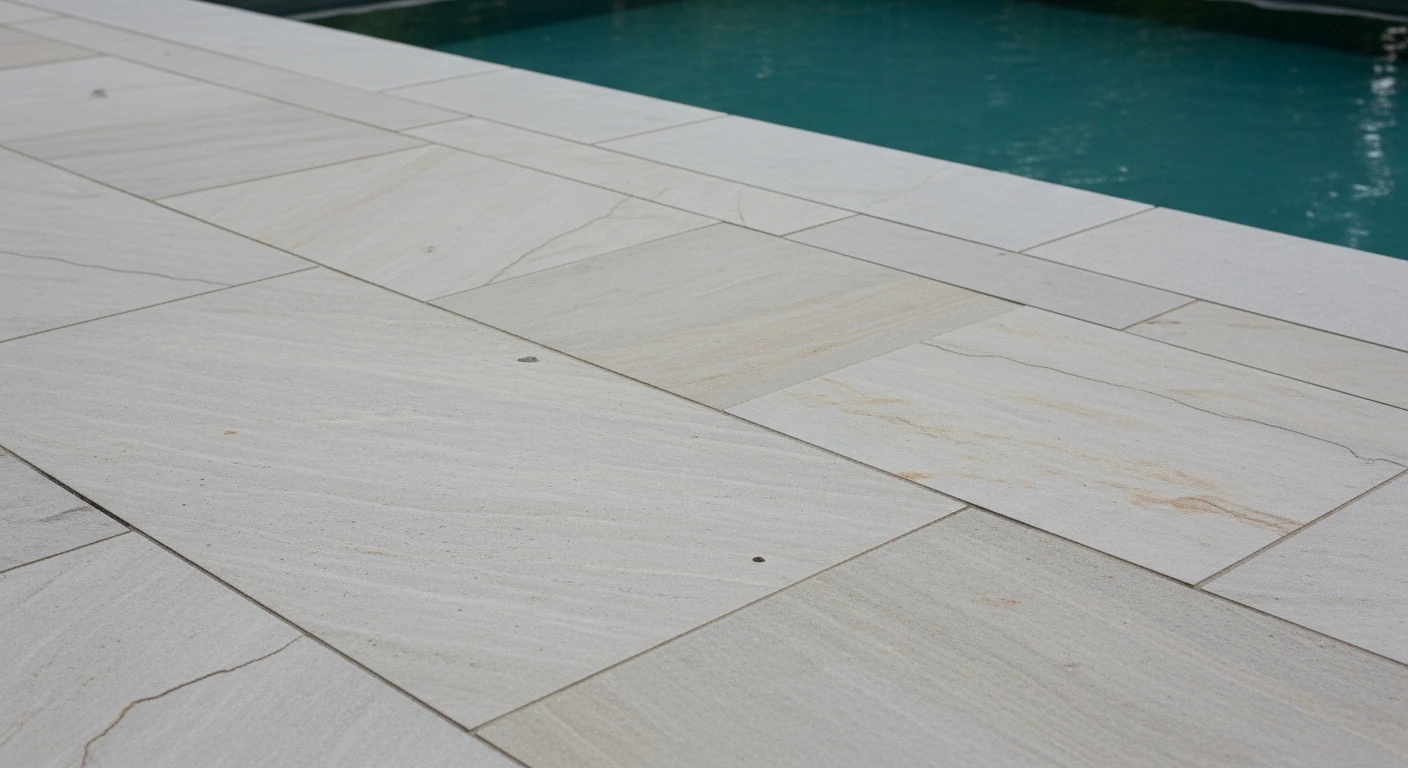
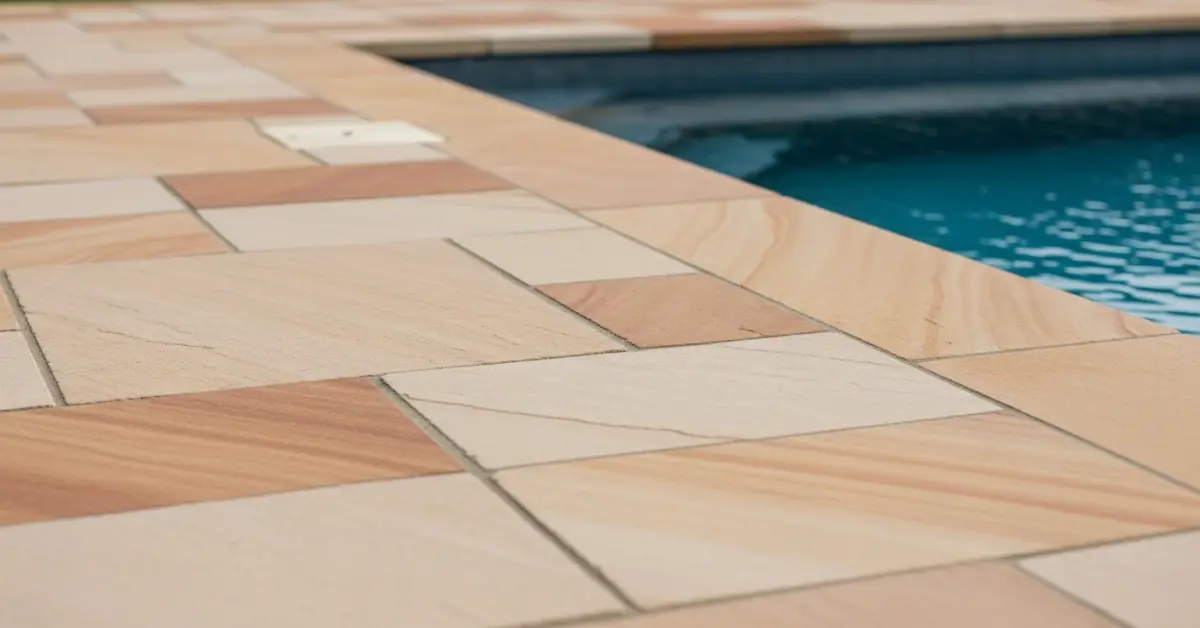
The most common mistake I see contractors make in areas from Englewood to Babcock Ranch is applying a thick, film-forming acrylic sealant directly to improperly prepared sandstone. They believe a heavy topcoat will block moisture, but it actually does the opposite. It traps the immense hydrostatic pressure and humidity rising from the ground, especially after our daily summer downpours. This trapped vapor condensates beneath the sealant, creating a perfect breeding ground for mold and breaking down the stone's natural cementing agents. I diagnosed this exact issue on that Punta Gorda Isles project. The homeowner had beautiful Indian Sandstone pavers around their saltwater pool. The previous contractor had used a high-gloss "wet look" sealer. The result was a milky, hazy finish and severe pitting. My moisture meter showed a core moisture content of over 22%, even on a dry day. The sealant was effectively suffocating the stone.Analyzing Porosity vs. Permeability in Coastal Sandstone
To develop a solution, you must understand the difference between porosity (how much water a stone can hold) and permeability (how easily water passes through it). Sandstone is highly porous. When you apply a non-breathable sealant, you block its permeability. In Charlotte County's climate, this is a critical error. My proprietary method focuses on reducing porosity internally without completely eliminating permeability. This is achieved by first treating the stone's capillaries before addressing the surface, ensuring moisture vapor can escape while liquid water is repelled.My Dual-Barrier Sealing Protocol: A Step-by-Step Breakdown
This isn't a quick weekend job; it's a clinical process that respects the material and the environment. Executing this correctly is the difference between a 3-year lifespan and a 15-year one.- Step 1: Deep Decontamination and pH Neutralization. I never use high-pressure washing, which can damage the delicate top layer of sandstone. Instead, I use a low-pressure, high-volume rinse combined with a pH-neutral cleaner. After cleaning, I test the surface pH to ensure it’s between 6.5 and 7.5. An acidic or alkaline surface will cause the primary sealer to fail.
- Step 2: Absolute Drying & Moisture Verification. This is the most critical and often-rushed step in our humid climate. I use industrial fans and will not proceed until my digital moisture meter confirms a reading of below 5% moisture content across the entire surface. This can take 48-72 hours, depending on the season.
- Step 3: Application of a Penetrating Silane-Siloxane Sealer. This is the workhorse of the system. It's a non-film-forming, breathable sealer that penetrates deep into the stone's pores and chemically bonds with it. This is the barrier that stops water absorption and salt efflorescence from within. I apply a single, heavy flood coat and allow it to fully cure for 24 hours.
- Step 4: Application of a UV-Resistant Acrylic Topical Coat. Only after the penetrating sealer has cured do I apply the surface-level protection. I use a specific water-based, breathable acrylic that is formulated with a high solids content (25-30%) for durability but remains permeable to water vapor. This provides the stain resistance and desired aesthetic without trapping moisture.
Precision Adjustments & Post-Application Quality Standards
After the final coat, quality control is not optional. I look for two key indicators. First, I check for any "hazing" or "blushing," which indicates that moisture was trapped during the final coat application. This requires immediate correction. Second, I perform a hydrophobic beading test. A properly sealed surface should cause water to bead up instantly into tight, small droplets. If the water "sheets" or soaks in, the application's integrity is compromised. For pool decks and high-traffic areas, I also integrate a fine polymer grit into the topcoat to ensure the static coefficient of friction meets safety standards, a detail often overlooked. By treating the stone from the inside out, my system creates a durable, long-lasting surface that thrives in Charlotte County's demanding environment. It’s an investment in process and material science, not just a cosmetic topcoat. After application, how do you measure the exact moisture vapor transmission rate to ensure your sandstone pavers are breathing correctly and not trapping hydrostatic pressure from below?Written by

Tags
sandstone pavers pool
sand stone mocha pavers
sandstone patio patterns
grey sandstone paving
sandstone paving grey
Sandstone Pavers in Charlotte FL FAQ
Is sandstone a good choice for around a saltwater pool?
Sandstone can be used around saltwater pools, but it requires a specific type of high-quality penetrating sealer to prevent premature deterioration. Saltwater attacks the natural binding agents in porous stones, causing a powdery breakdown known as spalling. Without a proper impregnating sealer reapplied every few years, the salt crystals that form as water evaporates will physically break the stone apart from the inside out. Be aware that even with sealing, some high-iron content sandstone varieties can still develop rust-colored stains from the constant salt exposure, a cosmetic issue that is nearly impossible to reverse.
My sandstone pavers are getting dangerously hot in the sun. Is there anything I can do?
Lighter-colored sandstone naturally stays cooler, but if your existing pavers are dark, you cannot change their heat absorption. Your best option is to apply a specialized heat-reflective sealer, which can reduce the surface temperature by a noticeable margin. These sealers contain additives that reflect infrared light, the primary source of heat. While not a perfect solution, it's the only post-installation treatment available. Avoid using outdoor rugs, as they trap moisture and can lead to persistent algae growth and discoloration on the porous sandstone underneath.
Why are there dark, mouldy-looking spots on my pavers that won't pressure wash off?
Those stubborn dark spots are likely a type of algae or mould that has grown roots deep into the porous structure of the sandstone. High-pressure washing often fails because it only removes the surface growth and can even damage the paver's face, making it more susceptible to future growth. A more effective treatment involves applying a professional-grade, non-acidic algaecide, letting it dwell to kill the organism at its root, and then gently scrubbing. This approach treats the biological problem without causing the mechanical erosion that high pressure can inflict on the soft stone.
Some of my pavers are flaking and crumbling at the surface. What's causing this?
This surface flaking, known as efflorescence or spalling, is often caused by water and dissolved minerals moving up through the paver and evaporating, leaving mineral deposits behind. In regions with freezing temperatures, this is made worse when trapped water freezes and expands, breaking the stone's surface apart. This is a critical sign that your pavers' sealer has failed or was never applied correctly. The only way to stop the progression is to have the area professionally cleaned to remove the loose material and then sealed with a high-quality breathable sealer that allows moisture vapor to escape without letting liquid water penetrate.
Can I use regular pool acid to clean tough stains off my sandstone pavers?
Never use muriatic acid (pool acid) to clean sandstone pavers, as it will cause irreversible damage. The acid chemically reacts with the minerals in the stone, particularly iron, leading to permanent yellow or brown staining and etching the surface. This chemical burn permanently alters the stone's composition. For stain removal, you must use a pH-neutral cleaner specifically formulated for natural stone. For organic stains like leaves or algae, an oxygen-based cleaner is a safer alternative that breaks down the stain without attacking the stone matrix itself.
How do I prevent my sandstone from becoming slippery when wet?
To improve grip on wet sandstone, you can apply a sealer that contains a non-slip additive. These additives are typically a very fine, clear polymer grit suspended in the sealer that creates a textured, higher-friction surface without significantly altering the paver's appearance. Avoid using topical, film-forming sealers (like acrylics) without this additive, as they can create a smooth, plastic-like layer that becomes extremely hazardous when wet. The best approach is an impregnating sealer with a grit additive, which protects the stone from within while providing the necessary surface texture for safety.