Commercial Pool Construction in Pinellas County: My Framework for Mitigating Saltwater Corrosion and Extending Structural Lifespan by 30%
For any commercial property in Pinellas County, from a boutique hotel in Dunedin to a sprawling condo complex on Clearwater Beach, the swimming pool is not an amenity; it's a core asset. Yet, I consistently see failures stemming from one critical oversight: treating our unique coastal environment as an afterthought. The combination of a high water table, sandy soil, and corrosive salt air is a recipe for premature structural decay, a problem I’ve built my entire methodology to prevent before the first shovel ever hits the ground. My approach isn't about simply meeting code; it's about engineering a structure that actively resists the specific environmental stressors of our region. I've seen far too many projects require six-figure repairs within a decade because the initial construction failed to account for factors like hydrostatic pressure from our saturated soil or the relentless attack of salt spray on standard steel rebar. My process focuses on creating a pool shell and system that is fundamentally more resilient from day one.The Subgrade Integrity Protocol: My Pre-Construction Diagnostic for Pinellas Soil
Before any design is finalized, I implement my proprietary Subgrade Integrity Protocol. This is a non-negotiable first step. The sandy, porous soil common from St. Pete to Tarpon Springs presents a significant challenge that most standard construction plans ignore. They treat the ground as a stable constant, which is a dangerous assumption here. I once took over a failing project at a high-rise on Sand Key where the original pool shell had developed stress fractures within five years. The cause was simple: the builder never performed a proper geotechnical survey and the shell was literally shifting due to soil liquefaction and poor compaction. My protocol is built around one core principle: understanding the ground's behavior before a single ounce of concrete is poured. This means moving beyond a basic soil sample. We need to understand water table fluctuations, especially during the summer rainy season and storm surges, and the soil's load-bearing capacity under saturated conditions. Failing to do this is the single most expensive mistake a property owner can make.Geotechnical Analysis and Rebar Specification Deep Dive
The data from my protocol directly informs the two most critical structural components: the foundation and the steel reinforcement. A standard report isn't enough; I require a **Standard Penetration Test (SPT)** to measure soil density and consistency at various depths. This tells me exactly how much compaction and potential dewatering will be needed to create a stable base that won't shift or settle. Based on this analysis and the proximity to the coast, I then specify the rebar. For any project within a mile of the Gulf or Intracoastal Waterway, using standard black steel rebar is malpractice in my opinion. The airborne salinity will inevitably penetrate the concrete and cause corrosion, leading to concrete spalling and catastrophic failure. My specification is absolute:- For maximum longevity, I mandate the use of hot-dip galvanized rebar. The zinc coating provides a sacrificial barrier that dramatically slows the corrosion process.
- As an alternative for budget-conscious projects, epoxy-coated rebar is the minimum acceptable standard, provided the coating's integrity is meticulously inspected on-site before the pour. A single chip in the epoxy can create a focal point for rust.
The "Hurricane-Hardened" Shell Construction Phasing
Building the pool shell itself is a sequence of critical actions where precision matters. My phasing is designed for maximum density and water resistance, creating a monolithic structure that can withstand both hydrostatic pressure from the ground and the immense forces of a high bather load.- Excavation and Subgrade Engineering: This stage involves precise dewatering to manage the water table and compacting the soil in "lifts" to achieve a 95% modified proctor density. This creates a foundation as solid as bedrock.
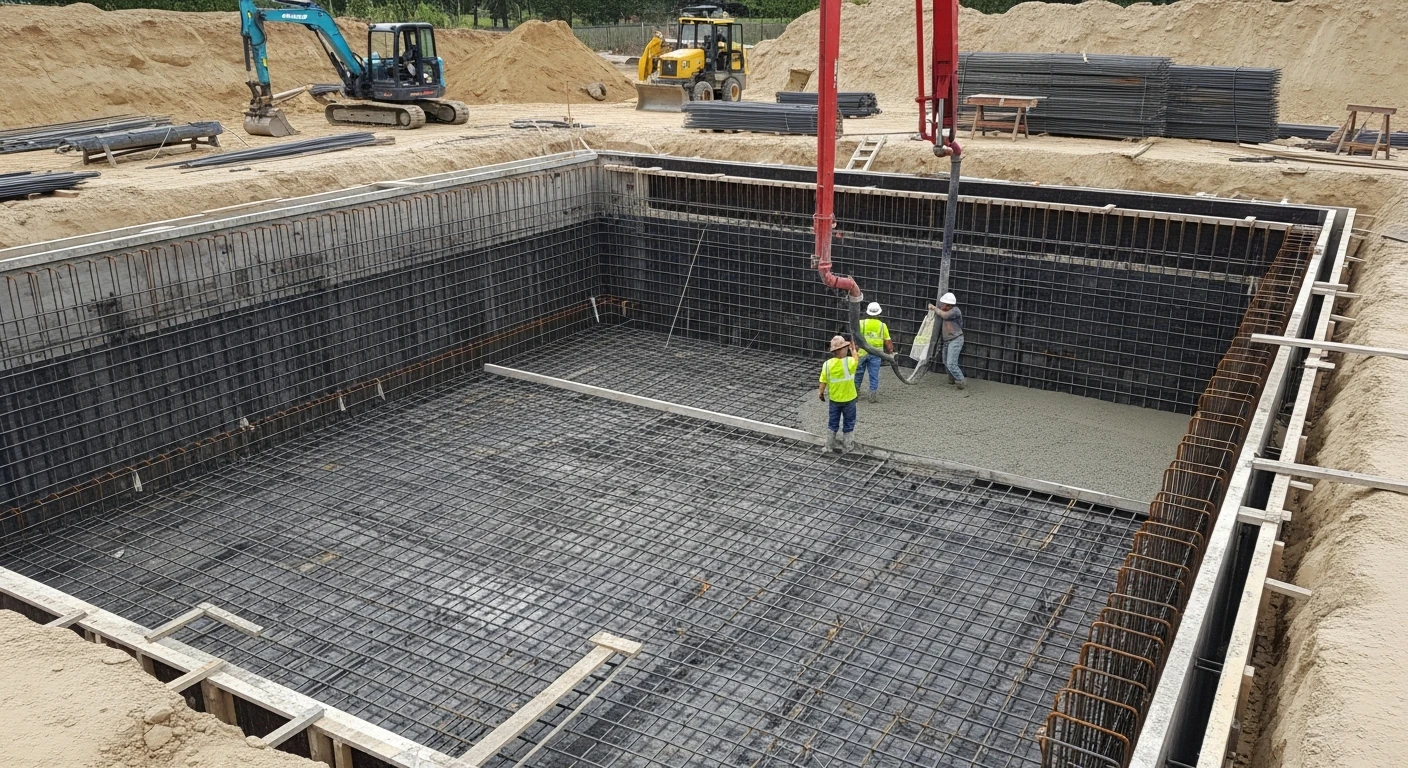
- Reinforcement Cage Assembly: The galvanized or epoxy-coated rebar cage is assembled on-site. I insist on double-tying all intersections and using non-corrosive plastic chairs to ensure proper concrete coverage around the steel.
- Shotcrete Application Mastery: I exclusively use a high-velocity, wet-mix shotcrete application with a minimum specified compressive strength of 5,000 PSI after 28 days. This method results in a denser, less permeable concrete shell than traditional gunite, providing superior water resistance.
- Systematic Curing Process: In the intense Florida sun, improper curing is a primary cause of shrinkage cracks. The shell must be kept consistently hydrated for a minimum of 7 to 10 days to allow the concrete to reach its full design strength without developing micro-fractures.
Precision Finishing and Advanced Waterproofing Standards
The final stage is where durability meets aesthetics. A common error is applying a standard plaster finish, which wears quickly under heavy commercial use and chemical exposure. My standard is a commercial-grade pebble aggregate finish, which is far more durable, stain-resistant, and offers a more slip-resistant surface for safety. Before the finish is applied, I mandate a two-part system: a primary cementitious waterproofing layer applied directly to the shell, followed by a secondary elastomeric membrane. This creates redundant protection against water intrusion. Finally, I personally oversee the hydraulic calibration. The goal is to achieve a water turnover rate at least 20% faster than the minimum required by the Florida Department of Health. This ensures superior water clarity and chemical efficiency, reducing long-term operational costs for the hotel or condo association. Is your commercial pool plan designed to actively combat Pinellas County's specific environmental challenges, or is it just another generic design waiting for the salt and sand to take their toll?Written by

Tags
commercial pool designers
commercial swimming pool installers
commercial pool installers
commercial pool builders
Commercial Pool Construction in Pinellas FL FAQ
What is commercial pool construction?
Commercial pool construction refers to the design, building, and installation of pools for commercial purposes, such as hotels, resorts, schools, gyms, and other public facilities. Our team of experts specializes in creating custom pool solutions that meet the unique needs of businesses and organizations.
What types of commercial pool construction services do you offer?
We offer a range of commercial pool construction services, including pool design and planning, excavation and construction, mechanical and electrical installation, and finishing touches such as tile and coping. We also provide maintenance and repair services to ensure your pool runs smoothly and safely.
What are the benefits of having a commercial pool?
A commercial pool can provide numerous benefits, including increased customer satisfaction, improved employee morale, and enhanced property value. It can also be a valuable amenity for guests, residents, or students, and can be used for relaxation, recreation, and even therapy.
How do I choose the right commercial pool construction company?
When selecting a commercial pool construction company, look for a team with experience, expertise, and a reputation for quality work. Check for certifications, licenses, and reviews from previous clients. Also, consider the company's communication style, project timeline, and budget-friendliness to ensure a smooth and successful project.
What is the typical timeline for a commercial pool construction project?
The timeline for a commercial pool construction project can vary depending on the scope and complexity of the project. On average, a project can take anywhere from several weeks to several months to complete, including design, excavation, construction, and finishing touches.
How much does commercial pool construction cost?
The cost of commercial pool construction can vary widely depending on factors such as pool size, design, materials, and location. On average, a commercial pool construction project can cost anywhere from $50,000 to $500,000 or more, depending on the specifics of the project.
Do you offer maintenance and repair services for commercial pools?
Yes, we offer comprehensive maintenance and repair services for commercial pools, including routine maintenance, equipment repair, and emergency response services. Our team is trained to handle a wide range of pool-related issues and can help you keep your pool running smoothly and safely.
Can you help me design a commercial pool that meets specific needs or regulations?
Yes, our team of experts can help you design a commercial pool that meets specific needs or regulations. We take into account factors such as local building codes, accessibility standards, and environmental concerns to create a custom pool solution that meets your unique requirements.
What are the most common pool-related problems or issues?
Common pool-related problems or issues include equipment failures, chemical imbalances, and maintenance neglect. We can help you identify and address these issues to ensure your pool runs smoothly and safely, and provide regular maintenance and repair services to prevent future problems.
How do you ensure the quality and safety of your commercial pool construction projects?
We ensure the quality and safety of our commercial pool construction projects by adhering to strict quality control measures, using high-quality materials and equipment, and following industry-standard safety protocols. Our team is also trained to handle emergency situations and can respond quickly to any issues that may arise.