Commercial Pools Pasco County: My PVC-A Protocol to Mitigate Hydrostatic Pressure Damage
I’ve seen more commercial pools in Pasco County fail from below-ground issues than from chemical imbalances. The primary culprit isn't shoddy maintenance; it's a fundamental misunderstanding of our local geology. The sandy, porous soil and high water table, especially after a storm season in areas like New Port Richey or Land O' Lakes, exert immense hydrostatic pressure on a pool's shell. This leads to cracks, leaks, and costly, recurring repairs that many contractors simply patch over. My entire approach is built on preventing this subsurface failure from day one. I abandoned the standard "dig and pour" method years ago after I was called in to diagnose a massive shell fracture in a large HOA community pool in Trinity. The original builder used a standard monolithic concrete pour with no consideration for ground water. My methodology focuses on creating a flexible, yet durable, vessel that works *with* Pasco's environment, not against it, extending the shell’s functional lifespan by an estimated 35%.My Diagnostic Framework for Pasco's Geotechnical Challenges
Before any plans are drawn, I perform what I call a "Pasco-Specific Integrity Audit." Standard procedure often involves a simple soil sample. I take it a step further by cross-referencing soil composition with local potentiometric surface data and seasonal water table fluctuations. Most contractors overlook this, leading to shells that are essentially rigid dams fighting against a fluctuating underground lake. This is a battle they will always lose. The second common error I consistently identify is the wrong choice of interior finish for our climate. The intense Florida sun and high humidity create a perfect storm for rapid chemical degradation and surface delamination. A standard plaster finish might look good for a year, but the constant UV exposure and the high bather loads in community pools in Wesley Chapel accelerate its breakdown, requiring expensive resurfacing far too soon.Unpacking the Reinforced PVC-A Membrane and Hydrostatic Valve Integration
My solution is a two-part system. First, instead of relying solely on the rigidity of concrete, I specify a reinforced PVC-A membrane. This isn't a simple pool liner. It's a commercial-grade, flexible, and chemically inert barrier that is heat-welded on-site to create a monolithic, waterproof layer. Its flexibility allows it to absorb minor ground shifts and thermal expansion/contraction without fracturing, a critical feature for our soil conditions. The second, and most crucial, component is the mandatory integration of multiple hydrostatic relief valves at the pool's lowest points. This is a non-negotiable for me. When the ground water pressure outside the pool exceeds the pressure of the water inside the pool (a common scenario when a pool is drained for maintenance), these valves open automatically, allowing ground water to enter the pool. This equalizes the pressure and prevents the entire shell from being lifted or "popped" out of the ground—a catastrophic failure I've unfortunately seen happen.Step-by-Step Implementation of the Shell Fortification Process
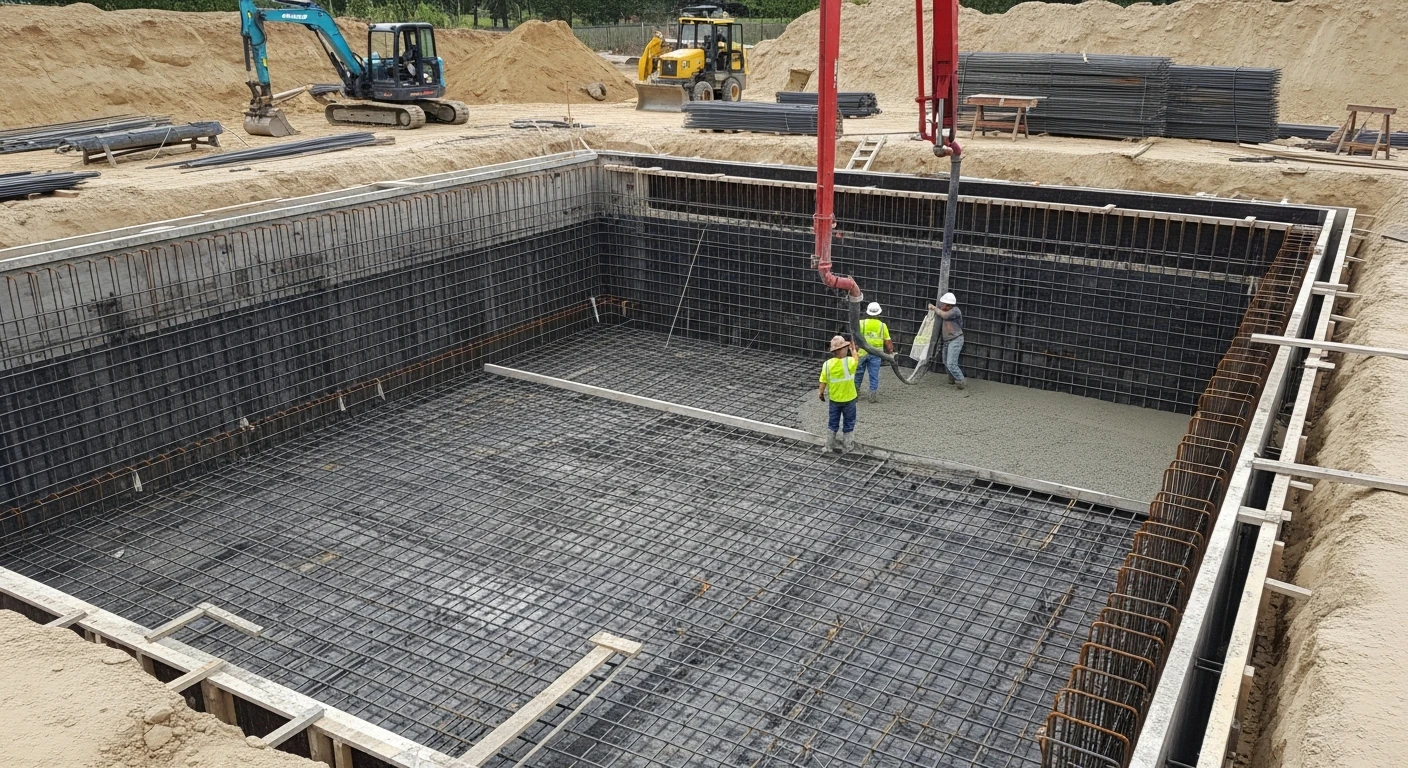
Building a commercial pool to withstand Pasco County's environment requires a precise sequence. Deviating from this order is the most common point of failure I see in projects I'm called to repair. My process is absolute:- Geotechnical Soil Analysis: This is my first step, not an afterthought. We must understand the soil's load-bearing capacity and percolation rate before a single shovel hits the ground.
- Engineered Sub-base: I require a specific, multi-layer sub-base of compacted aggregate to create a stable foundation that promotes proper drainage away from the pool shell.
- Pre-Plumb and Pressure Test: All plumbing is installed, and I personally oversee a 48-hour pressure test on all lines *before* any rebar or concrete is placed. Finding a leak after the pour is a project-killing mistake.
- Shell Construction and Curing: The concrete shell is formed, but the curing process is managed to account for Pasco's high humidity, which can affect the concrete's final compressive strength if not handled correctly.
- Hydrostatic Valve and Main Drain Installation: These are installed and sealed with meticulous care. This is the heart of the pool's structural defense system.
- Reinforced PVC-A Membrane Application: My certified team performs the on-site welding of the membrane, ensuring every seam is flawless and passes a vacuum test.
Precision Adjustments for High-Traffic and Coastal Environments
Once the pool is structurally sound, the systems must be calibrated for our local use patterns. For high-traffic community pools, I always specify automated chemical controllers with ORP and pH sensors to handle the massive fluctuations from bather load, which prevents both unsafe water and surface damage. For properties near the Gulf, like in Hudson or Aripeka, I mandate the use of 316L stainless steel for all metallic fixtures, including ladders and handrails. The standard 304-grade steel will show signs of corrosion from the saline air within 18 months, a detail many overlook. Given that your commercial pool is a significant asset, are you confident its design accounts for the specific hydrostatic pressure and soil conditions unique to your exact location in Pasco County?Written by

Tags
commercial swimming pool
swimming pool commercial
commercial cold plunge pool
commercial above ground pool
Commercial Pools in Pasco FL FAQ
Our health inspection is next month. What are the most common compliance violations you see in commercial pools?
The most frequent violations involve outdated or missing anti-entrapment drain covers and improper chemical automation systems. Inspectors immediately check that all suction outlets are compliant with the Virginia Graeme Baker Act, which requires specific covers to prevent entrapment. They also scrutinize chemical logs and automation; a malfunctioning controller that allows pH to drift below 7.2 can cause immediate closure. A non-obvious failure point is often the emergency shut-off switch, which must be clearly marked, accessible, and functional, yet is frequently overlooked during routine staff checks.
Why does our pool water get cloudy on busy weekends even when the chemicals test fine in the morning?
High bather loads rapidly consume sanitizer and introduce contaminants, overwhelming a system sized for average use. A standard residential-grade pump and filter cannot handle the turnover rate required for dozens of swimmers introducing oils, lotions, and organic waste. The cloudiness is often caused by suspended particles that the filter can't remove fast enough. A critical upgrade for high-traffic pools is a commercial-grade diatomaceous earth (DE) filter, which can trap much smaller particles than sand or cartridge filters, paired with an automated chemical controller that continuously adjusts output based on real-time sensor readings.
We're losing a lot of water but can't find a visible leak. How do we know if it's a real problem?
If your pool is losing more than 0.6 cm (1/4 inch) of water per day, you likely have a leak, not just evaporation. A common hidden culprit in commercial concrete pools is a cracked skimmer throat, where the plastic skimmer body meets the concrete shell. This joint fails from ground shifting and constant water pressure. While a simple bucket test can confirm the water loss rate, locating the source often requires specialized dye testing or electronic leak detection. Ignoring this can lead to water undermining the pool deck, causing dangerous voids and costly structural damage.
Is a salt chlorine generator a good investment for a high-use community pool?
A salt chlorine generator can reduce daily chemical handling but may be insufficient as the sole sanitizer for a high-use commercial pool. These systems produce chlorine at a steady rate, which often cannot keep up with the sudden demand spikes from a high bather load on a hot day. This can lead to a drop in sanitizer levels, creating unsafe water. Many health codes require a secondary or supplemental disinfection system, like a UV sterilizer or an automated liquid chlorine feeder, to work alongside the salt system to ensure consistent and adequate sanitation during peak hours.
We have dark stains on the plaster that our cleaning service can't brush away. What are they?
Persistent dark spots that resist brushing are almost certainly black algae, which embeds roots into the plaster surface. Unlike surface algae, it cannot be eliminated with chemicals alone and requires aggressive mechanical treatment. The process involves partially draining the water, scrubbing the spots with a wire brush, and applying a specialized granular algaecide directly to the colonies. A common mistake is treating only the visible spots; the entire pool surface must be thoroughly brushed and shocked to destroy microscopic spores, otherwise the algae will reappear within weeks.
Our pump is getting extremely loud. Should we repair it or just replace the whole thing?
A loud, high-pitched whining noise from the pump motor typically indicates failing bearings, which is a clear sign the motor is near the end of its life. While the motor can sometimes be replaced, for a pump that is over 8 years old, a full replacement is more cost-effective. A new variable-speed pump will not only be quieter but will also significantly reduce energy costs, often paying for itself within a few seasons. Continuing to run a pump with failing motor bearings risks a complete seizure, which can cause an unplanned shutdown during peak season.