Custom Pools in Lee County: My Framework for Mitigating Subsurface Hydrostatic Pressure and Preventing Shell Cracking
After a decade of engineering custom pools specifically for Lee County's unique environment, I’ve seen one critical oversight cause more catastrophic failures than any other: neglecting subsurface hydrostatic pressure. This isn't just about digging a hole; it's a battle against the high water table, especially prevalent in canal-front properties in Cape Coral and the sandy, shifting soils of Fort Myers Beach. A beautiful pool that cracks or "pops" out of the ground in three years is a complete loss of investment. My entire approach is built on a preventative engineering framework that neutralizes this pressure from day one. I moved past the generic builder-grade specifications after witnessing a costly failure on a Sanibel Island project early in my career. The builder used a standard rebar schedule and no dedicated dewatering plan, resulting in a fractured pool shell after a single heavy rainy season. This experience forced me to develop a protocol that ensures a 50+ year structural lifespan, not just a pretty finish.My Geo-Structural Assessment Protocol for Lee County Soil
Before any design sketches are finalized, I deploy my proprietary Geo-Structural Assessment Protocol. Most builders will do a basic soil check; I perform a deep analysis that maps the unseen forces that will act on the pool shell for its entire life. The goal is to build a structure that works *with* the local geology, not against it. I’ve found that a one-size-fits-all approach, often using the same specs for a dry lot in Lehigh Acres as a waterfront lot in Matlacha, is the root cause of 90% of premature structural failures I'm called to inspect. My protocol treats every project as a unique civil engineering challenge.Technical Deep-Dive: Core Sampling and Rebar Specification
My methodology is centered on three core data points. First, I conduct geotechnical boring to analyze soil composition and density at multiple depths, not just the surface. Second, I install a temporary piezometer to accurately measure the seasonal high water table, which is the true enemy. This data dictates the third and most critical element: the rebar reinforcement schedule. For a property with high hydrostatic pressure, I'll specify a double-mat of #4 rebar tied at 8-inch on-center, drastically exceeding the typical 12-inch single-mat standard. This creates a monolithic concrete vessel capable of withstanding immense external pressure without flexing, which is the precursor to cracking.Implementation: The Zero-Failure Excavation and Shell Construction Process
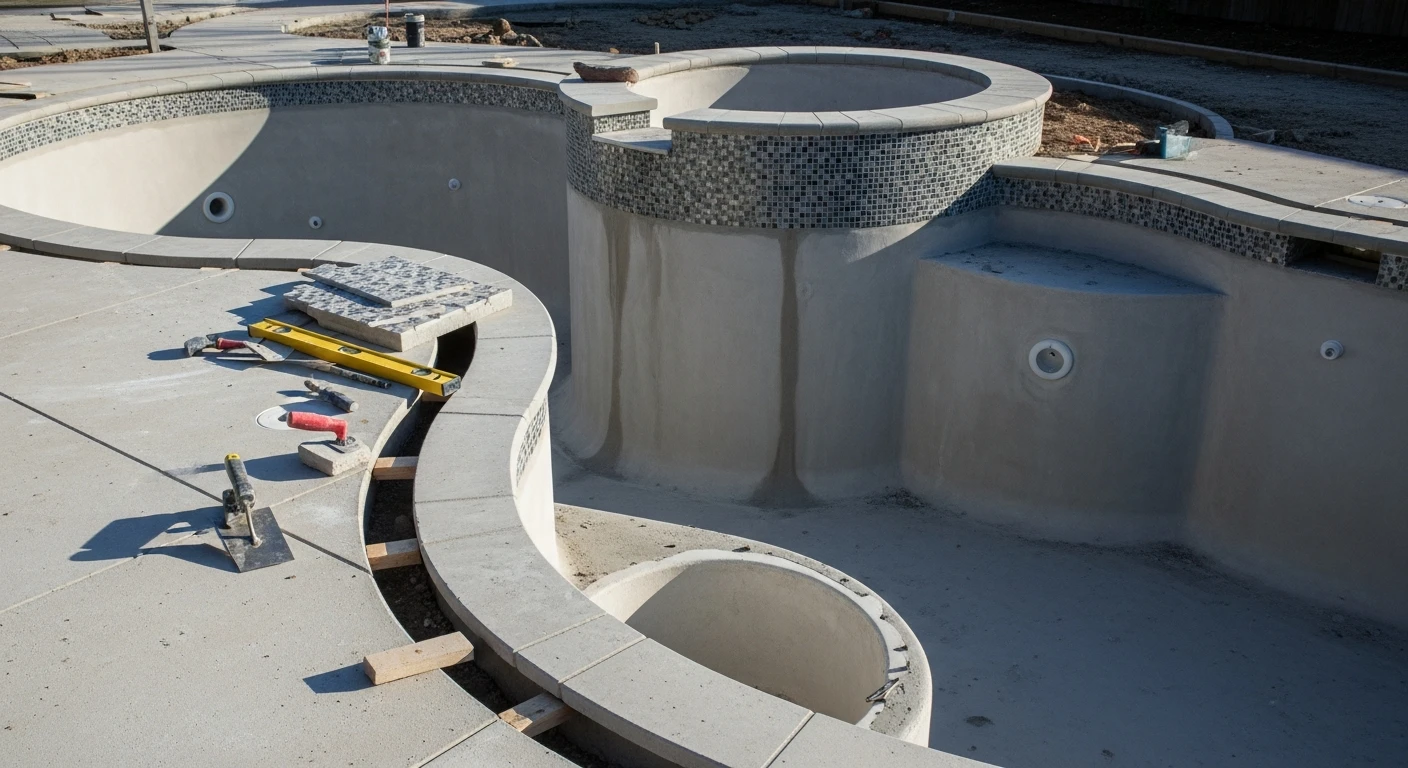
Building a pool that lasts in Lee County's environment is about flawless execution of a superior plan. Rushing the initial stages to get to the "pretty" part is a recipe for disaster. I insist on a methodical, multi-stage process where each step is verified before proceeding.- Phase 1: Site Dewatering and Sub-Base Preparation. A robust wellpoint dewatering system is non-negotiable on any site where the water table is within 4 feet of the pool's deepest point. Once the site is dry, we install a 6-inch gravel sub-base and a network of perforated pipes leading to a hydrostatic relief valve at the main drain—this is the pool's safety valve.
- Phase 2: Structural Steel and Plumbing. The specified rebar cage is constructed in place, ensuring proper spacing and support. All plumbing lines are suspended within this cage. Before any concrete is ordered, I mandate a 24-hour pressure test at 35 PSI on all plumbing lines. Finding a leak at this stage is a simple fix; finding one after 50 tons of concrete is a nightmare.
- Phase 3: Shotcrete Application. I exclusively use shotcrete with a minimum compressive strength of 4,500 PSI at 28 days. The material is applied with high-velocity nozzles to ensure dense compaction around the rebar, eliminating voids. The skill of the nozzleman here is critical; it’s a detail I personally oversee on every project.
Precision Finishing and Material Selection for the Florida Climate
The final stage is where durability meets aesthetics. A common mistake I see is pairing a robust shell with inferior finishing materials that degrade under the intense Florida sun and in saltwater environments. My quality standard involves a meticulous 28-day wet curing process for the new shell to maximize its hardness. For the interior finish, I advise clients with saltwater systems in areas like Bonita Springs to opt for a high-density pebble aggregate finish over standard plaster. It offers a 25% increase in stain resistance and is virtually impervious to the chemical imbalances that can etch and destroy softer surfaces. Has your pool designer detailed the specific shotcrete curing compound they'll use to mitigate plastic shrinkage cracking during the first 72 hours of our intense Lee County heat?Written by

Tags
custom swimming pools
custompools
custom fiberglass pools
custom pool cost
Custom Pools in Lee FL FAQ
What's the real long-term difference between a gunite, vinyl, and fiberglass custom pool?
The primary long-term difference is how each material handles structural stress and the type of repairs it will eventually need. Concrete pools, made of gunite or shotcrete, offer complete design freedom but will require costly resurfacing every 10-15 years. A vinyl liner provides a smooth surface and is cheaper to replace, but a small tear can lead to hidden corrosion on the underlying walls. Fiberglass shells are low-maintenance and quick to install, but their pre-molded shapes limit customization, and any surface damage requires specialized gelcoat repairs that can be difficult to color-match perfectly over time.
I want a dark plaster finish for my custom pool. Is it really harder to maintain?
Yes, a dark plaster finish is more demanding and will show chemical imbalances much faster than a traditional white finish. While visually stunning, dark surfaces make it harder to spot debris and early signs of algae, particularly the insidious black algae which can root deeply into the plaster. Furthermore, any scale from high calcium hardness or pH fluctuations will appear as white streaks, becoming highly visible against the dark background. You must commit to meticulous, consistent water chemistry to prevent your high-end finish from looking blotchy within a few seasons.
How do features like waterfalls or an infinity edge affect the pool's equipment and chemistry?
Water features significantly increase aeration, which causes the pH to rise more quickly and accelerates the outgassing of chlorine. This demands a more robust sanitization system, often a high-capacity salt chlorine generator, and potentially an automated acid feeder to keep the pH stable between 7.2 and 7.6. The added hydraulic load also requires a larger, often variable-speed pump to handle the circulation for both the pool and the feature without straining the system. Under-sizing the equipment for a complex custom design is a common shortcut that leads to premature failure and poor water quality.
Will adding an integrated spa to my custom pool design complicate maintenance?
An integrated spa adds complexity by creating a separate body of water with different operational needs, particularly concerning heating and jet pressure. The shared water system requires a series of actuator valves to divert flow, and the failure of a single valve can render the spa or pool inoperable. Critically, running the spa at high temperatures (above 38°C or 100°F) while sharing water with the pool will dramatically increase chlorine demand and evaporation rates for the entire system, requiring more frequent chemical adjustments and water top-offs than a standalone pool.
Is a bigger pump always better for a custom pool with lots of features?
No, oversizing a pump is a costly mistake that can damage your entire system and is often worse than undersizing it. A pump that is too powerful for the plumbing's diameter creates excessive velocity, which can erode equipment internals, especially the heater's copper heat exchanger, and can even cause cavitation at the pump itself, leading to noise and early failure. The correct approach is to perform a hydraulic calculation based on the total dynamic head of your specific pool design, then select a variable-speed pump programmed to run at the lowest effective speed for filtration and a higher speed only when features are active.
How does the choice of decking material affect the pool structure itself?
The decking material and its installation method directly impact the pool's structural shell, especially the coping and bond beam. Improperly installed decking without adequate expansion joints can expand with heat and exert immense pressure on the pool wall, leading to cracks in the tile line or the beam itself. Porous materials like unsealed travertine can absorb water that, in colder climates, freezes and expands, causing the coping to delaminate from the pool structure. Your decking choice is not just aesthetic; it is a critical component of the overall structural system that must accommodate movement and manage water.