Outdoor Pool Kitchens in Collier County: My Protocol for 30-Year Material Integrity Against Salt Spray & Humidity
I've seen far too many beautiful, expensive outdoor kitchens in Naples and Marco Island begin to degrade in under five years. The culprits are almost always the same: surface rust on standard stainless steel grills, warped cabinetry from the relentless humidity, and faded countertops from the intense Florida sun. This isn't just an aesthetic issue; it's a fundamental failure in material specification for the unique coastal environment of Collier County. My approach isn't about simply building an outdoor kitchen; it's about engineering a permanent outdoor living feature. It’s based on a hard lesson I learned on a waterfront project in Port Royal where the client’s specified 304-grade stainless steel showed corrosion spots within 18 months. That mistake led me to develop a specific material and assembly protocol that directly counters the effects of salt air and high moisture, ensuring the structure’s integrity for decades, not just a few seasons.Diagnosing Premature Failure: My Coastal Resilience Framework
The average contractor builds for a generic climate. Here, from the waterfront estates in Aqualane Shores to the golf course communities inland, the air itself is a corrosive agent. My methodology, which I call the Coastal Resilience Framework, is built on a diagnosis of the three primary failure points I consistently observe in Collier County: material oxidation, structural moisture absorption, and UV degradation. Standard building practices simply don't account for the constant, combined assault of these elements. The framework moves beyond generic "weather-resistant" labels and focuses on a material's specific performance metrics against salt spray and moisture vapor transmission. I don’t select a cabinet because it's "outdoor-rated"; I select it based on its ASTM B117 salt spray test results and its core material's lack of cellulose, which is food for mold in our humid climate. This level of scrutiny is the only way to build something that truly lasts by the Gulf.Technical Deep Dive: Material & Component Specification
My framework is not a concept; it's a granular set of specifications. When I design an outdoor kitchen for a Collier County home, these are my non-negotiable starting points.- Structural Integrity: I abandoned traditional concrete block (CMU) framing years ago due to its porosity. I exclusively use a welded aluminum or 316L stainless steel frame clad in a marine-grade, polymer-modified concrete board. This creates a completely inorganic and waterproof foundation, preventing the moisture wicking and internal mold growth I've seen destroy CMU-built kitchens.
- Appliance & Hardware Specification: All appliances, access doors, and even hinge hardware must be 316L marine-grade stainless steel. The "L" denotes low carbon content, which significantly increases corrosion resistance. For cabinetry, I specify high-density polyethylene (HDPE) or powder-coated stainless steel. A critical error I often fix is improper grill insulation; a non-combustible insulation jacket is mandatory to protect the surrounding structure and cabinetry from a grill’s high BTU output, extending the cabinet life by at least 50%.
- Countertop & Surface Protocol: While granite is popular, many varieties are too porous and can stain from humidity-driven mold. I lean towards high-density quartzite or porcelain slabs for their near-zero water absorption and superior UV resistance. The key, however, is the sealing process. I mandate a nano-particle penetrating sealer applied twice upon installation, with a scheduled re-application every 24 months, a crucial step most installers overlook.
Implementation: The Zero-Failure-Point Assembly Process
A design is only as good as its execution. Having the right materials is half the battle; assembling them to prevent water intrusion is the other half. This is my field-tested process.My Phased Implementation Checklist
- Site & Utility Mapping: Before any work begins, I map the site’s prevailing wind direction and sun path. This informs the placement of smoke-producing elements (like a grill or smoker) and ensures social areas aren't downwind. We perform a ground-penetrating radar scan for utilities, a step that saved one of my projects in Pelican Bay from a costly water main strike.
- Frame & Cladding Assembly: The frame is constructed and all joints are sealed with a marine-grade polyurethane sealant *before* the backer board is attached. This creates a redundant water barrier. Every single fastener used is also 316-grade stainless steel to prevent a single point of rust from staining the facade.
- Appliance Integration & Ventilation: Each appliance is installed with its specified clearance for ventilation. For high-power grills, I engineer a passive cross-ventilation system with discreet vents in the cabinet base and below the countertop to prevent gas buildup and heat damage, a major safety oversight in many DIY and low-bid projects.
- Countertop Installation & Final Sealing: Countertops are installed with a slight, almost imperceptible pitch (1/8 inch per foot) to direct water away from the base and appliances. The final sealing is done only after all other work is complete to ensure a perfect, unbroken barrier.
Precision Adjustments and Quality Control
The final 5% of the work is what separates a good build from a great one. My quality control process includes a few final checks that have become my signature. For all stone and tile work, I specify an epoxy-based grout instead of a standard cementitious one. In the high humidity of Collier County, epoxy grout provides a waterproof, stain-proof, and mold-resistant joint that will not degrade or discolor. My final sign-off only occurs after a controlled water intrusion test. I simulate a heavy, wind-driven rain on the entire structure for 15 minutes and then perform a thorough internal inspection with a moisture meter. This may seem excessive, but it has revealed tiny caulking gaps that would have led to major water damage within a few years. It's the ultimate proof of a truly sealed and resilient outdoor kitchen. Now that you understand the material science and assembly process required for a truly durable outdoor kitchen in this climate, have you considered how the galvanic corrosion potential between different metal fasteners and hardware will be mitigated in your design?Written by

Tags
outdoor kitchen pool area
swimming pool and outdoor kitchen designs
pool and kitchen designs
inground pool with outdoor kitchen
Outdoor Pool Kitchens in Collier FL FAQ
What is an outdoor pool kitchen, and why should I consider installing one?
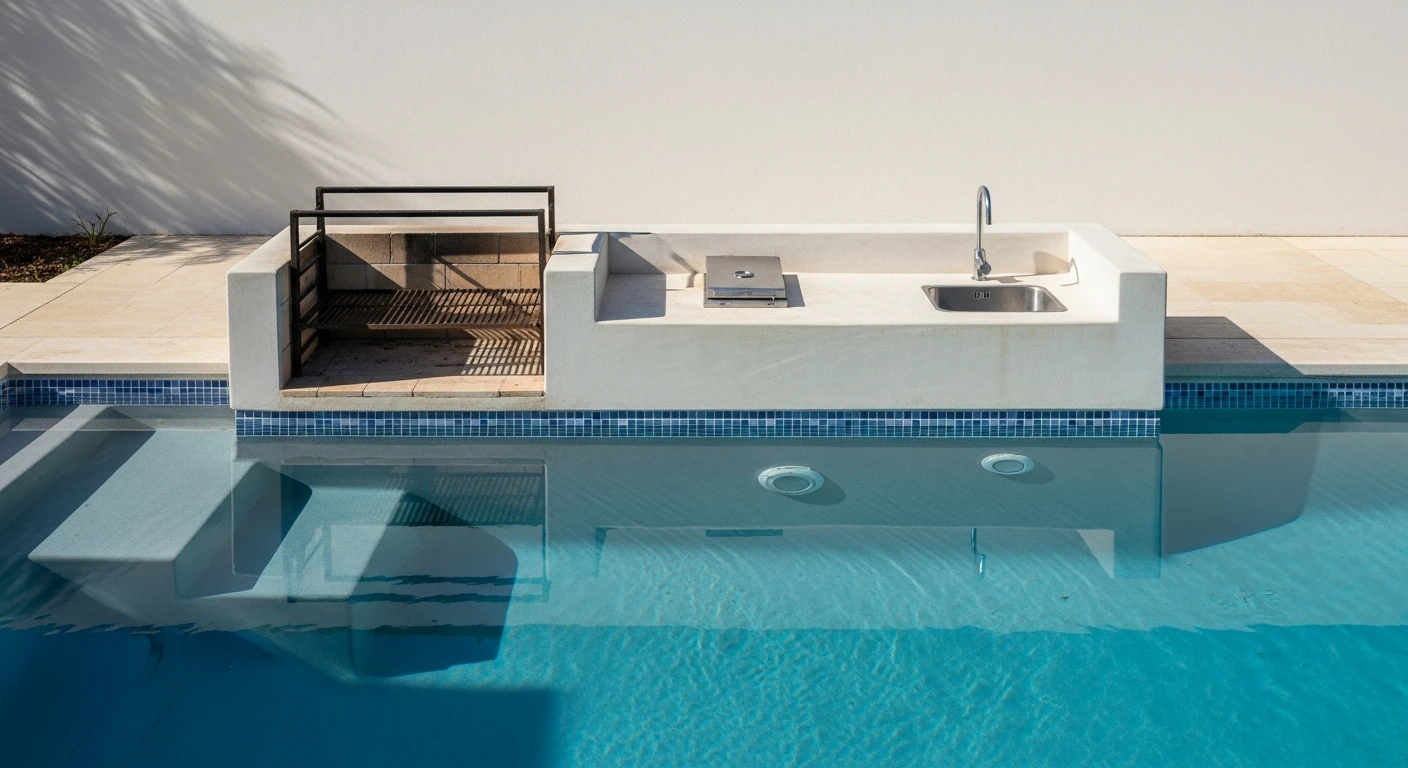
An outdoor pool kitchen is a outdoor cooking and entertainment space designed to enhance the pool area experience. It typically includes features such as a grill, countertops, sink, and storage. Installing an outdoor pool kitchen can increase the value of your property, provide a comfortable and convenient space for entertaining, and create a seamless transition between indoor and outdoor living areas.
What are the benefits of an outdoor pool kitchen compared to a traditional indoor kitchen?
An outdoor pool kitchen offers several benefits compared to a traditional indoor kitchen. It provides a unique and intimate dining experience, allows for year-round use, and can increase the overall value of your property. Additionally, an outdoor pool kitchen can be designed to complement the surrounding landscape and pool area, creating a cohesive and beautiful outdoor space.
What types of materials are commonly used in outdoor pool kitchens?
Outdoor pool kitchens can be designed using a variety of materials, including natural stone, brick, stucco, and wood. The choice of material will depend on your personal style, budget, and the overall aesthetic you want to achieve. It's also important to consider the durability and maintenance requirements of the materials used.
How do I determine the size and layout of my outdoor pool kitchen?
The size and layout of your outdoor pool kitchen will depend on several factors, including the size of your pool area, the number of people you plan to entertain, and your personal preferences. It's a good idea to consult with a professional designer or contractor to determine the ideal size and layout for your outdoor pool kitchen.
What features should I include in my outdoor pool kitchen?
Some popular features to include in an outdoor pool kitchen include a grill, cooktop, sink, refrigerator, and storage. You may also want to consider adding features such as a pizza oven, outdoor lighting, and a fire pit or fireplace. The key is to design a space that meets your needs and enhances your outdoor living experience.
How do I maintain and clean my outdoor pool kitchen?
Regular maintenance and cleaning are important to ensure the longevity and appearance of your outdoor pool kitchen. This may include tasks such as cleaning the grill and cooktop, wiping down countertops, and sweeping and mopping the floors. It's also a good idea to perform regular inspections to identify and address any potential issues before they become major problems.
Can I install an outdoor pool kitchen myself, or do I need to hire a professional?
While it may be possible to install an outdoor pool kitchen yourself, it's generally recommended to hire a professional contractor or designer who has experience with outdoor kitchen design and construction. This will ensure that your outdoor pool kitchen is installed correctly and meets local building codes and regulations.
What is the average cost of an outdoor pool kitchen, and what factors affect the cost?
The average cost of an outdoor pool kitchen can vary widely, depending on the size and complexity of the design, the materials used, and the location. On average, a basic outdoor pool kitchen may cost between $10,000 and $50,000, while a high-end design may cost $100,000 or more. Factors that can affect the cost include the size of the space, the number of features, and the quality of the materials used.
Can I integrate my outdoor pool kitchen with my existing indoor kitchen or other outdoor living spaces?
Yes, it's possible to integrate your outdoor pool kitchen with your existing indoor kitchen or other outdoor living spaces. This can be achieved through the use of similar design elements, such as materials and colors, and by incorporating features such as outdoor lighting and plumbing that tie into the rest of the space.