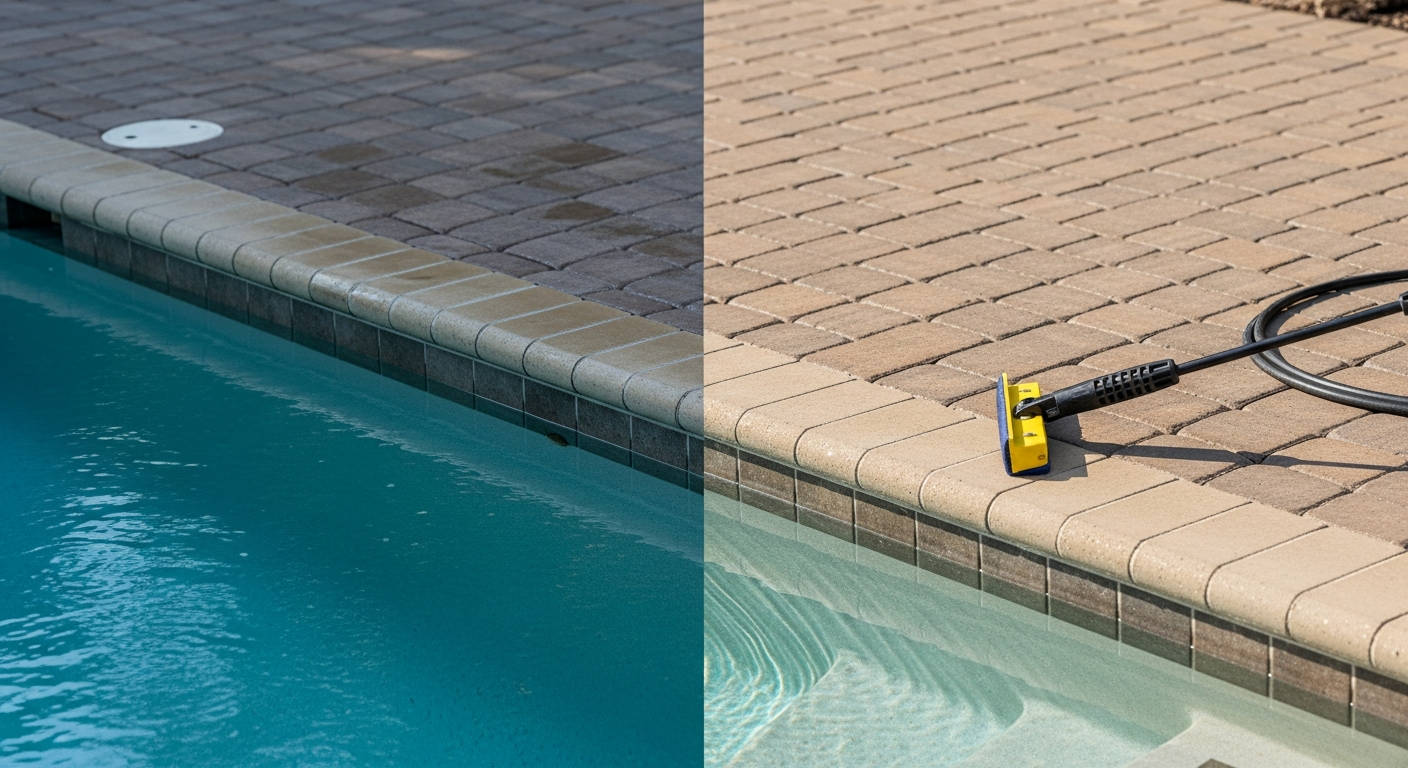
Professional Paver Sealer in Collier County: My Protocol for Preventing Polymeric Haze and Extending Color Life by 35%
As a paver sealing specialist in Collier County, the most costly mistake I see isn't faded pavers; it's a perfectly good installation ruined by the wrong sealer. Homeowners in Naples and on Marco Island often request that high-gloss, "wet look," only to call me six months later when their beautiful lanai is covered in a milky, white haze. This isn't dirt—it's **sub-surface moisture** trapped by a non-breathable acrylic sealer, a catastrophic failure under our intense humidity and sun. My entire process is built around preventing this single issue. The problem originates below the surface. After our heavy summer rains, moisture gets trapped in the sand bed beneath the pavers. A cheap, film-forming sealer acts like a plastic sheet, preventing this moisture from evaporating. The sun then bakes the surface, turning that trapped vapor into a cloudy mess known as **efflorescence bloom** or **polymeric haze**. My approach focuses on diagnosing moisture content and selecting a sealer with the correct **vapor permeability rating** for the specific microclimate, whether it's the salt air of Port Royal or the inland heat of Golden Gate Estates.My Diagnostic Framework: The Sub-Surface Moisture & Penetration Protocol
Before a single drop of sealer is applied, I perform a diagnostic that most contractors skip. I once took over a large commercial project in North Naples where the previous contractor had sealed a driveway that failed within 90 days, costing the client thousands. My analysis showed the failure was guaranteed before they even started. My protocol prevents this by focusing on two critical, unseen factors.Technical Deep Dive: Moisture Mapping and Sealer Chemistry
The core of my methodology rests on quantifiable data, not guesswork. First, I use a **calibrated digital moisture meter** to test not just the paver surface, but the polymeric sand in the joints. Readings above **15% moisture content** are an immediate red flag. Sealing over this is a direct cause of the hazing I mentioned. For properties near the coast, I also perform a **salinity test** on the surface, as high salt concentration can interfere with sealer adhesion. Based on this data, I almost never recommend a standard acrylic film-former for Collier County pool decks or driveways. Instead, I specify a **silane/siloxane hybrid penetrating sealer**. Unlike acrylics that sit on top, this formulation dives deep into the paver's capillaries. It doesn't form a film; it chemically bonds with the substrate to create a hydrophobic barrier from within. This allows the paver to breathe, letting trapped water vapor escape without compromising the seal. This single choice in chemistry is the difference between a 1-year job and a 5-year solution.The On-Site Implementation Process
A flawless application is non-negotiable. My process is a systematic sequence designed to control every variable, from surface preparation to the final curing phase. Each step is a checkpoint to guarantee maximum sealer penetration and longevity.- Step 1: Aggressive Surface Decontamination. This is more than a power wash. I use a commercial-grade surface cleaner to remove grime, followed by a targeted application of **sodium percarbonate** to kill organic growth like mold and algae—a constant battle in our humid climate. If efflorescence is present, a diluted **sulfamic acid solution** is used to dissolve the mineral salts.
- Step 2: Polymeric Sand Integrity Check. I inspect every joint. Any cracked or low-set sand is removed and replaced with new, dry **ASTM C-144 polymeric sand**. I then use a **plate compactor** to lock the sand into place, ensuring a stable foundation that resists weed growth and ant hills.
- Step 3: The Flood Coat & Back-Roll Technique. Sealer is applied using a battery-powered, low-pressure sprayer to avoid atomization. I apply a heavy "flood coat" to ensure the paver is completely saturated. The most critical action follows immediately: I **back-roll** the entire surface with a non-shedding roller. This forces the sealer deep into the pores and removes any excess from the surface that could form a film, guaranteeing a natural, matte finish that won't become slick.
Precision Tuning and Quality Assurance Standards
The job isn't finished when the sprayer is put away. The 48-hour period after application is when a project can succeed or fail, especially with Collier County's unpredictable weather. I will not seal if the ground temperature is above 90°F or if the relative humidity exceeds **75%**, as these conditions can cause the sealer to "flash cure" on the surface without penetrating properly. My final quality check is the **Water Drop Test**. 48 hours after completion, I place several drops of water on various pavers and joints. The water must bead up like on a freshly waxed car. If it soaks in or spreads out, the hydrophobic barrier is incomplete, and the area requires a targeted re-application. This simple, visual KPI provides undeniable proof of a successful, deep-penetrating seal, ensuring the paver system is protected from the inside out. Instead of asking a contractor how much shine their sealer provides, shouldn't you be asking for the sealer's vapor permeability rating and how they verify sub-surface moisture levels before they begin?Written by

Tags
concrete pavers sealer
porcelain paver sealer
driveway paver sealing near me
patio and paving sealer
paver patio cleaning and sealing near me