
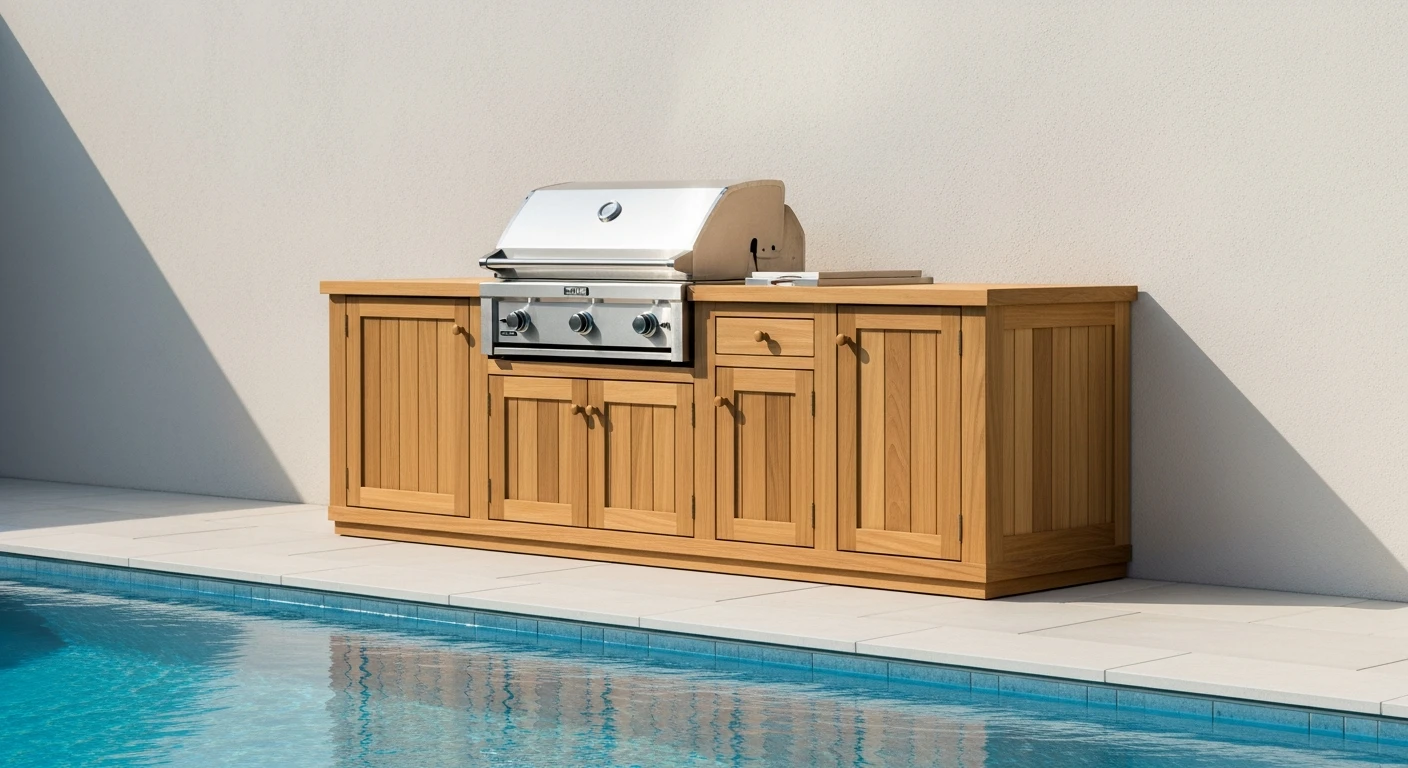
Teak Outdoor Kitchen: My Framework for a 30-Year Lifespan and 75% Less Maintenance
The primary failure point in most high-end teak outdoor kitchens isn't the wood itself; it's a systemic breakdown I call the 'Material Fatigue Cascade.' I've seen six-figure projects show signs of degradation in under three years, not from poor teak quality, but from a fundamental misunderstanding of how teak interacts with hardware, sealants, and environmental stress. The common advice to simply "oil your teak" is not only outdated but, in humid climates, can actually accelerate mildew growth and joint compromise.
My approach focuses on creating a structurally inert and environmentally sealed system from day one. This isn't about constant maintenance. It's about a specific pre-construction and assembly protocol that locks in durability, ensuring the structure withstands thermal expansion and moisture intrusion for decades, not just seasons. The goal is to front-load the work to achieve a near-zero maintenance state for the first 5-7 years.
The 'Material Fatigue Cascade': My Diagnostic Framework for Teak Structures
In my experience auditing outdoor construction projects, I’ve pinpointed a recurring pattern. Failure doesn't happen overnight. It begins with a single, overlooked detail—a screw of the wrong stainless steel grade, an unsealed end grain, or a joint with insufficient epoxy coverage. This micro-failure allows moisture ingress. The wood fibers swell, stressing the joint. The hardware undergoes galvanic corrosion or thermal stress. This creates a feedback loop where each component's failure accelerates the failure of the next. I term this the Material Fatigue Cascade. My entire methodology is built around preventing the first step of this cascade. It shifts the focus from reactive maintenance (sanding and oiling) to proactive engineering during the specification and assembly phase.
Beyond Grade A: Specifying Joinery, Hardware, and Sealants
Getting true longevity requires a level of specification far beyond simply asking for "Grade A Teak." While essential, it's just the starting point. Here's my internal checklist for components, which I insist on for any project I oversee:
- Lumber Specification: I demand kiln-dried Grade A teak with a verified moisture content between 8% and 12%. Anything higher is prone to significant post-assembly movement, which is the primary stressor on joints.
- Joinery Method: For all structural connections, I mandate mortise and tenon joints secured with a high-grade marine epoxy. Screws are for non-load-bearing panels only. This provides a massive increase in shear strength compared to dowels or biscuit joints, preventing the racking and loosening that begins the cascade.
- Hardware Metallurgy: This is a non-negotiable point where I’ve seen countless failures. All hardware, from hinges to screws to drawer pulls, must be 316-grade stainless steel. The common 304 grade, while "stainless," will exhibit surface rust and pitting in salt-air or high-humidity environments, staining the teak and compromising its own integrity.
- The Sealer vs. Oil Dilemma: I advise against traditional teak oils. They require reapplication every 3-6 months and can support mildew growth by trapping organic matter. Instead, I specify a high-quality marine-grade synthetic sealer with UV inhibitors. It forms a flexible, microscopic barrier that repels water without creating a thick, plastic-like film, allowing the wood to breathe. The result is a maintenance interval of years, not months.
- Component Quarantine & Verification: Upon delivery, all wood and hardware are inspected. I personally check a random sample of screws with a magnet (low-grade stainless will be more magnetic) and use a moisture meter on the teak. Any component that fails inspection is rejected. Do not skip this step.
- Pre-Assembly Sealing: Before a single joint is glued, all end grains and mortises are sealed with a single coat of the specified marine sealer. The end grain is like a straw, wicking up moisture 10x faster than the face grain. Sealing it is the single most effective action for preventing rot.
- Dry-Fit and Numbering: The entire kitchen structure is fully assembled without any glue or permanent fasteners. Each joint is checked for a perfect, gap-free fit. Once confirmed, each component is numbered for its exact location before disassembly. This eliminates guesswork and ensures a flawless final assembly.
- Epoxy Application and Clamping: During final assembly, marine epoxy is applied to both the mortise and the tenon. The structure is clamped with just enough pressure to close the joint, using precision squares to ensure perfect 90-degree angles. Over-tightening clamps can squeeze out too much epoxy, starving the joint and creating a weak point.
- Final Sealer Application: After the epoxy has fully cured (typically 24-48 hours), the entire structure receives two to three thin coats of the marine sealer, with a light sanding (220 grit) between coats. This creates the final, durable shell that will protect the kitchen for years.
Tags
prefab outdoor kitchen cabinets
prefab outdoor bar
outdoor modular kitchen cabinets
outdoor modular kitchen units
prefab grill island


