
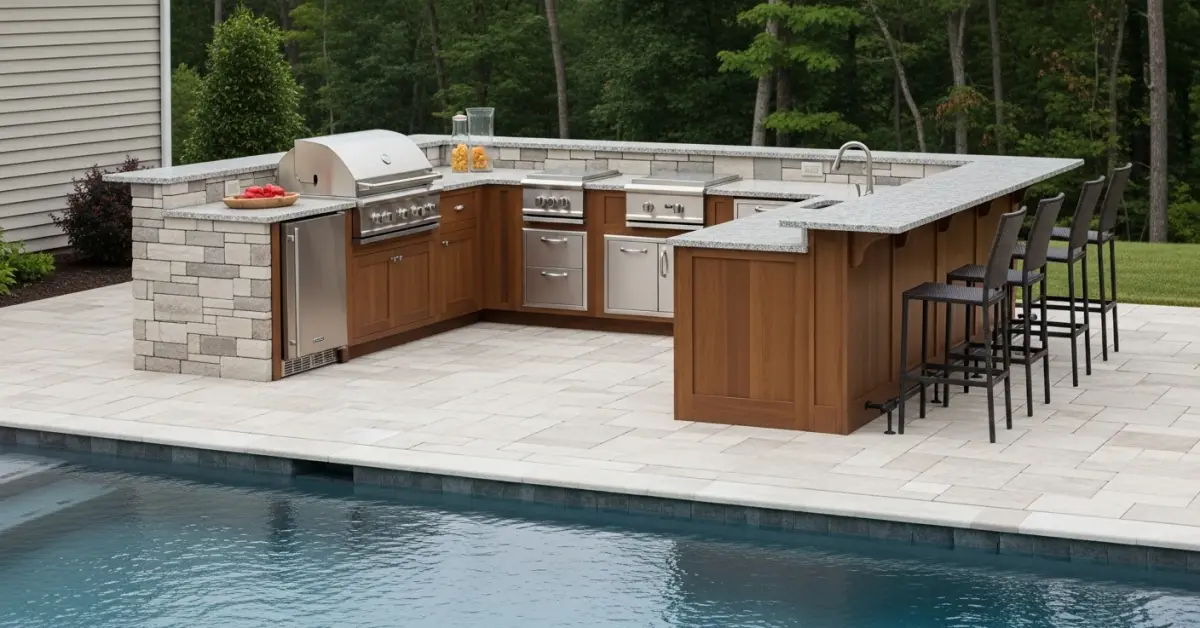
U Shaped Outdoor Kitchen with Bar: My Framework for Flawless Workflow and a 30% Longevity Boost
The biggest design failure I see in U-shaped outdoor kitchens isn't the choice of granite or grill; it's the fundamental misunderstanding of spatial dynamics. Most designs create a "cook's trap," a cramped, inefficient space that bottlenecks movement and makes hosting a nightmare. After redesigning dozens of these failed layouts, I developed a methodology that transforms the U-shape from a liability into a high-performance culinary hub.
My approach focuses on establishing a functional trinity: dedicated zones for high-heat cooking, wet prep, and social interaction. This isn't just about placing appliances; it's about engineering a workflow that allows multiple people to operate simultaneously without collision. By separating these functions, we eliminate crossover traffic, increase usable counter space by up to 30%, and drastically improve the hosting experience.
Diagnosing Inefficiency: The "Tri-Zone Workflow" Methodology I Developed
Years ago, on a large residential project, I inherited a U-shaped design that was beautiful on paper but a disaster in practice. The sink was next to the smoker, and the refrigerator was on the opposite end, forcing the host to constantly cross the primary cooking path. This experience forced me to scrap conventional thinking and create the Tri-Zone Workflow. It’s a simple, non-negotiable system I now apply to every U-shaped project to guarantee operational success.
The methodology divides the "U" into three distinct, non-overlapping sectors. Zone 1 (The Hot Zone) is strictly for cooking appliances like grills, side burners, and pizza ovens. Zone 2 (The Wet/Prep Zone) contains the sink, cutting surfaces, and waste disposal. Finally, Zone 3 (The Cold & Social Zone) houses the refrigerator, ice maker, and, most importantly, integrates seamlessly with the bar seating. The core principle is to place the Wet/Prep Zone at the base of the "U," creating a central command from which the cook can pivot to the Hot and Cold zones on either arm, keeping guest and service paths completely separate.
The Engineering Behind the Tri-Zone: Material Science and Appliance Integration
Executing the Tri-Zone concept requires a deep dive into materials and appliance specifications. Each zone has unique demands. For the Hot Zone, I never place a high-BTU grill on a combustible structure without a proper insulated jacket—a catastrophic error I've had to remedy more than once. The countertop material here must have an extremely high thermal shock resistance; I specify materials like Dekton or true quartzite, as granite can crack under intense, direct heat from a pizza oven.
In the Wet/Prep Zone, the primary concern is hygiene and water management. I insist on a marine-grade polymer base for under-sink cabinetry to prevent water damage, a common failure point. The countertop must be non-porous to prevent staining and bacterial growth. For the Cold & Social Zone, the bar top engineering is critical. A standard 12-inch overhang is insufficient for comfortable seating. I mandate a 15-inch cantilevered overhang, which requires robust, hidden steel supports tied directly into the frame. For appliances, I specify 304-grade stainless steel for most environments, but for coastal projects within 5 miles of saltwater, upgrading to 316-grade (marine-grade) stainless steel is the only way to prevent premature rust and corrosion.
From Blueprint to Reality: My Step-by-Step Implementation Protocol
Translating the Tri-Zone design into a physical structure requires a rigid sequence of operations. Deviating from this order is the single most common cause of budget overruns and timeline delays I've encountered.
- Phase 1: Foundation and Utility Mapping. Before any framing, we map and run all electrical and plumbing conduits within the concrete slab or footing. I've seen projects where this was an afterthought, leading to costly trenching or unsightly external conduits. This is the point of no return.
- Phase 2: Structural Framing. My standard is 20-gauge galvanized steel framing or concrete masonry units (CMU). I model the frame to accommodate the exact rough-opening dimensions of every specified appliance. We verify load-bearing capacity for the countertop and bar overhang at this stage.
- Phase 3: Cladding and Appliance Installation. After the frame is clad in cement board, we install all appliances. This must happen *before* the countertop template is made. Templating on an empty frame is a recipe for misaligned cutouts.
- Phase 4: Countertop Templating and Final Finishes. With appliances in place, a precise template is created. After the countertop is installed, we complete the final electrical connections, water hookups, and install any finishing materials like stone veneer.
Tags
u shaped outdoor kitchen
outdoor kitchen u shape
u shaped bbq island
custom outdoor bbq kitchen
custom outdoor kitchen
U Shaped Outdoor Kitchen with Bar FAQ
What's the minimum deck space needed for a U-shaped kitchen and bar without making my poolside feel cramped?
You need a clear rectangular area of at least 10 by 12 feet to comfortably fit a functional U-shaped kitchen and bar without obstructing pool access. This layout allows for standard appliance depths, adequate counter space on three sides, and sufficient room for bar seating. Anything less forces compromises that can create dangerous pinch points, especially with wet surfaces where a slip could cause injury. Remember to account for a minimum 3-foot walkway behind the bar stools to prevent guests from falling into the pool.
How do I ensure the plumbing for my outdoor kitchen sink doesn't interfere with my pool's underground pipes?
Properly mapping your existing pool plumbing is the critical first step before any trenching for your kitchen's water and drain lines. We often use electronic locators to trace the path of the pool's suction and return lines, which are typically buried 18 to 24 inches deep. Tapping into the pool's circulation system for a water source is a code violation and will unbalance your pool chemistry. A dedicated, properly winterized water line is essential to prevent freeze-burst damage that could also compromise the nearby pool structure.
Can the electrical wiring for my outdoor kitchen's grill and fridge be run in the same conduit as my pool light?
Absolutely not; running kitchen and pool wiring in the same conduit is a severe safety hazard and violates electrical codes. Pool lighting uses a low-voltage circuit connected to a transformer, while kitchen appliances require dedicated 120-volt or 240-volt circuits with GFCI (Ground Fault Circuit Interrupter) protection. Sharing a conduit risks electrical shock, especially in a wet environment. All new electrical work must be bonded to the pool's existing bonding grid to prevent stray voltage, which can cause corrosion of metal pool components.
What's the best countertop material for a U-shaped kitchen right next to a saltwater pool?
Sealed granite or quartzite are the best choices for countertops adjacent to a saltwater pool due to their high density and resistance to salt corrosion. Materials like travertine or certain types of porous concrete will absorb the aerosolized salt from the water, leading to pitting and rapid deterioration. Even with a durable material, ensure the counter has a slight slope away from the pool to prevent runoff from carrying grease and food particles into the water, which consumes chlorine and can lead to algae blooms like black algae.
How far should my grill and other heat-producing appliances be from my vinyl liner pool?
Your grill must be positioned at least 10 feet away from the edge of a vinyl liner pool to prevent radiant heat from deforming or melting the liner. A common mistake is underestimating how far embers can travel, which can instantly burn a hole in the liner, causing a leak that can lose over 1,800 liters of water per day. This distance also protects the pool's plastic skimmers and return fittings from heat damage and ensures cooking smoke and grease don't blow directly over the water surface.
Will building a heavy concrete-block kitchen on my pool deck cause it to crack or sink?
A standard 4-inch concrete pool deck is not designed to support the concentrated load of a masonry outdoor kitchen and will likely crack or subside. To prevent this, the kitchen's U-shaped footprint requires its own independent concrete footing, or foundation, poured to a depth below the frost line for your region. This foundation must be structurally separate from the pool deck and the pool shell itself to avoid transferring weight onto the pool's bond beam, which could cause catastrophic structural damage to the pool wall.


