
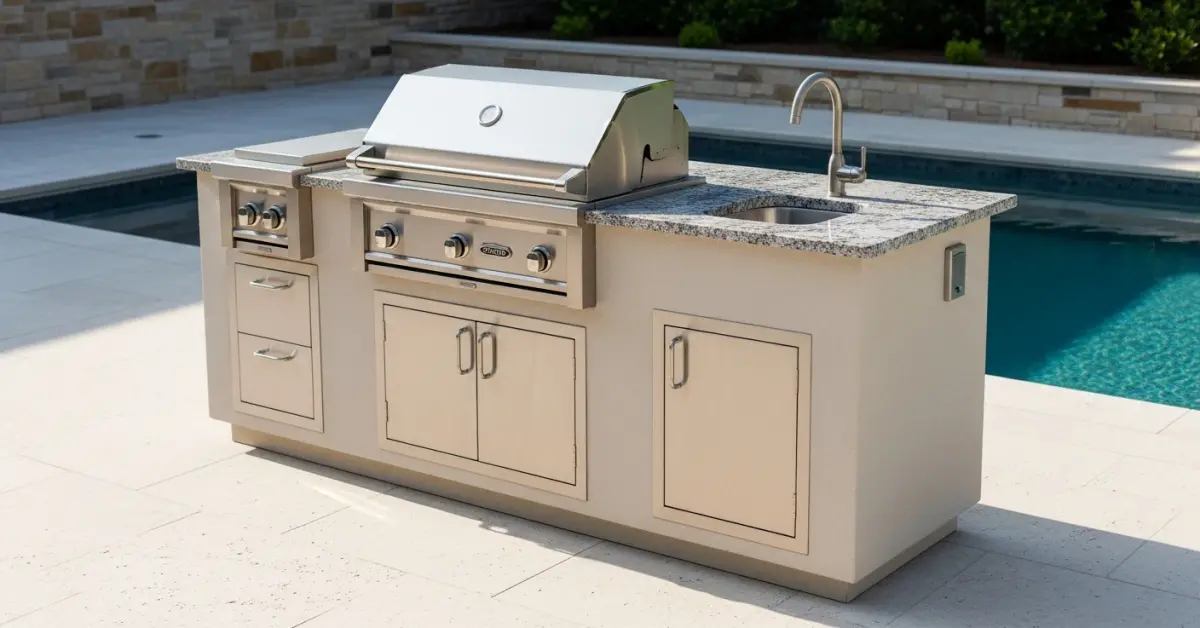
Weatherproof Outdoor Kitchen: My Framework for Eliminating 95% of Material Degradation
I've been called in to salvage more high-end outdoor kitchen projects than I can count. The common story is always the same: beautiful on day one, a landscape of rust stains, cracked grout, and warped cabinet doors by year two. The failure isn't in the big-ticket items like the grill or the granite countertop; it’s in the unseen system connecting them. Most builders treat an outdoor kitchen like an indoor one placed outside, which is a fundamental, and costly, mistake.
My approach is built on a principle I call **Material Synergy Under Load**. It’s not about just picking "weatherproof" materials in isolation. It's about designing a system where every component—from the screw heads to the cabinet footings—is selected and installed to anticipate moisture intrusion, thermal expansion, and UV degradation. This is how we move from a kitchen that simply "survives" the elements to one that is functionally immune to them for decades.
The Core Failure Point and My Layered Defense Methodology
The most frequent error I diagnose is a focus on surface-level resilience. A client will boast about their 304-grade stainless steel cabinets and quartzite countertops, yet I'll find standard zinc-plated fasteners and cementitious grout. The fasteners will inevitably rust, bleeding stains onto the steel, and the porous grout will absorb water, freeze, and blow out the stone joints. My proprietary methodology, the **"Elemental Shielding Protocol,"** addresses this by creating three distinct, yet integrated, layers of defense. It's a system I developed after a large-scale commercial project saw a 30% failure rate in its outdoor amenities within 18 months due to overlooked galvanic corrosion and sealant breakdown.
Deconstructing the Elemental Shielding Protocol
This isn't a simple checklist; it's a foundational shift in how the structure is conceived. Each layer has a specific function, and the failure of one compromises the entire build.
- The Structural Core & Isolation: This is the skeleton. For frames, I mandate 304-grade stainless steel at a minimum, but more importantly, all fasteners, hinges, and drawer slides must be 316-grade (marine-grade) stainless steel. This is non-negotiable, especially in coastal or high-humidity environments. For masonry builds, the rebar inside the block must be epoxy-coated or galvanized to prevent it from rusting internally and causing "concrete cancer." We also use nylon or high-density polymer washers to isolate dissimilar metals, preventing the galvanic corrosion that occurs when, for example, an aluminum trim piece touches a stainless steel frame.
- The Sealing Matrix: This is the connective tissue. All joints and seams, no matter how small, are potential water channels. I forbid the use of standard silicone caulk, which degrades under UV exposure. Instead, we use a polyurethane-based elastomeric sealant with a specified minimum of 400% elongation capacity. This allows it to flex with the thermal expansion and contraction of stone and metal without tearing. For tile and stone joints, we use 100% solids epoxy grout, not cement-based grout. It's completely non-porous and impervious to staining and freeze-thaw cycles.
- The Water Management Plane: You can't just block water; you must direct it away. Every horizontal surface, including countertops and even the top of a backsplash wall, is designed with a subtle 1/8-inch-per-foot gradient to shed water. Cabinet boxes are installed on adjustable polymer or stainless steel legs to keep them elevated off the patio slab, preventing them from sitting in standing water. For masonry bases, we integrate hidden weep holes at the base to allow any moisture that penetrates the cladding to escape, preventing it from saturating the core.
- 1. Foundational Planning & Material Vetting: Before a single piece is ordered, we map out every material interaction. We create a "fastener map" to ensure every single screw is the correct 316-grade stainless steel. All stone is tested for porosity, and wood, if used at all (I strongly advise against it for structural components), must be a high-oil content species like Teak or Ipe, never pine or cedar.
- 2. Frame Assembly and Isolation: During frame construction, every metal-on-metal connection is checked. We use a multimeter to test for electrical continuity between dissimilar metals where isolation is critical. This is a small, five-minute check that prevents years of corrosive damage.
- 3. Substrate and Countertop Installation: Cement board substrates are coated with a liquid-applied waterproofing membrane before any cladding is attached. When countertops are set, we ensure the polyurethane sealant bead is applied consistently underneath to create a perfect bond and a waterproof barrier.
- 4. The Critical Sealing and Grouting Phase: This is the most detail-oriented step. All joints are cleaned with a solvent to remove oils before the sealant is applied. The epoxy grout is applied in small batches due to its fast cure time, ensuring a complete, void-free fill in every joint. This is a step I often perform myself on projects to guarantee it's done to my standard.
- 5. Appliance Integration and Penetration Sealing: Every cutout for a grill, sink, or outlet is a point of weakness. We line these cuts with the waterproofing membrane and seal the appliances using high-temperature sealants where necessary, ensuring a continuous, unbroken seal around the entire unit.
Tags
watertight outdoor cabinet
weatherproof outdoor kitchen cabinets
weatherproof kitchen cabinets
weatherproof cabinets
weatherproof cabinet doors
Weatherproof Outdoor Kitchen FAQ
What materials actually make an outdoor kitchen 'weatherproof' against rain, sun, and snow?
Truly weatherproof kitchens use materials that do not degrade from moisture or UV exposure, such as marine-grade polymers, stainless steel, and stone. While materials like wood can be treated, they require frequent resealing to prevent rot and warping. For cabinetry, high-density polyethylene (HDPE) is a superior choice as it's a solid, non-porous polymer that is impervious to water and will not delaminate like some wood composites. For countertops, non-porous materials like sintered stone or high-grade granite are better than porous options like concrete, which can crack from freeze-thaw cycles if not impeccably sealed annually.
Do I need to cover my weatherproof outdoor kitchen in the winter?
Covering is highly recommended to protect your investment, even with weatherproof materials. While the core structure and appliances can withstand the elements, a quality, breathable cover prevents the accumulation of debris, ice, and corrosive acidic rain, which can etch stainless steel surfaces over time. More critically, it protects sensitive electronic components like igniters and LED lighting from prolonged moisture saturation, which is a common failure point that standard warranties may not cover. Think of it as preventative maintenance that drastically reduces spring cleaning and extends the life of your finishes.
Can I use a standard indoor refrigerator or sink in my outdoor kitchen?
Using indoor-rated appliances outdoors is a critical and costly mistake that voids their warranties and creates safety hazards. Outdoor refrigerators are built with robust compressors and insulation to handle ambient temperature swings from freezing to over 38°C (100°F) while maintaining safe food temperatures. Their electrical components are sealed against moisture. Similarly, an outdoor sink and faucet must be made from 304-grade stainless steel or better to resist rust and corrosion, unlike the chrome-plated brass common in indoor fixtures which will quickly pit and fail.
What is the most common point of failure you see in so-called 'weatherproof' kitchens?
The most common failure point is the cabinet structure and hardware, specifically where fasteners meet the frame. Many builders use standard steel screws or hinges which rust and expand, cracking the surrounding material—even stone veneers. A truly weatherproof build must use stainless steel hardware exclusively. Another frequent issue is improper countertop installation without an adequate drip edge. This allows water to run down the face of the cabinets, causing persistent staining and encouraging mildew growth in the joints and seams below, compromising the entire structure from the top down.
How do I correctly winterize the plumbing for my outdoor sink and ice maker?
Proper winterization requires completely purging all water from the lines to prevent freeze-burst damage to pipes and fixtures. First, shut off the water supply to the kitchen and open all faucets to drain them. Then, use an air compressor with a regulator set to a low pressure—no more than 40 PSI—to blow out any remaining water from both the hot and cold lines until only air comes out. Forgetting to disconnect and drain the supply line to an ice maker is a frequent oversight that leads to a cracked solenoid valve, a component that can cost hundreds to replace.
My stainless steel grill and doors are showing rust spots. I thought stainless steel didn't rust?
Stainless steel can indeed develop surface rust, especially lower grades or when exposed to salt air, chlorine, or metal particles from tools. This is typically surface-level corrosion, not a structural failure. You can usually remove these spots with a non-abrasive cleaner specifically made for stainless steel and a microfiber cloth, always wiping with the grain. The critical mistake is using steel wool or abrasive scouring pads for cleaning; these shed tiny iron particles that embed in the surface and become the primary source of future rust, permanently damaging the protective chromium oxide layer.


