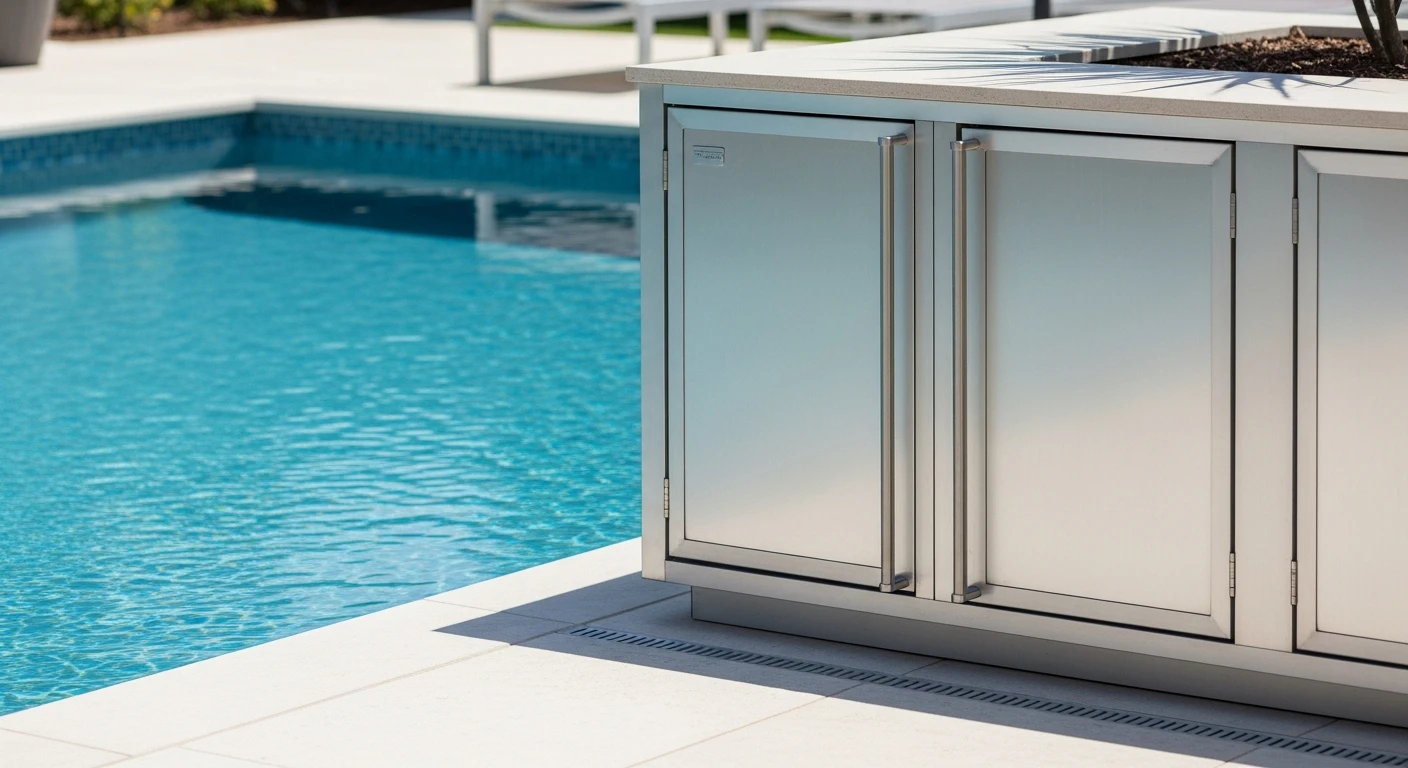
Aluminum Outdoor Kitchen Cabinets: A Zero-Corrosion Framework for Pinellas County's Saline Environment
My work centers on designing and specifying outdoor living spaces that last. In Pinellas County, I've seen more outdoor kitchens fail due to environmental degradation than any other cause. The combination of intense UV exposure, high humidity, and, most critically, the salt-laden air from the Gulf of Mexico creates a uniquely corrosive environment. A client in a St. Pete Beach waterfront home once showed me a two-year-old outdoor kitchen where the powder-coated steel cabinets were already showing rust blooms through the finish and the hardware was seized. The failure wasn't the concept; it was the material specification. This is why I exclusively specify powder-coated aluminum cabinets, but with a critical distinction that most suppliers overlook. It's not just about using aluminum; it's about using the correct alloy and coating process tailored for marine-adjacent conditions. My entire methodology is built around preventing galvanic corrosion and coating delamination, ensuring a 25-year plus lifespan even on properties in Treasure Island or Clearwater Beach that get direct salt spray.My Diagnostic Framework: The Coastal Durability Protocol
Over years of replacing failed outdoor kitchens across Pinellas, from Dunedin's coastal homes to the lanais in Old Northeast St. Pete, I developed what I call the Coastal Durability Protocol. It’s a non-negotiable checklist I use to vet any aluminum cabinet manufacturer. The common mistake I see is assuming all aluminum is created equal. A cabinet that performs well in a dry, inland climate will catastrophically fail here. My protocol focuses on three core technical pillars: the aluminum alloy itself, the surface pre-treatment, and the powder coating specification.Technical Deep Dive: Alloy, Pre-Treatment, and Coating Mil Thickness
The real expertise lies in the details that manufacturers often don't advertise. First, the alloy. I insist on cabinets fabricated from 5052 or 6061 series aluminum. These alloys contain magnesium and silicon, respectively, which provides substantially higher corrosion resistance compared to more common, cheaper alloys. This is the first line of defense. Second is the pre-treatment. Before any powder coating is applied, the aluminum must undergo a chromate conversion coating process. This step etches the surface at a microscopic level, creating a superior bond for the powder coat and serving as a secondary barrier to oxidation. I once rejected an entire shipment for a project because I discovered the manufacturer had skipped this step to save costs; their cabinets would have started peeling within three years in our humid climate. Finally, the powder coating itself must meet a minimum thickness of 3.0 mils and be certified to at least the AAMA 2604 standard. This ensures it can withstand the UV degradation from the Florida sun and resist the corrosive effects of salt air.The Pinellas Installation Blueprint: From Lanai to Waterfront
Proper installation is just as critical as material selection. An improperly installed premium cabinet will fail. My process for every Pinellas County project is meticulous and accounts for our local conditions.- Hardware Specification: This is a major point of failure. I mandate the use of 316 marine-grade stainless steel for all fasteners, hinges, and pulls. Standard 304 stainless steel, often supplied by default, will develop surface rust and tea-staining when exposed to the salt air here. It's an easy corner to cut, and one I see cut far too often.
- Isolation and Anchoring: The aluminum cabinet base must be isolated from direct contact with concrete lanais or pavers, which can be alkaline and hold moisture. I use high-density polymer spacers to create an air gap. For homes in hurricane-prone zones, especially along the barrier islands, every cabinet run is securely anchored to the structure to withstand significant wind loads.
- Joint and Seam Sealing: During assembly, a bead of marine-grade silicone sealant is applied to all structural joints before fastening. This prevents saltwater or moisture from our frequent rainstorms from penetrating the interior of the cabinet structure, which is a primary cause of hidden corrosion.
Post-Installation QA: My Non-Negotiable Checks
After the last cabinet door is hung, my job isn't done. I perform a final quality assurance check that I've refined over dozens of local installations. This includes a water drainage test on the countertop to ensure water sheets away from, not toward, the cabinet faces. I also check every single fastener to ensure it has been installed with a nylon washer to prevent galvanic corrosion between the stainless steel screw and the aluminum cabinet body. This tiny detail is what separates a 10-year kitchen from a 30-year one. Are your outdoor kitchen cabinet's fasteners and hardware truly specified for direct salt spray exposure, or are they a hidden failure point waiting for the Pinellas County climate to expose them?Written by

Tags
outdoor kitchen stainless steel
outdoor stainless steel sink cabinet
outdoor stainless sink
outdoor stainless steel sink
outdoor stainless steel sink station