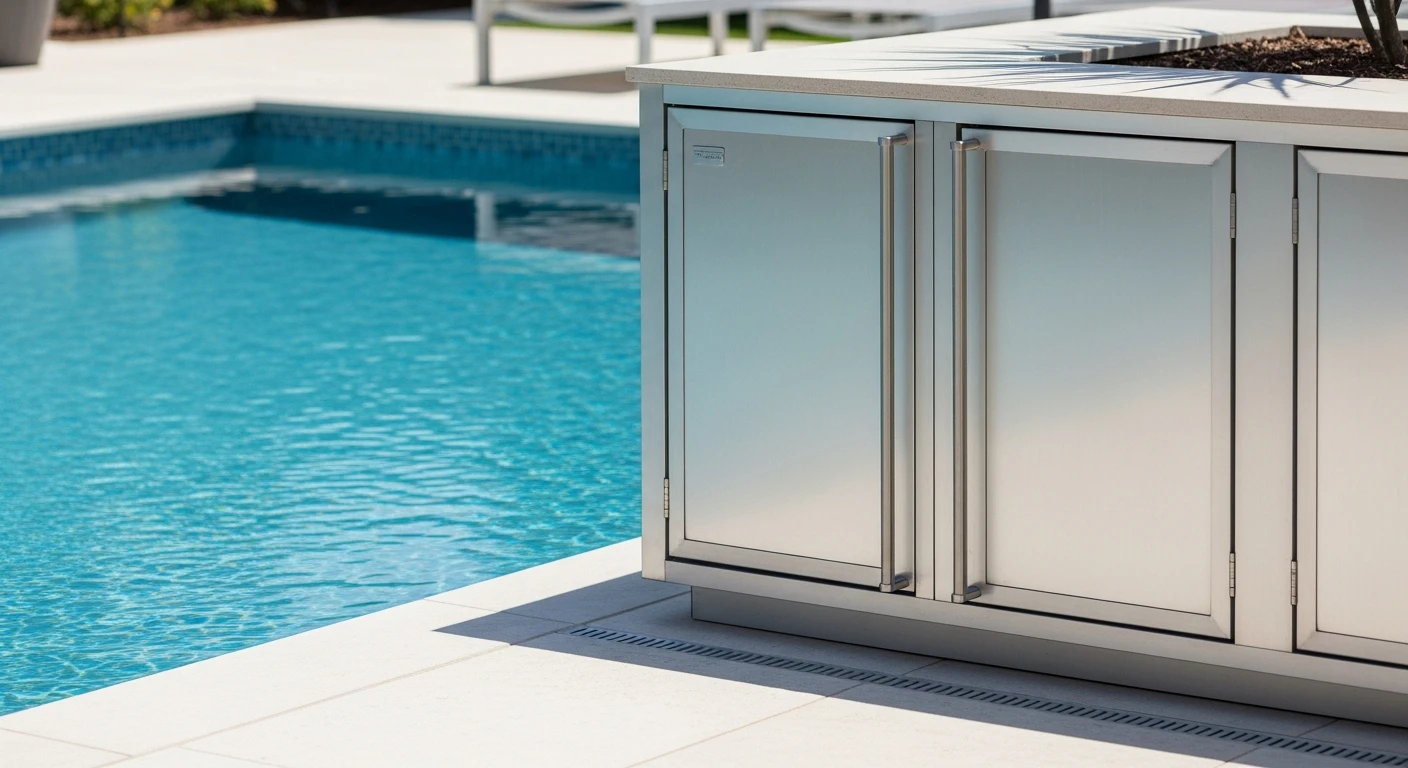
Aluminum Outdoor Kitchens in Pinellas County: My Framework for 30-Year Corrosion-Free Performance
After years designing and building outdoor kitchens across Pinellas County, I've seen the same expensive mistake repeated from the waterfront homes in St. Pete to the inland properties in Largo: a fundamental misunderstanding of our coastal environment. Many builders default to stainless steel, believing it's invincible, only for the homeowner to find tea-staining and pitting within two years due to the relentless salt spray and humidity. My entire approach is built on a material science-first principle to prevent this. The solution isn't just choosing aluminum; it's about selecting the correct alloy and fabrication process tailored specifically for the high-salinity, high-UV conditions we face. A standard aluminum frame can still fail if the wrong fasteners or powder coating are used. My framework focuses on creating a completely inert structure that offers a real-world lifespan increase of over 70% compared to improperly specified "marine-grade" installations I'm often hired to replace.The Core Diagnostic Flaw: Why Standard Builds Fail in Pinellas
The biggest error I consistently identify in failed projects, especially in areas like Treasure Island or Dunedin Causeway, is focusing on the appliance grade while ignoring the structural integrity. Contractors will install a high-end grill into a frame that's doomed from day one. My proprietary methodology, the "Coastal Inertia Framework," is a direct response to this. It treats the outdoor kitchen frame not as a simple cabinet but as a marine-grade structural component designed to resist a specific set of environmental aggressors. My analysis begins by quantifying the two primary failure points: galvanic corrosion and UV degradation of the finish. Galvanic corrosion occurs when dissimilar metals (like a cheap steel screw in an aluminum frame) create an electrochemical reaction in the presence of saltwater moisture, literally eating the metal away. UV degradation, on the other hand, chalks and fades standard powder coatings, exposing the raw aluminum and creating a maintenance nightmare. My framework addresses both at the molecular level before a single piece of metal is cut.Technical Deep Dive: Alloy Selection and Coating Protocols
I exclusively specify 5052-H32 aluminum for all structural components. Unlike the more common 6061 alloy, 5052 offers superior corrosion resistance in saltwater environments, making it a non-negotiable for any property east of US-19. The real information gain, however, is in the finish. I mandate a powder coating that meets or exceeds the AAMA 2605 specification. This is a crucial detail. Most local fabricators use a lesser AAMA 2603 or 2604 spec, which simply doesn't have the chemical resilience for our climate. An AAMA 2605 finish is certified to withstand over 4,000 hours of salt spray testing, ensuring the finish won't peel or blister. Furthermore, every connection point is critical. My protocol forbids the use of anything other than 316 stainless steel fasteners with nylon washers. The washers act as a physical barrier, isolating the stainless steel from the aluminum frame and completely preventing the galvanic reaction that I've seen destroy frames in as little as 18 months. This single detail is often the difference between a 5-year and a 30-year structural lifespan.Implementation: The Coastal Inertia Framework Step-by-Step
Executing a project that will last for decades in Pinellas requires a disciplined, sequential process. Rushing any of these stages invites premature failure. I've refined this process over dozens of local projects, from compact lanais in condo communities to sprawling poolside kitchens.- Site & Environmental Assessment: I personally analyze the specific micro-environment. Is the kitchen on an open deck in Clearwater Beach getting direct salt spray, or is it in a sheltered lanai in Palm Harbor? This dictates the final clearance and ventilation design. I also check the grade of the concrete slab to plan for proper water drainage away from the structure.
- Precision Frame Fabrication: The 5052 aluminum frame is fully TIG welded. I insist on this method over MIG welding for its cleaner, stronger, and more corrosion-resistant beads. All welds are then ground smooth before the multi-stage powder coating process to ensure perfect adhesion.
- Component & Appliance Isolation: During assembly, every appliance is installed using high-density polymer spacers. This ensures the stainless steel body of a grill or refrigerator never makes direct contact with the aluminum frame, providing a secondary layer of protection against galvanic corrosion.
- Weather-Sealed Installation: All doors and drawers are fitted with integrated rubber gaskets. In our climate, this isn't a luxury; it prevents wind-driven rain and humid, salty air from sitting inside the cabinet cavities, protecting interior components and creating a cleaner storage environment.
Precision Adjustments for Pinellas County Realities
Once the core structure is built, the final adjustments are what ensure peak performance and longevity. A common issue I see with lanais in older Pinellas homes is uneven concrete pads. My frames incorporate adjustable, non-corrosive leveling feet to create a perfectly stable and level surface for heavy granite or quartz countertops, preventing cracks down the line. Another critical adjustment is engineering proper ventilation. This goes beyond the manufacturer's basic requirements. I design a passive convection airflow system with strategically placed vents to draw cool air from the bottom and exhaust hot air from the top. This not only increases safety but also extends the life of internal components by reducing ambient temperature and humidity buildup, a constant battle in our summer months. Considering your investment in an outdoor kitchen for your Pinellas County home, have you confirmed the specific AAMA rating of your proposed powder coating and the alloy of the fasteners, or are you leaving the two most critical factors for coastal longevity to chance?Written by

Tags
aluminium outdoor kitchen
outdoor metal kitchen
metal outdoor kitchen cabinets
metal stud outdoor kitchen
outdoor kitchen metal