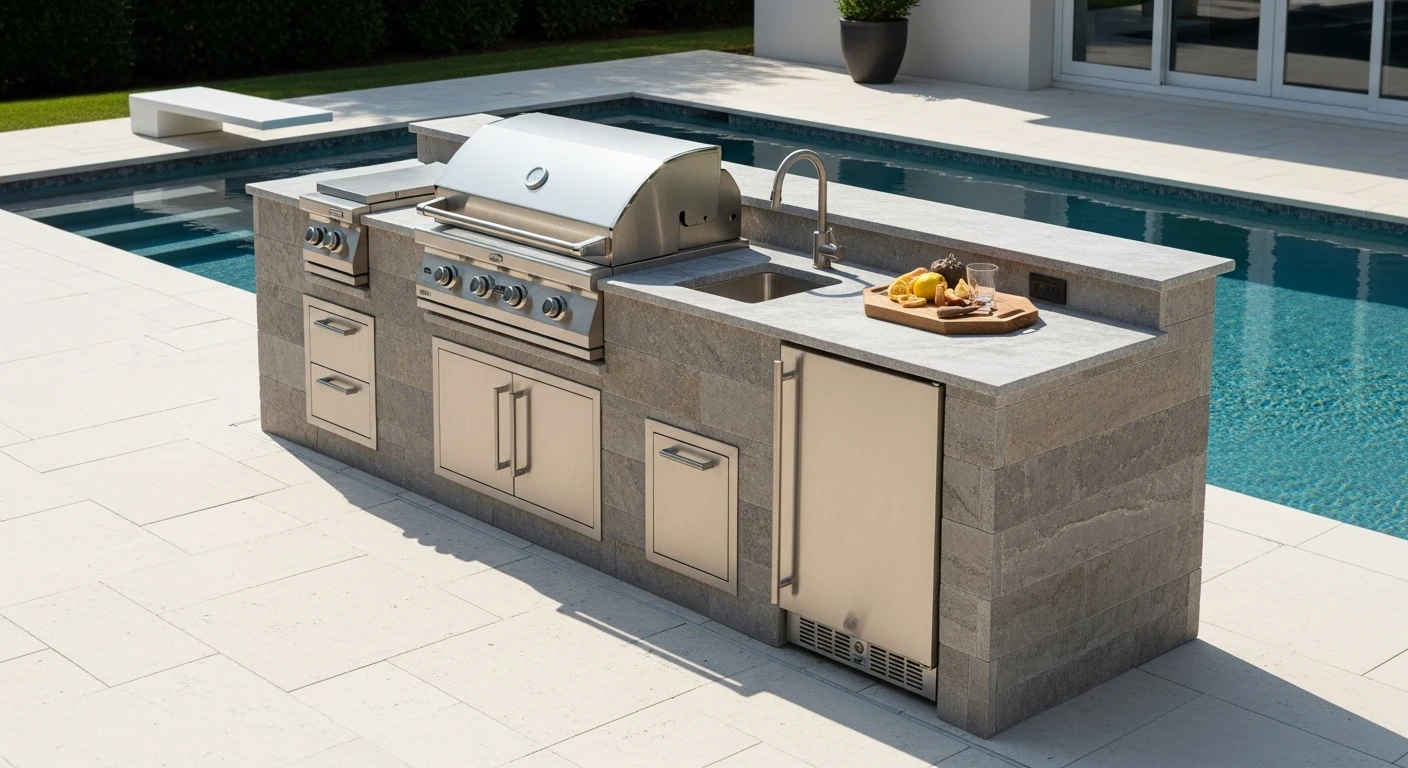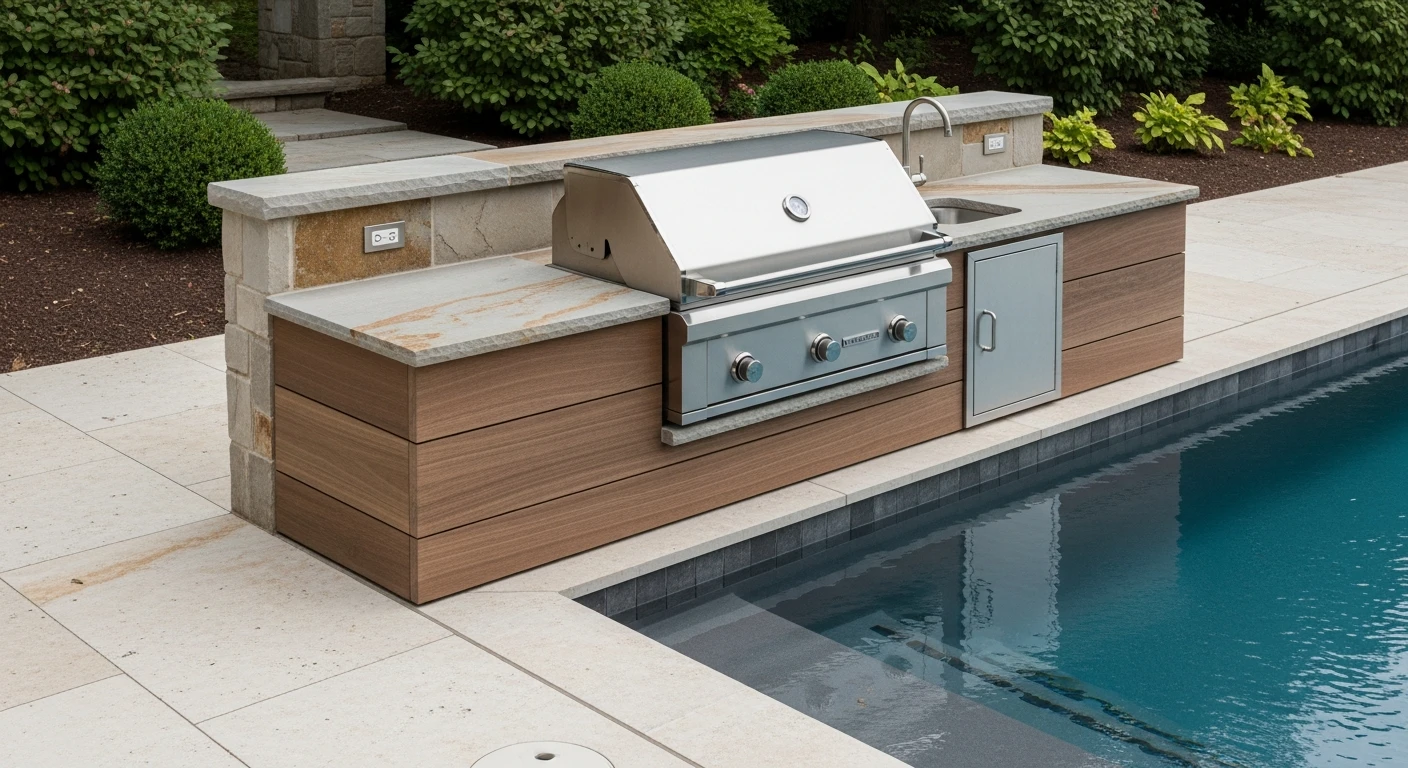
Custom Built Outdoor Kitchens in Hillsborough County: My Weatherproofing Protocol to Triple Material Lifespan
I've lost count of the number of custom outdoor kitchens I've been called to repair or completely rebuild across Hillsborough County, from the waterfront homes in South Tampa to the sprawling backyards in Brandon. The common denominator is almost always material failure caused by a fundamental misunderstanding of our local climate. Standard building practices that work up north are a recipe for disaster here; our relentless humidity, intense UV exposure, and salty air (especially near the bay) will degrade a poorly planned project in less than five years. It’s a costly and frustrating outcome for homeowners.
My entire approach is built on a single premise: an outdoor kitchen in this region is not a piece of cabinetry, it's a marine-grade installation. The core of my work isn't just design; it's a material science and engineering protocol I developed after seeing a high-end project in Tampa Palms fail catastrophically. The builder used standard exterior-grade materials, and the moisture intrusion led to a complete structural collapse. My method focuses on preventing water vapor from ever penetrating the core structure, which can increase the functional lifespan of the kitchen by an estimated 200%.
The Hillsborough Humidity Failure Point: A Diagnostic Framework
Before I even sketch a design, I perform a diagnostic I call the "Environmental Stress Assessment." This isn't just about measuring space; it's about mapping the specific micro-climate of the property. A home in Westchase faces different challenges than one on Davis Islands. The latter requires an immediate focus on preventing galvanic corrosion due to salt spray, a detail most builders overlook. My framework isolates three critical failure points that are amplified by our local weather: material porosity, hardware degradation, and trapped moisture within the structure.
I learned this the hard way on an early project where I used a popular, sealed granite for a countertop. The homeowner was diligent with upkeep, yet after three years, the substrate beneath the granite showed signs of delamination. The issue wasn't the top seal; it was water vapor wicking up through the concrete block base. That's when I realized the entire system, not just the surface, has to be hydrophobic (water-repellent) and vapor-impermeable.
Deconstructing the Core Durability Matrix
My proprietary methodology, the "Core Durability Matrix," directly addresses these failure points. It’s a non-negotiable set of standards I apply to every project.
- Material Selection Beyond Aesthetics: Homeowners often select materials based on looks, but I steer them toward options with near-zero porosity. While sealed natural stone is an option, I often recommend materials like Dekton or other ultra-compact surfaces that are fundamentally non-porous. For cabinetry, I exclusively use marine-grade polymers (like HDPE) or, in specific applications, 316-grade stainless steel frames. I’ve seen beautiful wood-look cabinets made from standard PVC completely warp and discolor under the Florida sun; it’s a common but avoidable mistake.
- The 316 Marine-Grade Hardware Mandate: This is a critical "insider" detail. Many contractors use 304-grade stainless steel, marketing it as rust-proof. In the humid, often salty air of Hillsborough County, 304-grade will inevitably show surface rust (tea staining) and eventually fail at the joints. I mandate that every single piece of metal hardware—from screws and hinges to drawer pulls and vent covers—must be 316 marine-grade stainless steel. The added molybdenum content provides a dramatic increase in corrosion resistance, a crucial investment that prevents a 25% reduction in hardware lifespan.
- Engineered Air Gaps & Ventilation: A sealed box in our climate is a moisture trap. My designs incorporate engineered air gaps and concealed ventilation channels within the cabinet structure. This allows for passive airflow, preventing the buildup of stagnant, humid air that leads to mold, mildew, and accelerated decay of any organic material nearby. It's a subtle detail that makes a monumental difference in long-term structural integrity.
The Build Protocol: From Foundation to First Grill
Execution is everything. A brilliant plan with sloppy implementation is worthless. My process is a meticulous sequence where each step builds upon the last to create a monolithic, weather-resistant structure.
- Foundation & Drainage Plane: We begin by pouring a concrete slab that is precisely graded to ensure water flows away from the structure and the main home. Before framing begins, I apply a liquid-applied waterproofing membrane to the entire slab, creating the first layer of moisture defense.
- Non-Combustible Framing: The kitchen's skeleton is built with welded aluminum or galvanized steel studs. I never use wood framing, regardless of treatment. It’s simply not a variable I’m willing to entertain in this climate. All utility lines (gas, electric, water) are run and secured before any cladding is attached.
- Cladding & Countertop Integration: Cement board or a similar waterproof backer is installed over the frame. Every seam is meticulously sealed with a polyurethane-based, marine-grade sealant. When the countertops are installed, the joint between the counter and the base is not just caulked; it’s sealed with the same high-performance sealant to create a truly watertight bond.
- Appliance & Component Installation: Every appliance, from the grill to the refrigerator, is installed using the manufacturer-specified insulating liners. A common error I fix is seeing grills installed too close to combustible materials or without proper ventilation, creating a fire hazard and causing damage to the structure. This is a critical safety checkpoint.
Post-Installation Audit: The 25-Point Quality Checklist
My job isn't done when the last screw is tightened. I conduct a rigorous post-installation audit to stress-test the final product. This isn't a simple walkthrough; it's a quality assurance protocol. Key checkpoints include a high-pressure water ingress test on all seams and appliance openings to simulate a hurricane-force downpour. I also perform a full gas line pressure-drop test for 30 minutes to ensure there are absolutely no leaks in the connections. Finally, every drawer and door is checked for alignment, and every piece of hardware is given a final torque check. This obsession with detail is what separates a kitchen that looks good for a year from one that performs for decades.
Now that you understand the material science involved, have you considered how the galvanic potential between your stainless steel grill and an aluminum frame could lead to accelerated corrosion in Hillsborough's salty air?