Custom Made Outdoor Kitchen in Lee County: A Framework for 30-Year Material Longevity Against Salt Air
Designing a custom outdoor kitchen in Lee County isn't about aesthetics alone; it's a battle against atmospheric chemistry. I've seen countless beautiful but poorly engineered projects in Fort Myers and Cape Coral degrade in under five years due to our unique combination of humidity, intense UV radiation, and, most critically, salt spray corrosion. A generic approach guarantees failure. The key is engineering for the environment from the ground up, a process that can increase the functional lifespan of your investment by over 300%. My entire design philosophy is built on mitigating these local environmental stressors before a single cabinet is ordered. The common mistake I consistently see is selecting materials based on indoor kitchen standards. This oversight leads to rusted appliance housings, warped cabinet doors, and stained countertops. My methodology focuses on a material-first approach, ensuring the structural and aesthetic integrity of your outdoor kitchen can withstand a decade on Sanibel Island as well as it does a year in Lehigh Acres.My Coastal Durability Framework: Beyond Standard Construction
Over the years, I developed what I call the Coastal Durability Framework. It’s not just a checklist; it’s a diagnostic system I apply to every project, from compact lanais in Estero to expansive waterfront setups in Bonita Springs. The framework moves beyond the generic "work triangle" and focuses on two core pillars: environmental material science and hyper-realistic use-case mapping. It’s about predicting failure points based on the specific micro-environment of a property and designing them out from the start.Material Forensics: The Non-Negotiable First Step
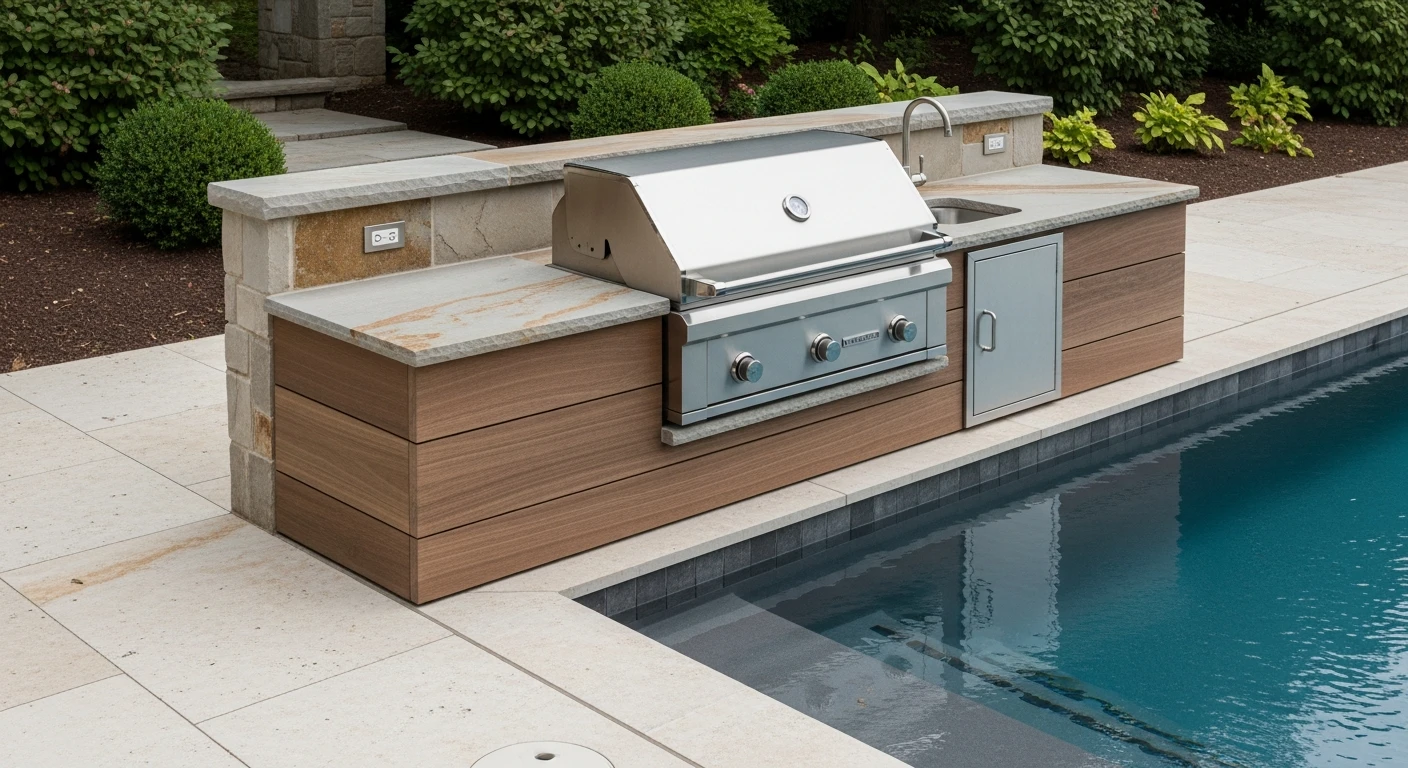
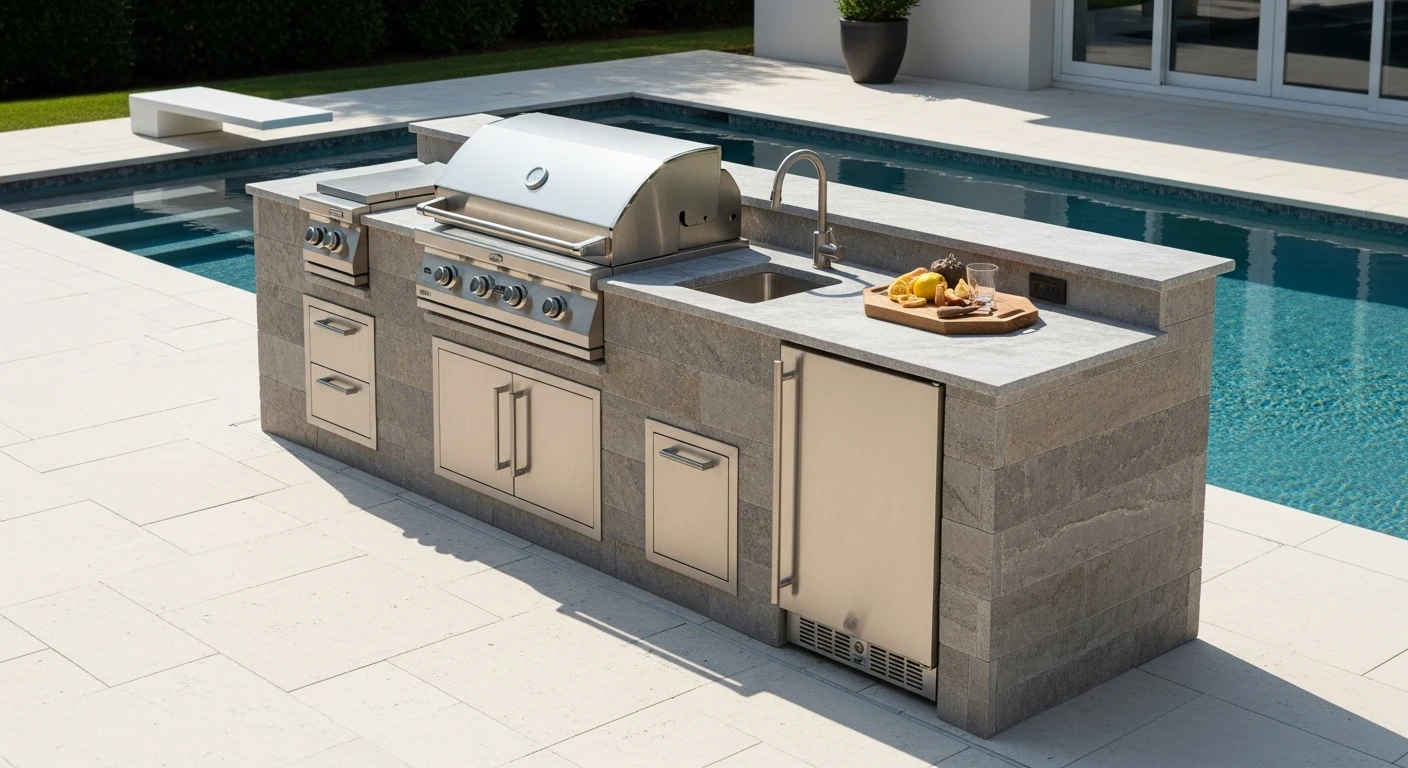
This is where most projects go wrong. A "stainless steel" grill purchased from a big-box store is often made from 304-grade steel. While fine for inland climates, here in Lee County, it will show pitting and rust within 24 months. I learned this the hard way on an early project near Fort Myers Beach. Now, my absolute baseline requirement is 316L marine-grade stainless steel for all metallic components, from grill bodies to cabinet handles. Its molybdenum content provides superior resistance to chloride and salt corrosion. For cabinetry, I steer clients away from wood and powder-coated steel. The humidity causes wood to swell and rot, while any scratch in the coating on steel becomes an entry point for rust. My go-to solution is high-density polyethylene (HDPE) or sealed PVC polymer cabinetry. It’s a closed-cell material, meaning it’s 100% waterproof, impervious to salt, and won't delaminate. For countertops, I specify non-porous materials like Dekton or quartzite. Unlike granite, they don't require constant sealing and won't harbor mildew in our humid climate.The Implementation Blueprint: From Bare Lanai to Functional Hub
Building an outdoor kitchen that lasts in Lee County requires a precise sequence of operations. A misstep in the initial phase can compromise the entire structure. Here is my core installation protocol:- Environmental Site Assessment: I personally analyze the site for sun exposure patterns, prevailing breezes, and proximity to salt water. This dictates appliance placement to minimize corrosion and maximize user comfort.
- Utility Master Plan: I map out and specify dedicated GFCI-protected circuits for refrigerators and lighting, and a properly sized, professionally installed gas line. A common, dangerous error is under-sizing the gas line, which starves appliances of fuel.
- Foundation and Framing: The frame must be non-combustible and non-corrosive. I exclusively use welded aluminum or galvanized steel framing, never wood. This structure is then anchored to the concrete slab to meet our local hurricane code requirements.
- Appliance and Cabinetry Integration: This is a critical step. Each appliance requires specific ventilation clearances. I ensure every unit is installed with proper insulation and ventilation shafts, especially for grills installed under a covered lanai, to prevent heat damage and soot buildup.
- Countertop and Component Installation: The final step involves meticulous sealing of all joints and entry points. I use a marine-grade silicone sealant to ensure a completely waterproof barrier against our torrential summer rains.
Precision Tuning for Lee County's Climate
Once the core structure is built, the fine-tuning begins. This is what separates a standard build from a truly resilient one. For any kitchen under a roof, a ventilation hood isn't a luxury; it's a necessity. I specify hoods with a minimum of 1200 CFM (Cubic Feet per Minute) and, again, constructed from 316L stainless steel. This prevents grease and smoke from staining the lanai ceiling and creating a fire hazard. Furthermore, I design subtle drainage gradients into the countertop and floor plan to manage our heavy rainfall, preventing pooling water that can accelerate material decay. Every detail is a calculated defense against the local climate. Considering the high humidity and salt content unique to Lee County's coastal and inland areas, are your current outdoor kitchen plans based on a material's catalog photo or its specific molecular resistance to chloride-ion-induced corrosion?Written by

Tags
custom outdoor kitchen
custom outdoor kitchens near me
design your own outdoor kitchen
custom bbq island
custom built outdoor kitchen