Custom Made Outdoor Kitchen in Pasco County: My Framework for 100% Salt Air Corrosion Resistance
After designing and building dozens of outdoor kitchens across Pasco County, from the newer developments in Trinity to the waterfront properties in Hudson, I've seen one catastrophic, recurring failure. It’s not the grill that fails first, nor the refrigerator. It's the structural integrity of the kitchen itself, eaten away by our unique combination of intense humidity, blistering sun, and corrosive salt air. Most builders use methods that are simply not engineered for the Suncoast climate, leading to rust, rot, and delamination within 3-5 years. My entire approach is built on preventing this specific, expensive failure. The mistake I often see is a focus on the "sheen" of the appliances while completely neglecting the material science of the underlying structure. An outdoor kitchen in Wesley Chapel faces different environmental stressors than one in New Port Richey, and a one-size-fits-all approach is a recipe for a teardown. My methodology focuses on a **material-first design philosophy** that guarantees a minimum 15-year structural lifespan, even in the harshest coastal conditions.The Pasco County Outdoor Kitchen Failure Audit: My Diagnostic Protocol
Before I even sketch a design, I perform what I call a "Failure Audit." This is a diagnostic process I developed after being called in to fix a massive, two-year-old outdoor kitchen in a Seven Springs home that was literally crumbling. The builder had used a standard galvanized steel frame with green board—a combination that trapped moisture and rusted from the inside out. My protocol now centers on identifying and eliminating these potential failure points from day one. The core of my audit involves assessing three critical environmental factors specific to the property's location within Pasco County: **Airborne Salinity Level**, **Direct UV Exposure Index**, and **Substrate Moisture Content**. A property east of the Suncoast Parkway has vastly different material requirements than one west of US-19. Ignoring this is the single most common error I see. My proprietary **Coastal Durability Framework** is not about aesthetics; it’s a technical specification for material selection and assembly techniques designed to counteract these local forces.Deep Dive: Material Selection for the Suncoast Climate
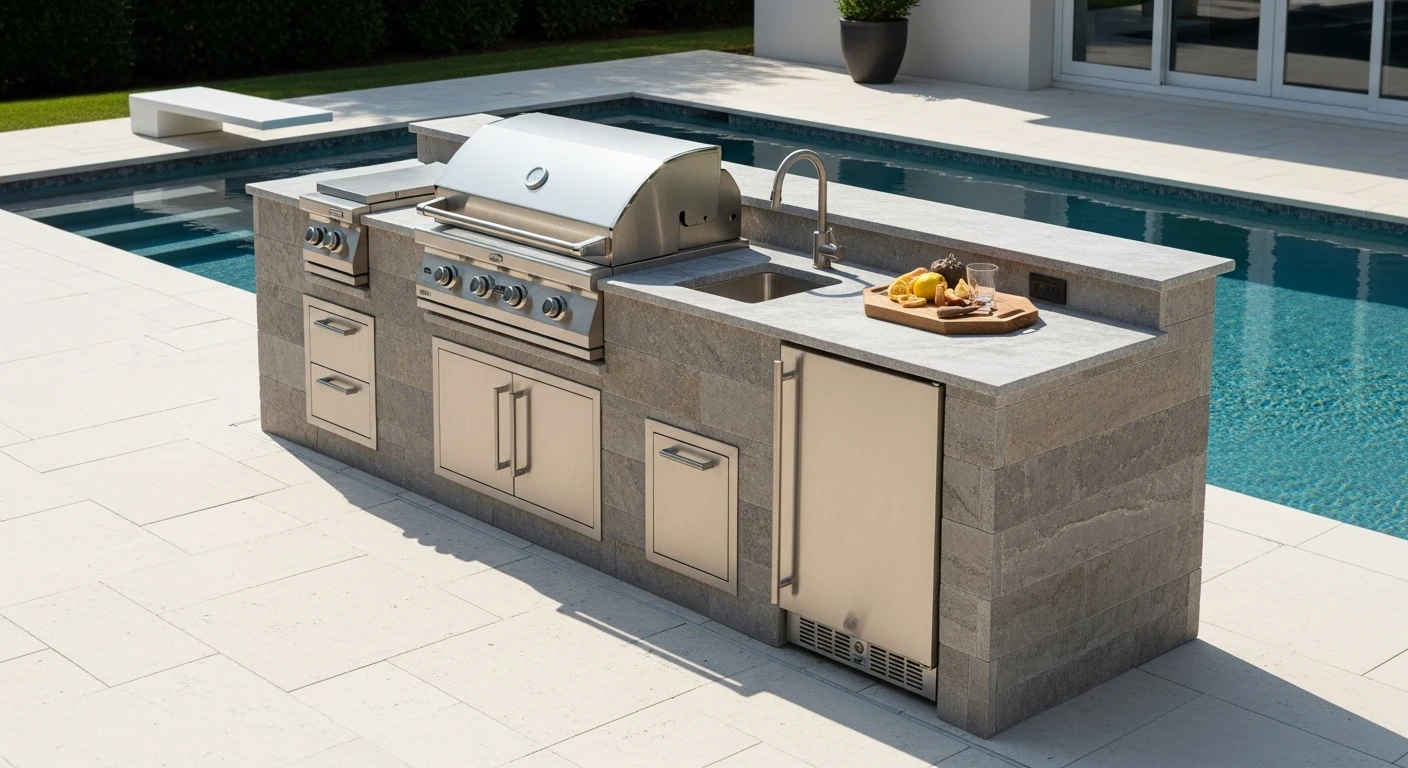
The materials are the heart of a resilient outdoor kitchen. Here’s a breakdown of my non-negotiable specifications for Pasco County builds, based on years of field testing and observing competitors' failures.- Structural Frame: I exclusively use either 100% welded T6061 aluminum framing with a marine-grade powder coat or reinforced concrete block (CMU). I abandoned steel studs entirely after seeing them fail repeatedly. For aluminum, the key is the welding process and the coating; anything less than a high-performance powder coat will oxidize.
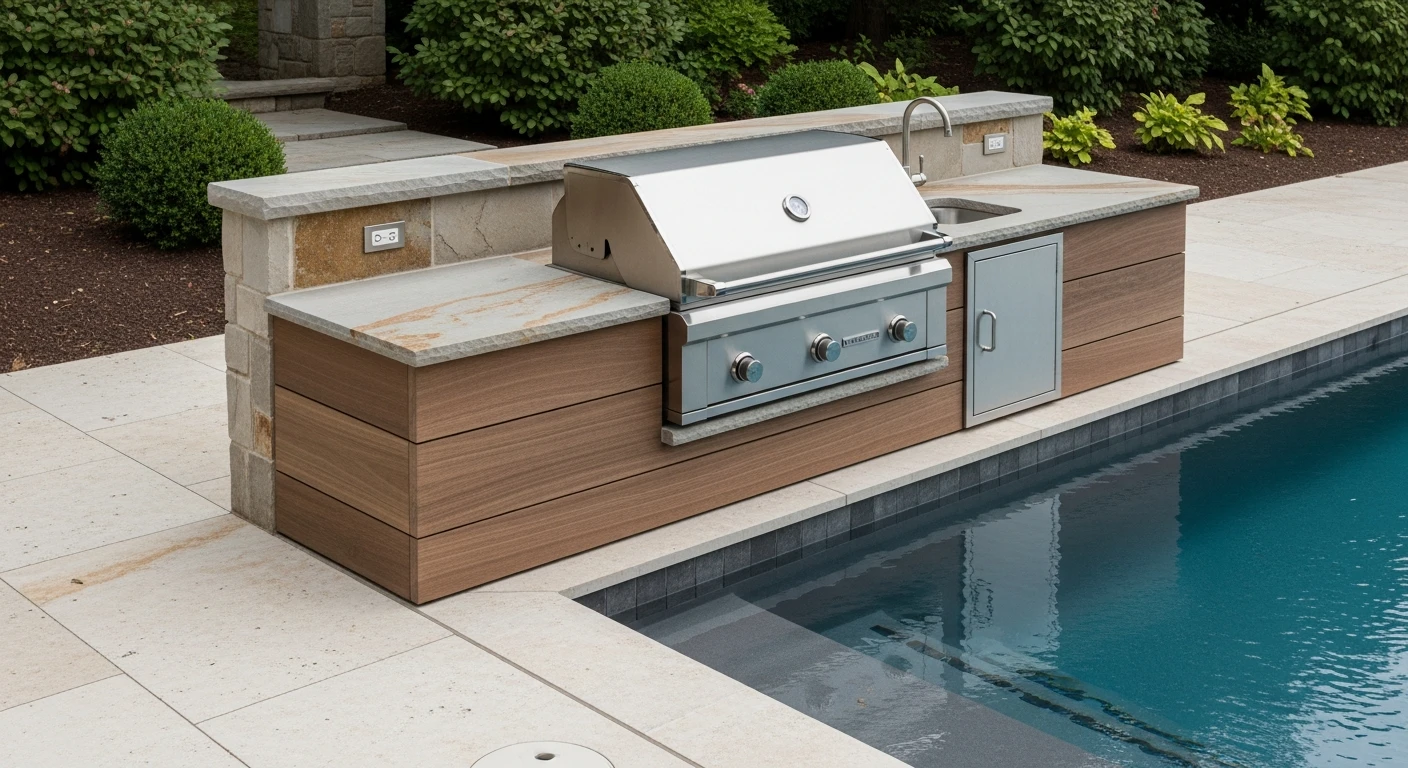
- Cabinetry & Cladding: Forget wood or wood-composite materials. My standard is high-density polyethylene (HDPE) or other marine-grade polymers. These materials have **zero water absorption** and are UV-stabilized, preventing the chalky fading you see on cheaper materials after just one Florida summer.
- Countertops: While granite is a good option, I often steer clients toward sintered stone like Dekton. Unlike many quartz products whose resins can yellow under intense UV exposure, sintered stone is completely impervious to sunlight and thermal shock. I saw a client's expensive quartz countertop in a Land O' Lakes home develop yellow spots around the grill from the combined heat and sun; this is a preventable issue.
- Hardware: Every single screw, hinge, and drawer slide must be 316-grade stainless steel. This is non-negotiable. Using the cheaper 304-grade is a common cost-cutting measure, but it will show surface rust within a year, especially in our humid environment.
From Foundation to First Grill: The 5-Phase Implementation Process
A flawless design means nothing without meticulous execution. My process is rigid and ensures every stage is verified against my durability standards.- Phase 1: Site Prep & Utility Mapping: We start by verifying setback and code requirements with Pasco County Planning and Development. We precisely map out gas, water, and electrical lines. A critical step here is pouring a monolithic concrete slab with a **minimum 4,000 PSI rating** and integrated vapor barrier, which prevents ground moisture from wicking up into the structure.
- Phase 2: Frame Assembly & Leveling: The welded aluminum or CMU frame is installed. I mandate a **maximum tolerance of 1/16th of an inch** across the entire length for levelness. This precision is critical for proper countertop installation and appliance fitment later.
- Phase 3: Cladding & Component Installation: The facade materials and cabinet boxes are attached using only 316 stainless steel fasteners. I ensure there are adequate **ventilation panels** installed, a step often missed that is crucial for allowing any trapped moisture to escape and for safely venting gas appliances.
- Phase 4: Appliance Integration & Connection: All appliances are installed, sealed with high-temperature silicone, and connected. All electrical connections are made within weatherproof boxes using GFCI outlets, a critical safety measure given Pasco’s frequent lightning storms.
- Phase 5: Countertop Templating & Final Sealing: We create a precise template for the countertop on-site. After installation, every seam and edge is sealed with a UV-resistant, mold-proof sealant to create a completely impervious surface.
Post-Installation QA: My Pasco-Specific Durability Checklist
My job isn't done when the last appliance is installed. I perform a final quality assurance check using a 15-point checklist I developed specifically for our local climate. This includes verifying the countertop has a **minimum 1/8-inch per foot slope** away from the wall for proper rainwater drainage, pressure testing all gas connections to 1.5x their operating pressure, and performing a full water-immersion test on all sealed areas to check for leaks. This final step is what separates a good-looking kitchen from one that will actually perform for decades. Have you asked your builder about the specific tensile strength of their frame fasteners or the measured UV-degradation rating of their proposed cabinet materials?Written by

Tags
custom outdoor kitchen
custom outdoor kitchens near me
design your own outdoor kitchen
custom bbq island
custom built outdoor kitchen