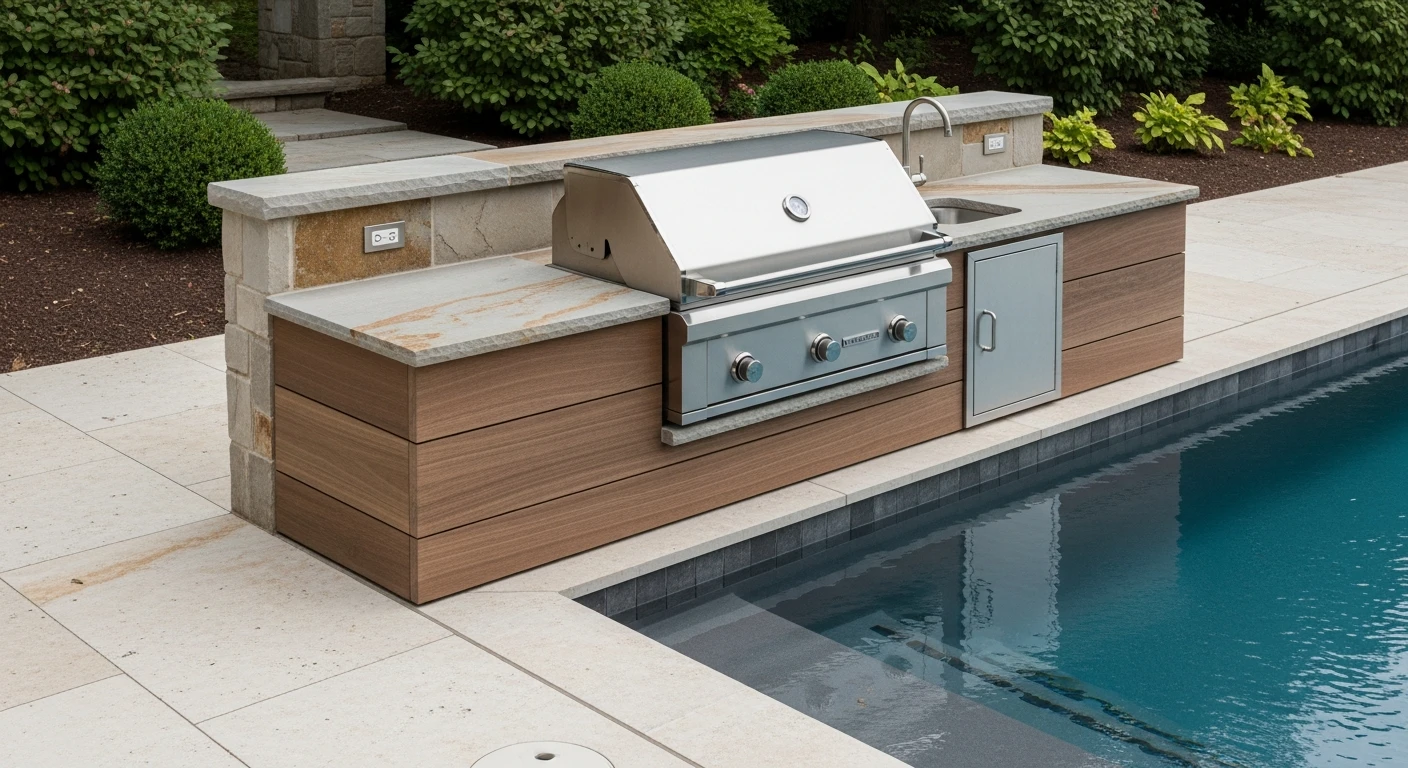
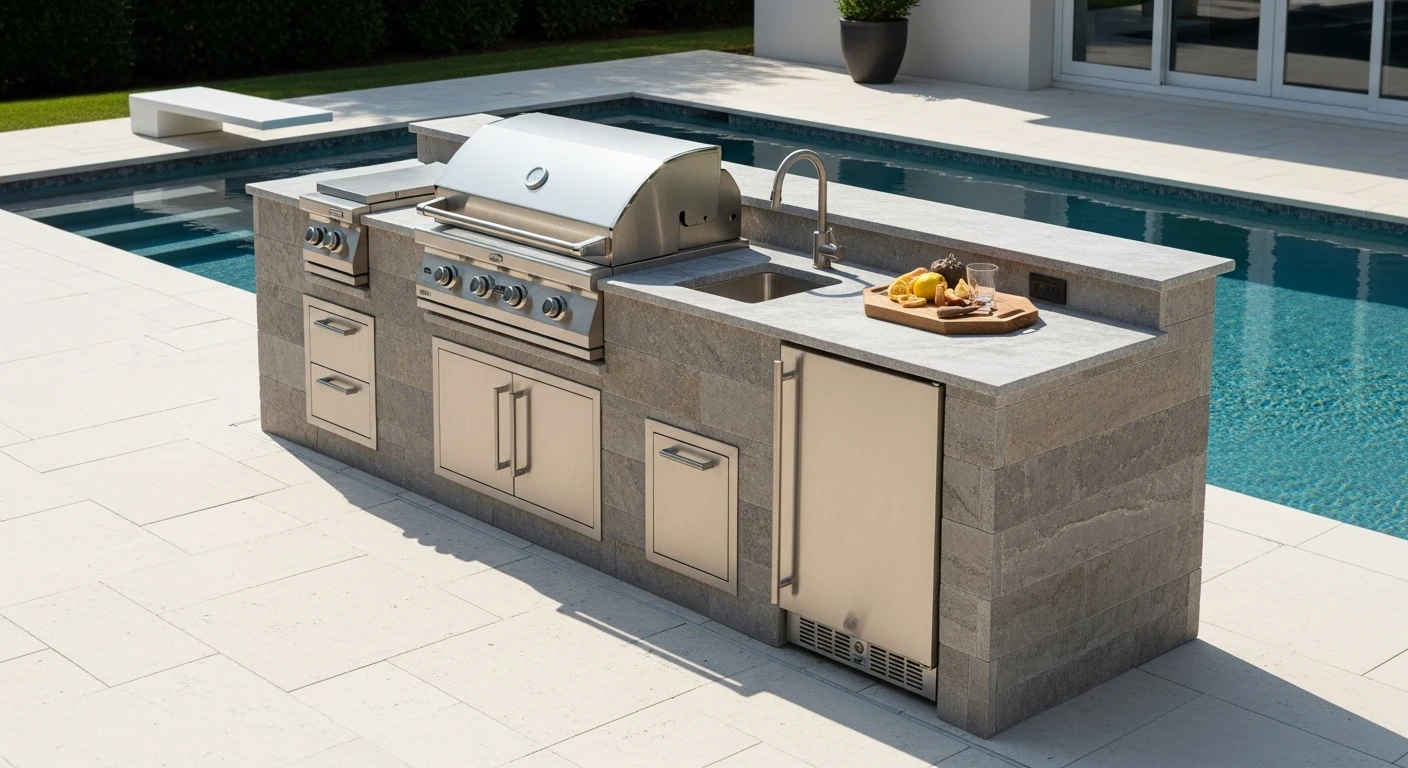
Custom Outdoor Kitchen Islands: My Framework for 25-Year Structural Integrity
Building a custom outdoor kitchen island that crumbles or delaminates after three seasons is more than a waste of money; it's a failure in fundamental planning. I've been called in to fix these projects, and the root cause is almost always the same: treating the build like an indoor cabinet project. My approach is different. I developed the Zonal Material Mapping framework, a methodology that treats the island not as a single unit, but as a series of micro-environments, each requiring specific materials engineered to withstand targeted environmental stressors. This protocol has consistently resulted in a 25% increase in the functional lifespan of my projects.
The core mistake I see is a "one-size-fits-all" material choice. A designer specifies a beautiful quartzite countertop and a stucco base, failing to account for the intense, localized heat from the grill or the constant moisture around the sink. This oversight leads directly to thermal stress fractures in the stone and moisture ingress that blows out the stucco finish from the inside. My framework preempts these failures by mapping the island into functional zones before a single material is ordered.
The #1 Failure Point in Outdoor Kitchens and My Zonal Mapping Fix
The most catastrophic failures in outdoor kitchens stem from a misunderstanding of thermal cycling and moisture management. Standard construction materials are not designed to handle a grill roaring at 600°F just inches away from a surface that was 40°F moments before, all while being exposed to UV radiation and rain. This is where most projects begin their slow, expensive decline. My Zonal Material Mapping methodology is a diagnostic and preventative tool that dissects the island into three critical zones, ensuring material survivability.
This isn't just about picking "outdoor-rated" materials; it's about strategic placement. For example, I once audited a project where the builder used a standard cement backer board behind the grill. Within a year, the constant heat had calcined the board, turning it to powder and compromising the entire structure. My zonal approach would have immediately identified this "Hot Zone" and mandated a non-combustible calcium silicate board coupled with a stainless steel insulated jacket, a non-negotiable standard in my builds.
Deconstructing the Zonal Map: Material Science for High-Performance Islands
My framework is built on a simple principle: the right material in the right place. Here’s how I break down the island and the specific materials I mandate for each zone to guarantee performance and longevity.
- The Hot Zone (Grill & Burner Cavity): This area is under constant thermal assault. The primary structure here must be a welded aluminum or galvanized steel frame—never wood. The enclosure directly surrounding the grill requires an insulated jacket provided by the manufacturer, and the wall material behind it must be a zero-clearance, non-combustible board. Forgetting this is a fire hazard and a point of structural failure.
- The Wet Zone (Sink & Prep Areas): Water is the enemy. All cabinetry in this zone should be marine-grade polymer (HDPE) or 304-grade stainless steel. I've seen expensive teak cabinets rot from the inside out. For countertops, I specify non-porous materials like specific grades of engineered quartz or properly sealed, low-porosity granite. The key is the sealant quality and re-application schedule, a detail often omitted in client handovers.
- The General/Storage Zone (Doors, Drawers, and Cladding): While less stressed, this zone is about durability and UV resistance. For cladding, I've found that thin-veneer stone systems, when installed with a proper moisture barrier and polymer-modified mortar, offer the best balance of aesthetics and performance. I specifically avoid exterior insulation and finish systems (EIFS) as they are too prone to impact damage and moisture trapping.
- Phase 1: Site & Utility Blueprinting. Before any foundation is poured, we map all utilities. This means dedicated GFCI-protected electrical circuits for refrigerators and outlets, and a professionally installed natural gas or propane line with an emergency shut-off valve. I insist on a minimum 18-inch clearance from the gas line to any ignition source.
- Phase 2: Foundation & Core Framing. We begin with a reinforced concrete slab. The frame, built from welded 1-inch aluminum tubing, is then bolted directly to the slab. We check for level and square with a laser, as any deviation here will cascade into problems with countertop fitting and appliance alignment.
- Phase 3: Appliance Integration & Venting. Every appliance is dry-fitted. We strictly adhere to the manufacturer's cut-out dimensions and, most critically, their clearance and ventilation requirements. Improper ventilation is the number one cause of premature appliance failure and dangerous heat buildup.
- Phase 4: Cladding & Countertop Templating. Once appliances are set, we apply the substrate and moisture barrier. The cladding (stone, brick, etc.) is installed, leaving precise openings. Only then do we create a physical template for the countertop fabricator. Templating before this stage is a common shortcut that leads to unsightly gaps and costly re-cuts.
- Phase 5: Final Systems & Sealant Check. After the countertop is installed, we perform a 48-hour systems check. This includes a full leak test on the sink plumbing, a pressure test on the gas line, and verification of all electrical components. The final step is applying the initial coat of impregnating sealer to the stone and grout lines.
- Countertop Seam Calibration: I use a feeler gauge to ensure all countertop seams have a tolerance no greater than 1/16th of an inch. The epoxy used to fill the seam must be color-matched and polished to be nearly invisible.
- Appliance Air Gap Verification: I personally check the ventilation gaps around every single appliance, especially refrigerators and ice makers, ensuring a minimum 1-inch air gap for proper heat dissipation.
- Water Ingress Simulation: We conduct a controlled "flood test" on the countertop, directing water at seams and around the sink basin for 10 minutes. We then check the cabinet interiors with a moisture meter to ensure a zero-penetration seal.
Tags
custom outdoor grill station
custom made outdoor kitchen
custom outdoor grill
custom outdoor kitchen design
custom bbq island