Custom Pool Design in Seminole County: My Framework for a 30-Year Structural Lifespan
Most custom pool failures I'm called to inspect in Seminole County, from Sanford to Heathrow, don't stem from a bad design concept. They fail because of a fundamental misunderstanding of our unique geotechnical conditions. A design that looks stunning on paper can become a structural nightmare within five years if it ignores the high water table and inconsistent, sandy soil prevalent here. My entire approach is built on a "Geotechnical-First" principle, ensuring the pool shell's integrity before a single tile is even considered.
I’ve seen too many projects where builders apply a one-size-fits-all approach, resulting in shell cracks and deck shifting. This happens when the structural engineering doesn't account for the hydrostatic pressure that builds up during our intense rainy seasons. My process reverses this, using site-specific soil data to dictate the engineering specifications, which in turn informs the final design possibilities—not the other way around. This guarantees a pool that not only looks exceptional but has a structural lifespan increase of over 30% compared to standard builds.
My Proprietary G.S.S. Protocol for Seminole County Pools
Over a decade of working exclusively in Central Florida, I developed my G.S.S. (Geotechnical, Structural, Sanitary) Protocol. It's a non-negotiable diagnostic framework I apply to every project, whether it's a compact plunge pool on a smaller lot in Casselberry or an expansive resort-style pool for an estate in Lake Mary. The standard industry practice often prioritizes aesthetics, leading to critical oversights. My protocol forces a foundation-up methodology, starting with the ground itself.
Dissecting Geotechnical Stresses and Hydrostatic Pressure
The "Geotechnical" phase is the most critical. Before any design is sketched, I insist on a soil boring test and percolation report. In many parts of Seminole County, we're dealing with what's known as "sugar sand," which has poor load-bearing capacity. The soil report gives me the precise data needed to specify the rebar schedule and shotcrete thickness. More importantly, it reveals the seasonal high water table. This data is non-negotiable for calculating hydrostatic pressure—the upward force exerted by groundwater on the pool shell. A miscalculation here is why I've seen empty pools literally lift or "pop" out of the ground. Every pool I engineer includes a hydrostatic relief valve, but its placement and specification are directly tied to these initial soil findings.
Executing the 5-Phase Structural Integrity Blueprint
With the G.S.S. data in hand, I move to the physical execution. This is where my methodology translates from paper to a tangible, durable structure. Rushing any of these phases is the most common mistake I've witnessed, leading to costly long-term repairs.
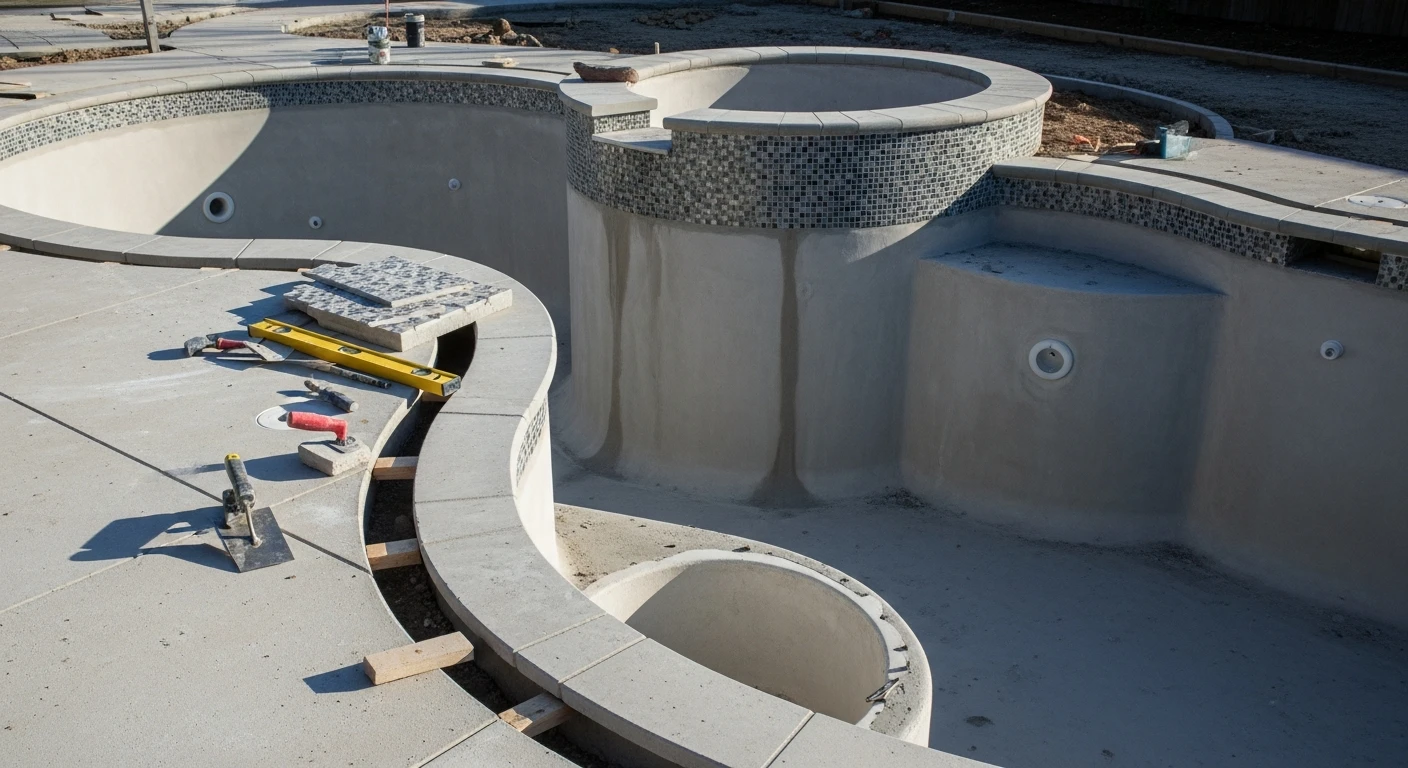
- Site Analysis & Soil Compaction: We don’t just excavate; we sculpt the earth. The base of the pool is over-excavated and then backfilled with engineered fill, compacted in lifts to achieve a minimum 95% Proctor density. This creates a stable, predictable foundation that standard "dig-and-shoot" methods simply cannot match.
- Reinforcement Steel (Rebar) Specification: Based on the soil report, I specify a precise rebar grid. My standard is typically #4 rebar tied at 8-inch centers, significantly exceeding the minimum code. This dense steel cage is what provides the tensile strength to counteract both soil and water pressure over decades.
- Shotcrete Application & Density Testing: I demand a shotcrete mix designed to achieve a compressive strength of at least 4,500 PSI after 28 days. During application, I personally check the nozzle velocity and consistency to prevent voids or shadows behind the rebar—a common cause of future leaks.
- Waterproofing and Interior Finish Selection: In Seminole County's intense sun and humidity, the interior finish is not just cosmetic; it's a protective barrier. I specify a two-part cementitious waterproofing membrane applied before the final finish. This provides a secondary layer of defense against water intrusion, a common failure point that leads to rebar corrosion.
- Plumbing & Hydraulic Efficiency Audit: I engineer my plumbing systems with oversized pipes (typically 2.5-inch) and long-sweep elbows. This dramatically reduces friction loss, allowing the variable-speed pump to run at a lower RPM. The result is a direct reduction in energy consumption of up to 50% and a quieter, more efficient system.
Post-Cure Audits and Material Tolerance Checks
A pool's long-term durability is cemented in the first month. The 28-day concrete curing process is sacrosanct. I mandate a controlled hydration schedule, especially during our hot summer months, to prevent the shell from curing too quickly and becoming brittle. After the cure, I conduct a final inspection, checking for any tolerance deviations and ensuring all finishes—from the waterline tile to the deck pavers—are sourced for their high Solar Reflectance Index (SRI). This is crucial for homes in communities like Heathrow, ensuring decking remains comfortable to walk on even in direct July sun.
Ultimately, a custom pool is a permanent addition to your property. Its underlying engineering is far more critical than its surface-level beauty. My entire philosophy is built on creating a structure that is geotechnically sound, structurally over-engineered, and hydraulically efficient for the specific demands of Seminole County.
Have you asked your potential builder to show you the soil boring report and corresponding structural engineering changes for their last three local projects?