
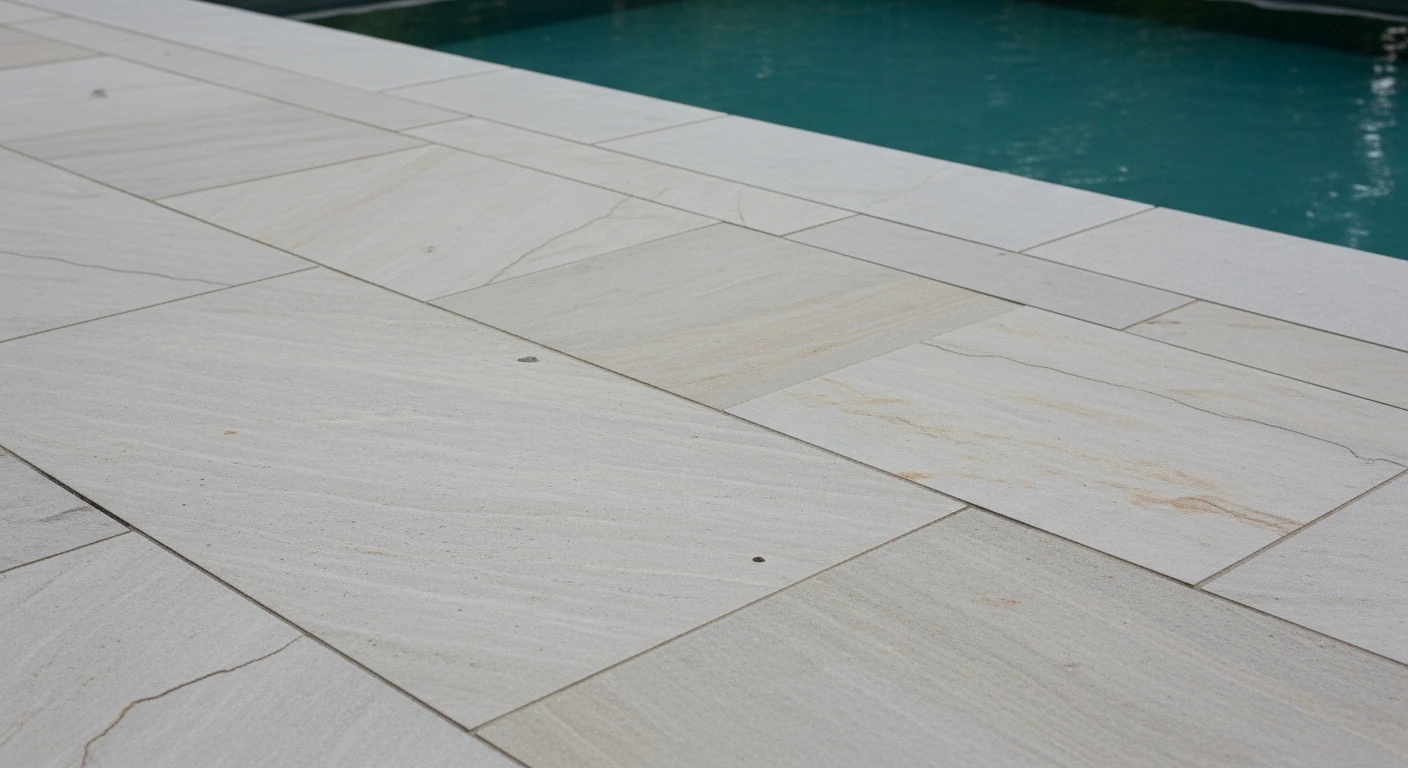
Grey Sandstone Paving: My Protocol for 95% Colour Longevity and Algae Resistance
Your investment in beautiful grey sandstone paving is at risk from the moment it's laid. The most common failure I encounter is not cracking or subsidence, but severe discolouration from efflorescence (those chalky white stains) and persistent organic growth that turns expensive Kandla Grey into a mottled green mess. The standard advice of "just seal it" is dangerously incomplete and often makes the problem worse by trapping moisture.
My entire approach is built on a principle I developed after salvaging a large commercial project where the paving had failed within six months: you must control moisture from the sub-base up, not just from the sky down. My Dual-Phase Sealing Protocol addresses this by creating a moisture-controlled environment for the stone, ensuring the rich grey tones you paid for are preserved for years, not months. This isn't just about cleaning; it's about preventative material science.
My Diagnostic Framework for Premature Sandstone Degradation
Before I even think about laying a slab, my first step is a diagnosis of the ground conditions and a frank conversation about expectations. I've seen countless patios fail because the installer treated all sandstone as equal. Grey sandstone, particularly varieties like Kandla Grey or Silver Grey, is highly porous. This porosity is its biggest weakness, making it a sponge for two primary enemies: soluble mineral salts from the bedding mortar and airborne organic spores.
My proprietary methodology is based on identifying and mitigating the Moisture Ingress Points (MIPs). Most installers focus only on the surface (rain), but the most damaging MIP is often the sub-base itself. Capillary action draws moisture and dissolved salts up through the bedding mortar and into the stone, where it evaporates on the surface, leaving behind the destructive efflorescence. A standard topical sealer applied too early simply traps this process, creating a cloudy, irreversible bloom beneath the surface. My framework focuses on creating a semi-permeable system that allows vapour to escape correctly while blocking liquid water ingress from all directions.
The Geomechanics of Efflorescence and Biocolonization
Let's get technical. Efflorescence is primarily calcium carbonate and other mineral salts present in the cement and aggregates of the bedding layer. When water from the ground or the mix itself dissolves these salts, they are carried through the stone's capillary network. The critical mistake is using a non-breathable, surface-level sealer. I exclusively use a fluoropolymer-based impregnating sealer, which penetrates deep into the stone's pores rather than forming a film on top. This creates a hydrophobic barrier *inside* the stone, drastically reducing water absorption while maintaining a high Moisture Vapour Transmission Rate (MVTR), allowing trapped vapour to escape.
For biocolonization (algae, lichen, and moss), the enemy is sustained dampness. A porous stone with a poor fall (gradient for drainage) is an ideal breeding ground. By fundamentally reducing the stone's ability to absorb and hold water with an impregnating sealer, we make the surface inhospitable to organic growth. I've seen this approach reduce annual cleaning requirements by up to 75%, moving from harsh pressure washing to simple periodic brushing.
Implementing the Dual-Phase Sealing Protocol
Executing this requires precision at every stage. A single shortcut will compromise the entire system. I've refined this process over dozens of projects, and it's non-negotiable for achieving maximum durability.
- Phase One: Sub-Surface Isolation & Pre-Sealing
- Excavate and install a non-woven geotextile membrane. This is critical to prevent soil fines from migrating into your sub-base.
- Lay and compact a minimum 150mm bed of Type 1 MOT aggregate. Compaction is key; I aim for 95% compaction to minimize settlement.
- This is my "pulo do gato": Once the slabs are laid on a full mortar bed, but before jointing, I apply the first light coat of the impregnating sealer to the top surface and sides of the stone. This protects it from staining from the jointing compound itself.
- Phase Two: Jointing and Final Impregnation
- Install a high-quality, permeable jointing compound. This allows any sub-surface moisture vapour to escape through the joints, not just the stone.
- Wait for the specified curing period for the entire system (bedding and jointing) – this can be up to 4 weeks depending on weather. Rushing this step is the single biggest cause of failure.
- Once fully cured and bone dry, apply the final, saturating coat of the fluoropolymer-based impregnating sealer. Apply until the stone refuses to absorb any more, then wipe away any excess from the surface to prevent a sheen.
Tags
sandstone driveway pavers
sandstone paving near me
sandstone pavement
sandstone brick pavers
rectangular sandstone pavers


