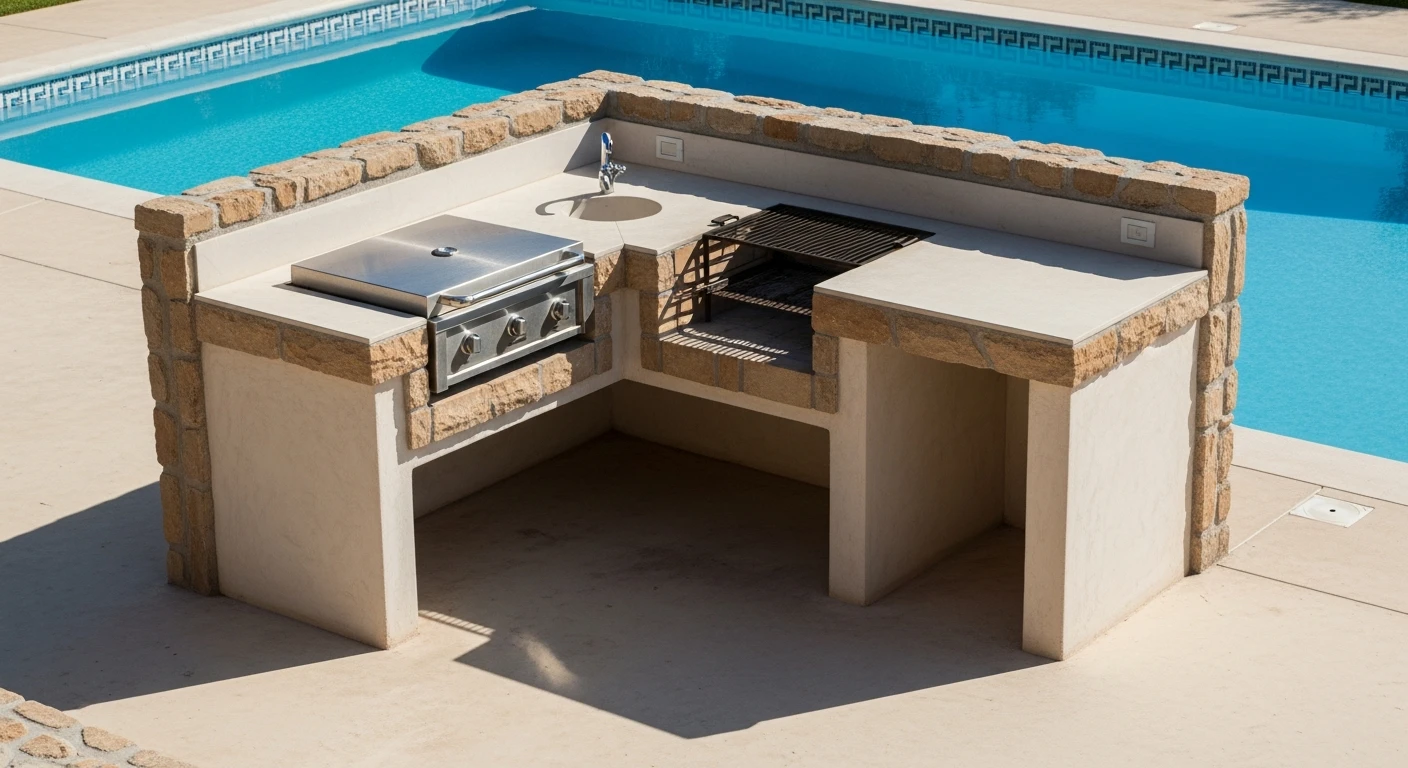
L Shaped Outdoor Grill Island: A Material Selection Protocol for 30-Year Durability in Charlotte County's Saline Air
I’ve lost count of the number of L-shaped outdoor kitchens I’ve been called to inspect in Punta Gorda and Port Charlotte that are failing prematurely. The common denominator isn’t poor workmanship; it’s a fundamental misunderstanding of our coastal environment. The combination of intense UV exposure, high humidity, and, most critically, the salt-laden air from the Gulf creates an aggressively corrosive environment that standard building materials simply cannot withstand. Homeowners invest heavily in beautiful stone veneers and high-end grills, only to see rust stains, cracked stucco, and delaminating countertops in under five years.
My entire approach is built on a "materials-first" principle that directly combats these local Charlotte County aggressors. Forget the generic advice you find online. The key to a multi-decade lifespan for your grill island is not the brand of the grill, but the chemical composition of the unseen structure and bonding agents holding it together. I'm going to detail the exact material specifications I use to engineer outdoor kitchens that thrive, rather than just survive, in our challenging climate.
My Diagnostic Framework for Coastal Outdoor Kitchens
Before I even sketch a design, I run every project through what I call my C.A.S.T. Framework (Coastal-Adapted Structural Triad). This isn't just a checklist; it's a diagnostic tool I developed after seeing a large-scale project in an Englewood waterfront community fail because the contractor used galvanized steel studs. The salt air found microscopic imperfections in the galvanization, and the entire frame began to disintegrate from the inside out within three years. The C.A.S.T. Framework ensures this never happens on a project I touch.
Deconstructing the C.A.S.T. Protocol: Material Specification Deep Dive
This protocol forces a decision on three critical, non-negotiable components. Getting any one of them wrong compromises the entire structure's longevity.
- Corrosion-Proof Framing: This is the absolute foundation. I exclusively mandate welded 6061-T6 aluminum alloy tubing for the frame. It is lightweight, incredibly strong, and, most importantly, forms a passive oxide layer that makes it inert to salt spray. I will not use galvanized steel, as its zinc coating is sacrificial and will eventually fail. All fasteners, access doors, and vent covers must be 316-grade stainless steel, which contains molybdenum for superior chloride corrosion resistance. Using the more common 304-grade is a critical error I often see.
- Airtight, Water-Impermeable Substrate: The frame needs a skin. Standard cement board is a frequent mistake; it's porous and acts like a sponge for our humid air, promoting mold growth and trapping moisture against the frame and internal components. My standard is a coated glass-mat sheathing or a high-density PVC board. These materials are 100% waterproof and provide no organic material for mold to feed on, ensuring the internal cavity of your island stays dry.
- Stable Thermal-Resistant Surfaces: Charlotte County's sun is relentless. This causes significant thermal expansion and contraction. For countertops, I steer clients in areas like Deep Creek away from porous granite and toward ultra-compact surfaces like sintered stone (Dekton). It has near-zero porosity, meaning no sealing is required, and its UV stability is unmatched. For the vertical veneer, I insist on using a polymer-modified thin-set mortar, which provides a stronger, more flexible bond to handle the expansion cycles without sheering the stone off the substrate.
From Blueprint to Reality: A Step-by-Step Implementation Checklist
Once the materials are specified via the C.A.S.T. Framework, the implementation phase becomes a matter of precision. Here is the exact sequence I follow for every L-shaped grill island build.
- Foundation and Layout: The process starts with a 4-inch thick, 3500 PSI concrete slab with rebar reinforcement. I ensure the slab is precisely level and pitched almost imperceptibly (1/8" per foot) away from the lanai or home to manage water runoff.
- Frame Fabrication and Placement: The 6061-T6 aluminum frame is TIG welded in my shop based on the final design, including precise cutouts for all appliances. This pre-fabrication minimizes on-site cutting and guarantees perfect alignment.
- Substrate and Component Installation: The waterproof substrate is attached to the frame using 316-grade stainless steel self-tapping screws. All electrical boxes for outlets are weatherproofed, and gas lines are pressure-tested. This is also when the critical insulated grill jacket is installed if the island structure is deemed combustible.
- Veneer and Countertop Templating: The stone or brick veneer is applied using the polymer-modified mortar, with clean grout lines. Once the veneer is set, a precise template for the countertop is created and sent for fabrication. This ensures a perfect fit with the correct overhangs.
- Final Installation and Sealing: The countertop is installed using a 100% silicone adhesive. I then apply a high-solids, penetrating silane-siloxane sealer to all grout lines to provide a final hydrophobic barrier against our driving rains.
The Final 5%: My Quality Assurance Protocol for Longevity
The job isn't done when the last stone is placed. My final quality check focuses on the small details that prevent future service calls. I ensure every appliance is grounded correctly and all outlets are GFCI-protected within "in-use" weatherproof covers. I check that the countertop has a slight "drip edge" cut underneath the overhang, which prevents water from running back along the underside and down the face of the cabinets. Finally, I confirm all ventilation ports are clear and unobstructed, a simple step that is crucial for both gas safety and preventing moisture buildup.
Given the aggressive coastal conditions, have you considered how you will manage galvanic corrosion between your 316-grade grill chassis and the aluminum support frame it rests upon?