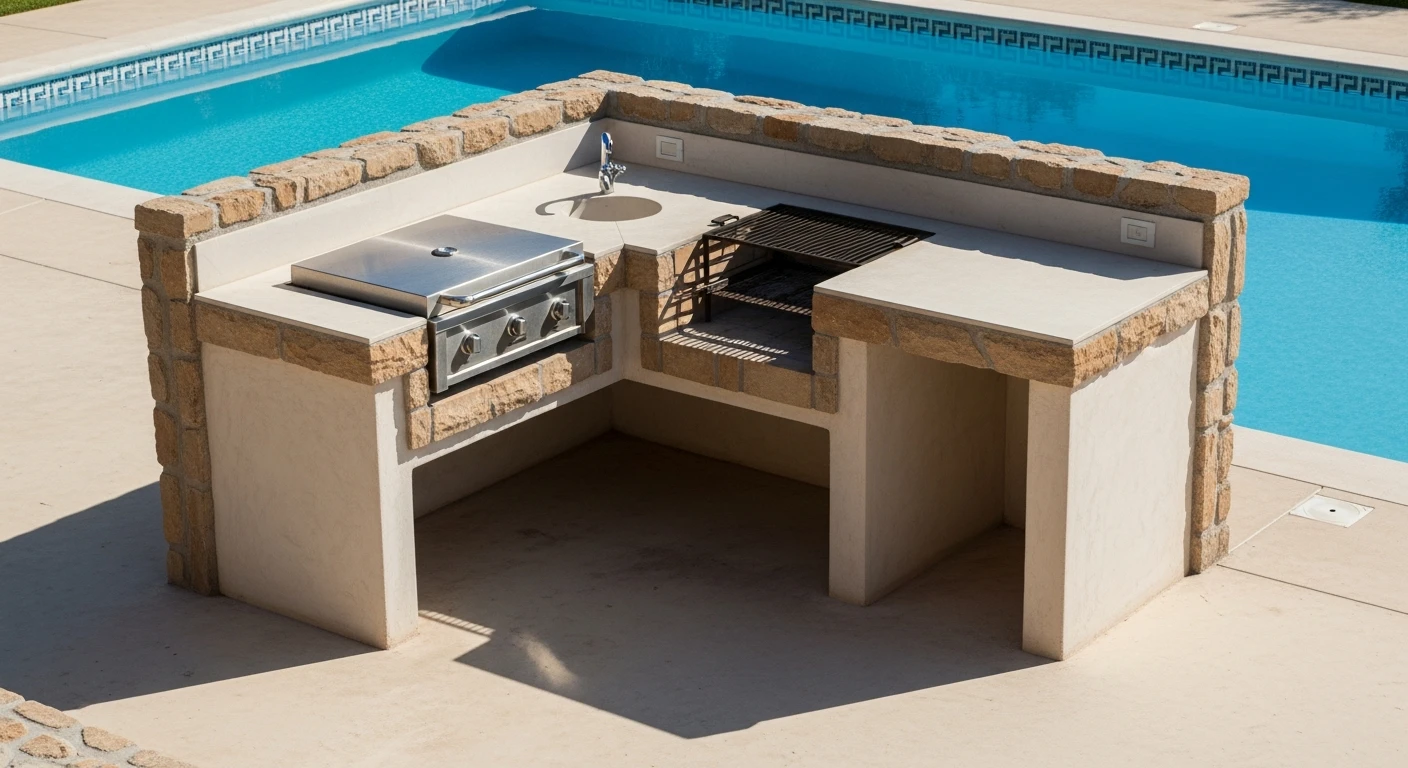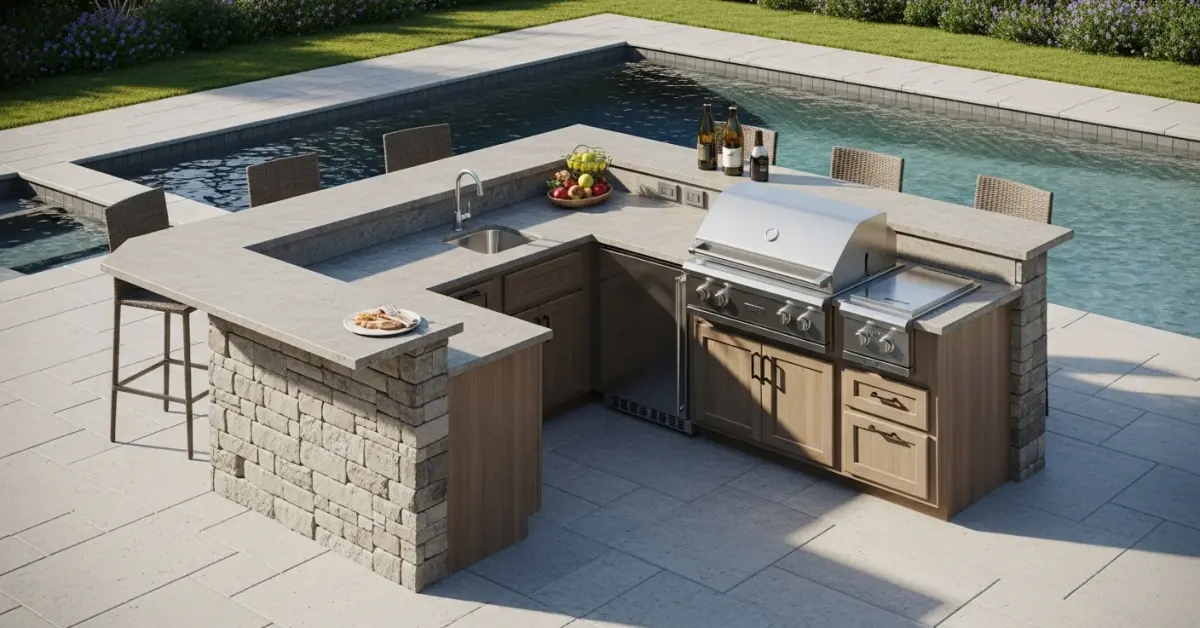
L Shaped Outdoor Kitchen with Bar: The Zonal Ergonomics Framework for a 30% Increase in Usable Space
Most L-shaped outdoor kitchen designs fail before the first stone is laid. The critical error I see, even in high-budget projects, is a fundamental misunderstanding of outdoor workflow. Designers often just copy indoor kitchen principles, like the classic "work triangle," which completely collapses when faced with radiant grill heat, guest flow, and weather exposure. This leads to a beautiful but functionally awkward space where the bar seating is unusable or the prep area is constantly in a smoke path.
My approach, the Zonal Ergonomics Framework, fixes this. It’s a methodology I developed after deconstructing dozens of dysfunctional outdoor kitchens. It’s not about just placing appliances; it's about creating distinct, purpose-driven zones—Hot, Cold/Wet, and Social—that work in harmony to maximize safety, efficiency, and the actual enjoyment of the space. By correctly separating these zones along the "L," we can reclaim up to 30% of what would otherwise be wasted or uncomfortable real estate.
The Core Flaw in Conventional L-Shaped Designs & My Zonal Methodology
The standard approach to an L-shaped kitchen is to place the grill on one leg and the sink on the other, with the bar on the outer edge. On paper, it looks balanced. In reality, it’s a recipe for failure. I once consulted on a project where a $15,000 grill was placed on the shorter leg of the "L," with the bar seating wrapping around it. The radiant heat made the first two bar seats completely unusable, and smoke would consistently blow into the faces of guests sitting further down. The homeowner had a beautiful bar where no one wanted to sit.
This is why I abandoned the traditional work triangle for outdoor spaces. My proprietary Zonal Ergonomics Framework is built on a simple, non-negotiable principle: heat and people don't mix. The L-shape is perfect for this. We designate one entire leg of the "L" as the Hot Zone and the other as the Cold/Wet Zone. The bar, or Social Zone, is then positioned to interact with the Cold/Wet Zone, keeping guests comfortable and safely away from the intense heat and grease.
Technical Breakdown: Zone Separation and Material Science
Diving deeper into the framework, the execution is in the details. It's about more than just placement; it's about the technical specifications that support each zone.
The Hot Zone is the engine. This is where your primary grill and any side burners are located. The absolute non-negotiable is clearance. I mandate a minimum of 24 inches of landing space on either side of the grill. This isn't just for platters; it's a critical fire safety buffer. For materials, I specify 304-grade stainless steel for most applications, but for coastal projects with salt in the air, upgrading to 316L marine-grade steel is the only way to prevent premature corrosion—a costly mistake I've seen clients make. Electrical here must be a dedicated 20-amp GFCI circuit.
The Cold/Wet Zone contains the sink, outdoor refrigerator, and primary prep surface. The key here is utility planning. The refrigerator needs proper ventilation, meaning the cabinet must have vents at the top and bottom for airflow, a detail often missed in pre-fabricated islands. For plumbing, I always install a dedicated water shut-off and drain line that can be easily winterized to prevent a pipe burst, which can destroy the entire stone structure. The countertop material here should be non-porous. While granite is popular, it can stain from grease and wine; I often recommend quartzite or a high-quality porcelain for better durability.
Finally, the Social Zone—the bar itself. The standard 12-inch countertop overhang is insufficient for comfortable seating. I specify a minimum 15-inch overhang to provide proper knee space. The bar should be positioned on the outside of the Cold/Wet Zone leg. This keeps guests close enough to interact with the host but completely shielded from the grill's radiant heat. It also provides them direct access to the refrigerator and sink without ever having to cross into the active cooking path of the Hot Zone.
Step-by-Step Implementation: From Foundation to First Use
Building an L-shaped kitchen with my framework is a sequential process. Skipping a step or doing them out of order is what leads to budget overruns and functional flaws. Here is my proven implementation checklist:
- Phase 1: The Utility Audit. Before any design is finalized, we map all underground utilities. I've seen projects halted for weeks because a gas line was in the proposed location. We must confirm the locations for running a dedicated gas line, water supply, drainage, and at least two separate electrical conduits.
- Phase 2: Foundation and Framing. The kitchen needs a proper concrete footing, not just a paver patio base, to prevent shifting. I insist on galvanized steel framing instead of wood. It's non-combustible and won't rot or warp, adding decades to the structure's life.
- Phase 3: Zonal Component Placement. This is where the framework becomes reality. We install the cabinet structure and place the grill and appliances in their designated zones. Install the Hot Zone components first along one leg. Then, install the sink and refrigerator on the other. This locks in the workflow before any finishing materials are applied.
- Phase 4: Countertop Templating. A critical error is ordering countertops from the initial blueprint. I always have the templating done after the base structure is fully built and appliances are on site. This ensures a perfect fit and accounts for any minor framing variances.
- Phase 5: Final Hookups and System Test. Once countertops are in, all utilities are connected. We perform a full system check: a gas line leak test using a manometer, a full water pressure test on the plumbing, and a load test on the electrical circuits to ensure they don't trip under full use.
Tags
small l shaped outdoor kitchen
outdoor kitchen l shaped island
l shaped outdoor kitchen ideas
l shaped outdoor grill island
l shaped outdoor bbq kitchen
L Shaped Outdoor Kitchen with Bar FAQ
How far should an L-shaped outdoor kitchen with a bar be from the pool's edge?
Your L-shaped kitchen's bar seating should be at least 1.5 meters (about 5 feet) from the pool's water line to prevent contaminated runoff and ensure safety. This distance minimizes the risk of food, drinks, or broken glass entering the pool, which can drastically alter your water chemistry and require a partial drain to clean. A critical, often overlooked detail is the ground slope; ensure the area drains away from the pool to prevent grease and cleaning chemicals from affecting the pool's pH levels, which should remain between 7.2 and 7.6 to avoid corrosion of pool equipment.
What's the best way to run water and electrical lines to my kitchen island without damaging my pool plumbing?
Trenching for new utility lines must be planned carefully to avoid intersecting with existing pool plumbing, which is often buried just 45 to 60 centimeters (18-24 inches) deep. Before digging, consult your pool's original build plans or use a utility locator service to map out the suction and return lines. Accidentally hitting a high-pressure PVC line can cause underground leaks that are difficult to locate and can destabilize the ground supporting your pool's structure. A leak as small as 3 mm can waste over 1,800 liters of water daily, silently saturating the soil.
Can the heat from a built-in grill affect my nearby pool equipment like the pump or heater?
Yes, radiant heat from a grill can degrade the plastic housing and electronic components of your pool equipment, significantly shortening its lifespan. Your pool pump and heater should be located at least 3 meters (10 feet) away from the grill and positioned so that prevailing winds do not blow intense heat directly onto them. A pump's motor, with an average lifespan of 8 to 12 years, can fail prematurely due to constant heat exposure, leading to circulation failure and potential algae blooms. Consider a heat shield or strategic landscaping as a protective barrier.
My new kitchen's stone patio is getting slippery from pool splash-out. What's the safest surface?
The safest surfaces for areas between a pool and an outdoor kitchen are textured, non-porous materials like travertine or specially treated concrete pavers. Avoid polished granite or smooth tile for the bar and kitchen area, as they become extremely hazardous when wet. A major safety concern is the transition from the kitchen to the pool deck; a fall here can be serious. Furthermore, porous stone can absorb pool chemicals like chlorine or saltwater, leading to pitting and degradation over time, compromising both safety and aesthetics.
Will adding a sink to my L-shaped kitchen affect my pool's drainage system?
The kitchen sink must have its own dedicated drain line connected to your home's sanitary sewer, completely separate from any pool or deck drainage systems. Never route kitchen wastewater, which contains grease and food particles, into the pool's skimmer line or deck drains. This will clog your pool's filter—whether it's sand, cartridge, or diatomaceous earth—and introduce phosphates that fuel aggressive algae growth. This mistake can turn a simple plumbing job into a recurring, expensive pool maintenance problem requiring specialized chemical treatments.
We want to install bright lighting for our kitchen bar. Could this interfere with the pool's safety?
Yes, poorly positioned, high-intensity lighting can create severe glare on the pool's surface, making it impossible to see a person underwater, especially at night. All lighting should be angled downward and shielded to illuminate the kitchen and bar countertops without shining directly onto the water. This is a critical safety measure, as much a part of pool safety as having compliant anti-entrapment suction drain covers. Ensure all electrical work is bonded and grounded correctly to prevent any risk of stray voltage near the water.