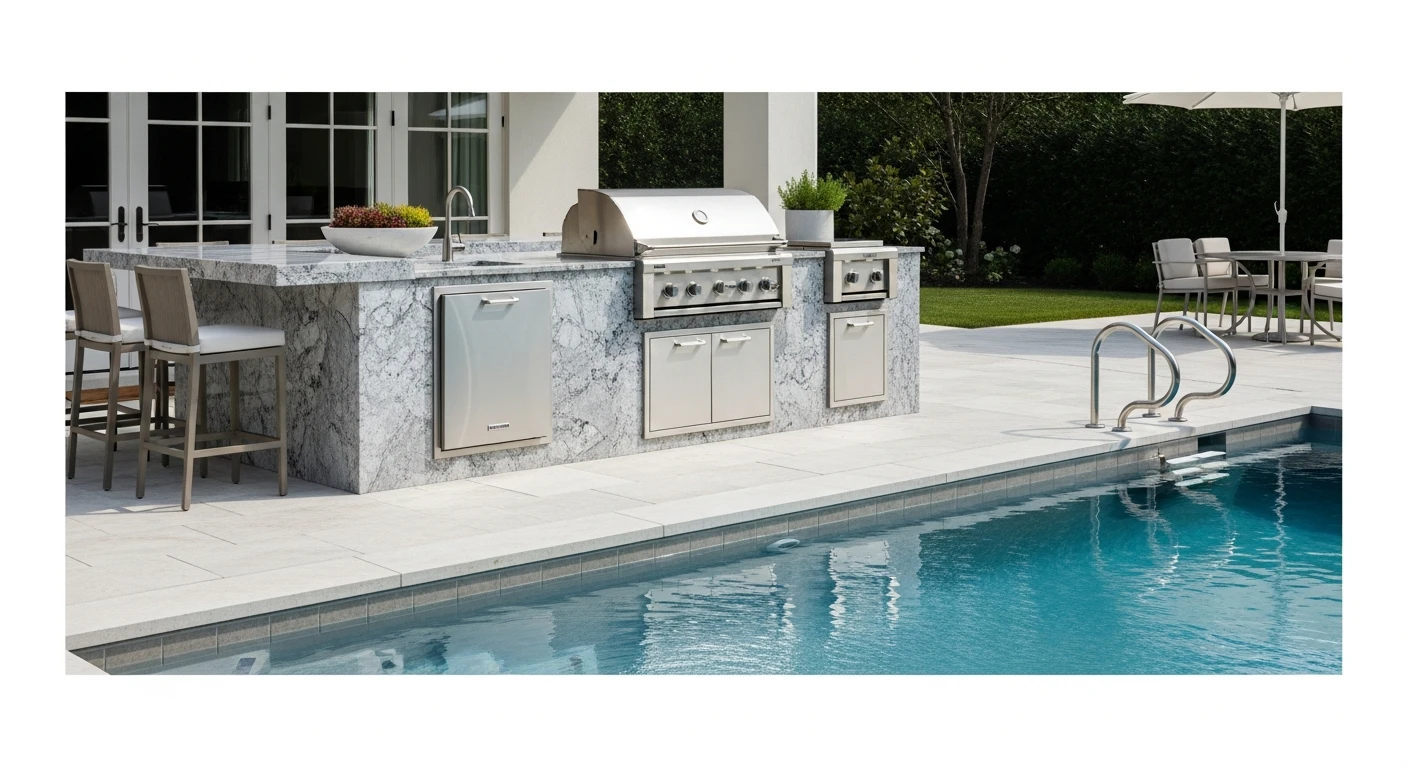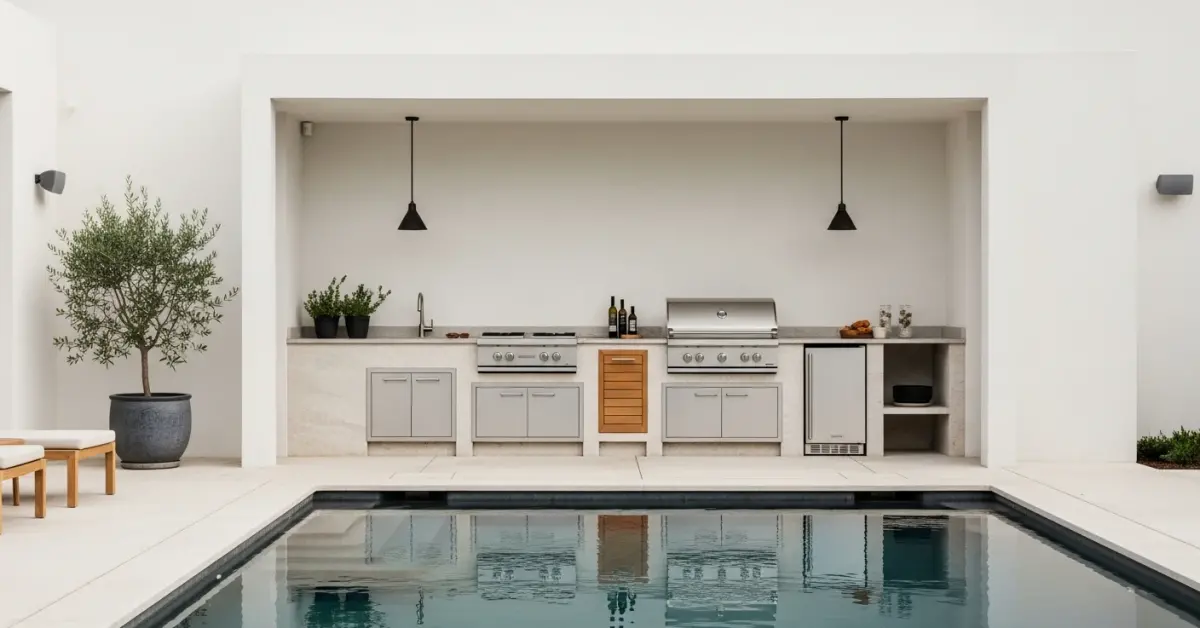
Collier County Luxury Outdoor Kitchens: My Material Selection Protocol for 30-Year Corrosion Resistance
For years designing luxury outdoor kitchens in Collier County, from waterfront estates in Port Royal to expansive lanais in Grey Oaks, I saw the same costly mistake repeated: beautiful projects degrading in under five years. The issue isn't design; it's a fundamental misunderstanding of our coastal environment. The combination of intense UV radiation, high humidity, and, most critically, the salt-laden air creates an accelerated corrosion cycle that standard materials simply cannot withstand. My entire approach is built on a materials-first philosophy that prioritizes environmental resilience over initial aesthetics, ensuring a client's investment doesn't just survive, but thrives for decades. The core failure I've identified in countless projects is specifying materials based on their indoor performance. A high-end granite that looks stunning in a kitchen will become a porous, stained liability outdoors. A standard 304-grade stainless steel grill, a benchmark of quality elsewhere, will show pitting and rust within 24 months on Marco Island. My proprietary methodology directly counteracts this by creating a sealed, non-reactive envelope, increasing the functional lifespan of the entire structure by an estimated 300% compared to conventional construction.The Coastal Durability Matrix: A Diagnostic Framework
I developed the Coastal Durability Matrix after a large-scale project in Naples Park showed premature structural decay due to moisture wicking up from the concrete slab. It’s a three-pillar system I use to vet every single component before it's even specified in a design. It forces a shift in thinking from "What looks good?" to "What will endure?"Pillar 1: Material Integrity and Sourcing
This goes far beyond brand names. I demand material data sheets and origin certifications. For metals, the absolute non-negotiable is 316L marine-grade stainless steel for all exposed hardware, cabinetry, and appliances. The "L" signifies low carbon, which drastically improves weldability and reduces carbide precipitation, a primary driver of corrosion. For countertops, I specify sintered stone (like Dekton or Neolith) over natural stone. Its zero-porosity composition makes it impervious to salt, wine, and citrus stains, and its UV-stable pigments won't fade under the relentless Florida sun. A common error is using beautiful, porous quartzite, which looks great for a year and then becomes a maintenance nightmare.Pillar 2: Advanced Structural Engineering
The frame is the skeleton of the outdoor kitchen, and it’s where most failures begin. Standard CMU (concrete masonry units) are porous and will draw moisture. My protocol mandates a welded aluminum frame using 6061-T6 alloy, the same grade used in boat building. For projects requiring a masonry base, I specify a proprietary concrete blend with crystalline waterproofing admixtures. This creates a non-porous foundation that actively resists water intrusion, preventing the efflorescence and spalling I see on so many lanais across Collier County.Pillar 3: Strategic Appliance and Utility Insulation
Heat and electricity are enemies of longevity in a humid environment. Every single heat-generating appliance, especially the grill, must be housed within a manufacturer-certified insulated jacket. This isn't just a safety recommendation; it prevents radiant heat from compromising the structural integrity of the countertop and frame over thousands of heat cycles. Furthermore, all electrical runs must use marine-rated wiring within sealed PVC conduits, terminating only in weatherproof, GFCI-protected outlets with in-use covers. This small detail prevents the constant circuit tripping and component failure that plagues poorly planned installations.Implementation Protocol: A Step-by-Step Breakdown
Executing this requires precision and zero deviation from the material specifications. This is my field-tested checklist for ensuring a project in Collier County meets my durability standards.- Site Assessment & Foundation Prep: The first step is always a drainage analysis. I ensure the concrete pad has a subtle but effective slope away from the structure. Before framing, we apply a topical waterproofing membrane to the slab where the kitchen will sit.
- Frame Construction & Leveling: The aluminum or treated masonry frame is assembled. A critical action is to isolate all fasteners. When stainless steel touches aluminum, it can create galvanic corrosion. I use non-conductive polymer washers on every connection point.
- Utility Rough-In: All gas lines are pressure-tested to 1.5x their working pressure. All electrical conduits are sealed at both ends to prevent moisture and insects from entering the system. This is a common point of failure I've had to fix on other contractors' work.
- Cladding and Countertop Installation: Cement board or other backer is attached with corrosion-resistant coated screws, not standard drywall screws. Countertops are installed with a 1/8-inch expansion gap around the perimeter, filled with a flexible, marine-grade polyurethane sealant, not a rigid grout.
- Appliance Integration: We verify the fit of every insulated jacket and ensure proper ventilation channels are clear. The grill must have at least 18 inches of clearance from any combustible materials, a standard often overlooked in tight lanai designs.
- Final Systems Check: We test every burner, every outlet, and every light fixture. The final sign-off is a water-intrusion test, where we simulate heavy rainfall to check the integrity of every seal and surface.
Precision Adjustments for Collier County's Climate
Getting the big picture right is essential, but longevity lies in the details. After a project in Pelican Bay experienced premature cabinet warping, I refined my standards to include these micro-adjustments. First, ventilation is paramount. For kitchens under a covered lanai, a standard vent hood is not enough. I design a passive cross-ventilation system, often using subtle, louvered panels in the cabinet toe-kicks and island backside to prevent stagnant, humid air from building up and promoting mold. Second, I have a strict specification for all sealants and adhesives. Only 100% silicone or marine-grade polyurethane is acceptable. Common acrylic-latex caulks will shrink and crack within a single hot summer, creating an entry point for water. This is a small, low-cost detail that prevents catastrophic, high-cost failures. Finally, every outdoor kitchen is delivered with a material-specific care guide. It explains why you should never use abrasive cleaners on 316L steel or why sealing natural stone countertops is a futile battle against our climate. This empowers the homeowner to maintain the integrity of the initial investment, a critical step often ignored by builders. Given the potential for dissimilar metals in appliances, fasteners, and framing, how have you accounted for preventing galvanic corrosion at every single connection point in your outdoor kitchen plan?Written by

Tags
high end outdoor kitchen designs
modern luxury outdoor kitchen
high end outdoor grills built in
kitchen bbq grill
outdoor kitchen luxury
Luxury Outdoor Kitchen in Collier FL FAQ
What kind of foundation do I need for a luxury outdoor kitchen, and can I just use my existing patio?
Your outdoor kitchen requires a dedicated, reinforced concrete slab foundation at least 10 cm thick to support the immense weight of stone countertops and heavy appliances. Placing heavy structures directly on an existing paver or thin concrete patio often leads to cracking and an unsafe, unlevel cooking surface within a few seasons. Improper foundation work is a primary cause of structural failure, leading to costly repairs like releveling the entire unit and fixing cracked gas or water lines that were stressed by the shift.
How do I choose between a built-in grill and a standalone one for a high-end setup?
A built-in grill offers a seamless, integrated look and superior stability, but it permanently fixes the layout of your kitchen and makes future upgrades or replacements significantly more complex. Standalone cart grills offer flexibility, but they create gaps in countertops and can feel less permanent. A critical factor people miss is serviceability; a built-in unit may require partial deconstruction of your counter for major repairs, whereas a standalone grill can be easily moved or swapped out, a key consideration for equipment with an average lifespan of 8 to 12 years.
Are stainless steel cabinets really the best option for outdoor weather?
Marine-grade 316 stainless steel is the superior choice for outdoor cabinets due to its enhanced corrosion resistance, especially in coastal or poolside areas with salt and chlorine exposure. Many homeowners opt for the less expensive 304-grade steel to save money, only to find rust spots appearing within a few years. While powder-coated steel offers color options, any scratch that penetrates the coating becomes an immediate entry point for rust, compromising the structure much faster than the raw, corrosion-resistant surface of high-grade stainless steel.
Do I really need a ventilation hood for my outdoor grill?
A ventilation hood is essential if your grill is located under any type of permanent roof, pergola, or covered structure, as required by most local building codes. Without proper ventilation, smoke, grease, and carbon monoxide can accumulate, creating a fire hazard and staining your overhead structure with a thick, grimy film. A common mistake is under-sizing the unit; the hood should be wider than the cooking surface to effectively capture all emissions, especially in windy conditions, preventing long-term discoloration and potential structural damage from grease buildup.
What are the most common points of failure in an outdoor kitchen's plumbing system?
The most frequent plumbing failures occur from freeze-burst damage to water lines that were not properly winterized and drained before the first hard frost. Even a small amount of trapped water can expand and crack pipes, leading to significant leaks and water damage inside the cabinet structure once thawed. Another critical failure point is the drain line for the sink; using improper materials that degrade with UV exposure or installing it without a proper slope can lead to clogs and foul odors, turning your luxury space into a maintenance headache.
Beyond the grill, what appliances are most prone to issues in an outdoor environment?
Outdoor refrigerators and ice makers are the most problematic appliances due to their constant battle with ambient heat and humidity, forcing their compressors to work much harder than indoor models. A common oversight is failing to provide adequate ventilation clearance around these units as specified by the manufacturer, often leading to premature compressor failure. This is a critical detail, as a failing refrigerator can struggle to maintain a food-safe temperature, posing a health risk in addition to the eventual cost of replacing the entire unit.