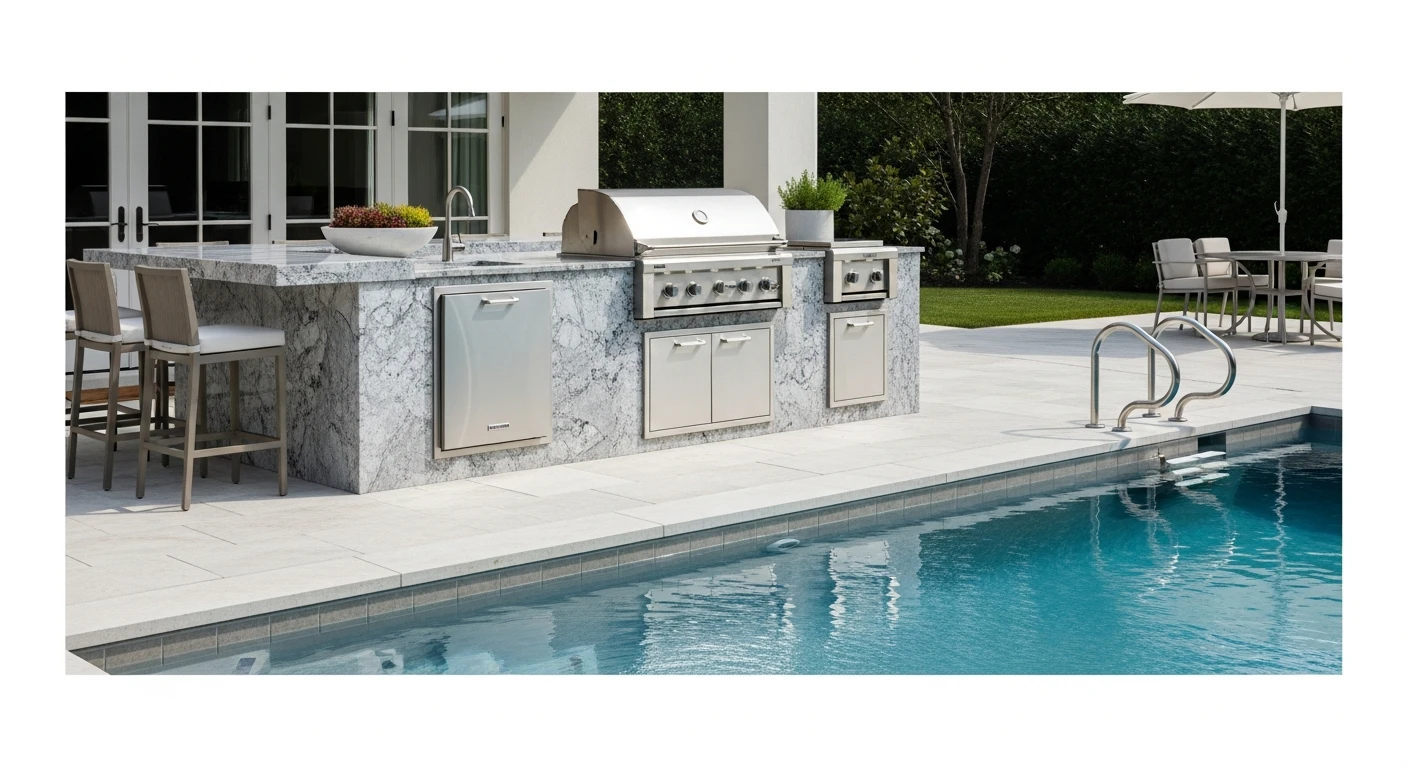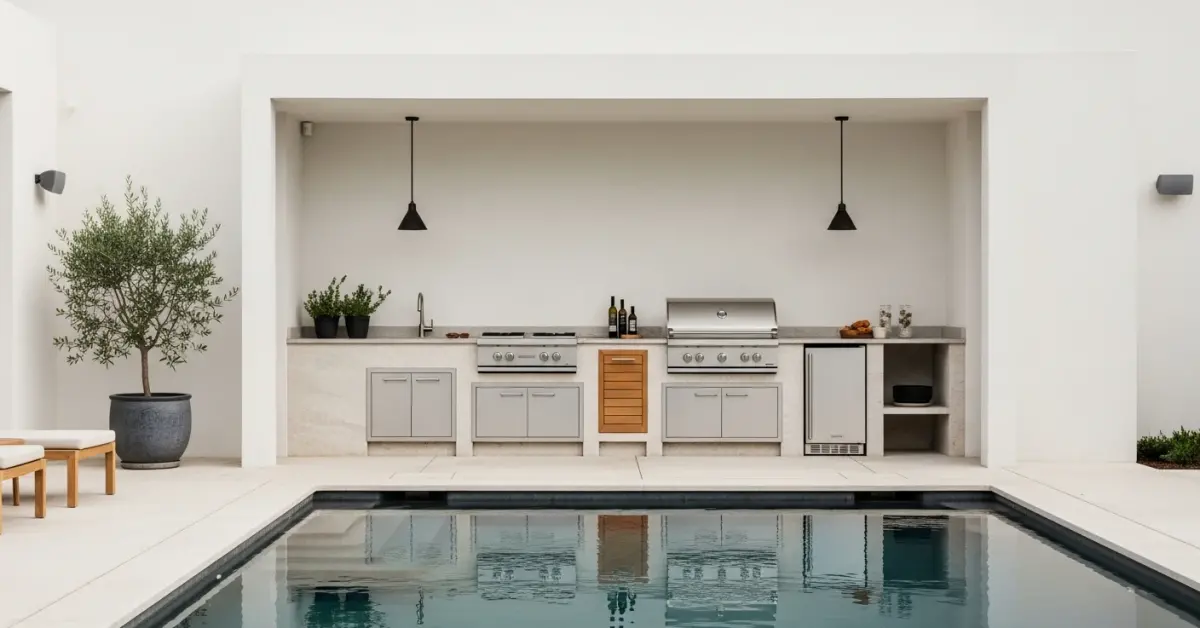
Luxury Outdoor Kitchen Lee County: My Protocol for 30-Year Material Longevity in Salt Air
After a decade designing high-end outdoor kitchens from the canal-front homes of Cape Coral to the waterfront estates on Sanibel Island, I've seen one critical failure point decimate six-figure investments: material specification mismatched with our coastal environment. Standard "luxury" components, especially 304-grade stainless steel, simply don't survive the relentless combination of Lee County's salt spray, intense UV radiation, and suffocating humidity. This isn't about aesthetics; it's a structural and financial liability.
My entire design philosophy is built on a principle I call the Coastal Resilience Framework. It prioritizes material science over brand names, ensuring every component, down to the fasteners, is specified to counteract galvanic corrosion and moisture intrusion. The goal isn't just a kitchen that looks good on day one, but one that performs flawlessly for decades, requiring minimal maintenance despite being battered by our subtropical climate. This is how I guarantee a tangible ROI by eliminating the need for a costly rebuild in 5-7 years, a fate I've seen befall countless projects in Fort Myers Beach.
My Diagnostic Process for Coastal Corrosion Failure Points
Before a single cabinet is chosen, my initial site analysis on a Lee County property is more of a meteorological survey than a design consultation. I'm not just measuring space; I'm mapping environmental exposure. A property directly on the Gulf in Captiva has a different airborne salinity profile than one on the Caloosahatchee River. I assess the prevailing winds, the intensity of the afternoon sun, and the potential for standing moisture due to landscaping or overhangs. It was on a large project in a Bonita Springs golf community, seemingly far from the coast, that I identified severe pitting corrosion on a high-end grill. The cause? The community's reclaimed water for irrigation had an incredibly high saline content, which became aerosolized by the sprinklers—a factor the original builder completely missed.
The Coastal Resilience Framework: Beyond 304 Stainless Steel
My framework is a non-negotiable set of material standards. The most common and costly mistake I fix is the use of 304 stainless steel. While it's industry-standard for "outdoor" use elsewhere, it's woefully inadequate for Lee County. The "tea staining" and pitting I see is inevitable. My baseline is always 316L marine-grade stainless steel for any metallic component, especially grill bodies and access doors. The "L" signifies low carbon, which improves weldability, and the added molybdenum is the critical element that provides superior resistance to chlorides (salt).
For cabinetry, I often steer clients away from all-stainless construction. In our high-humidity environment, the interiors can become condensation traps, leading to mold and mildew. I've found that powder-coated aluminum or, even better, closed-cell marine-grade polymer cabinets offer superior durability and are completely impervious to moisture. For countertops, I advise against porous natural stones like travertine, which can harbor mold. A high-density, non-porous engineered stone or Dekton provides a far more resilient and hygienic surface, with the added benefit of high UV stability to prevent fading under the intense Florida sun.
Step-by-Step Implementation for a Hurricane-Resistant Build
Executing the design requires a build protocol as rigorous as the material selection. My process is designed for longevity and to meet, and often exceed, Lee County's stringent building codes, especially regarding wind load and foundation integrity.
- Phase 1: Foundation and Framing: We start with reinforced concrete footings tied directly into the lanai's foundation. The framing is never wood; it's either welded aluminum tubing or concrete block (CMU), creating a rigid, hurricane-resistant island structure.
- Phase 2: Utility Installation and Isolation: All electrical runs are made with marine-grade wiring in sealed conduits. Every outlet is a GFCI with a corrosion-resistant, in-use "bubble" cover. Gas and water lines are meticulously sealed at every penetration point to prevent moisture intrusion into the cabinet interiors.
- Phase 3: Cabinet and Appliance Installation: This is a critical control point. Every single fastener used—from the cabinet pulls to the bolts securing the grill—must be 316 stainless steel. Using a cheaper screw will create a galvanic reaction with the high-grade materials, causing rust streaks that ruin the finish within a single season. I once had to completely disassemble a new kitchen in Fort Myers because the installer used galvanized screws.
- Phase 4: Countertop and Cladding Seal: Once the countertop is installed, we apply a professional-grade nano-tech hydrophobic sealer, not a standard granite sealer from a big-box store. This creates a barrier that repels water, oils, and prevents mildew from taking hold. The same attention is paid to any stone or brick cladding on the island base.
Precision Tuning for Lee County's Climate
The final 5% of the work is what separates a good outdoor kitchen from a truly resilient one. I focus on ventilation and thermal management. A common oversight is failing to properly ventilate the cabinet island. It's not just for gas safety; it's for the health of the structure. I design in passive cross-flow ventilation using discreet, water-resistant vents to prevent stagnant, humid air from building up inside. This simple step can add a decade to the life of internal components and prevents that musty odor so common in other outdoor kitchens. Another adjustment is appliance orientation. If possible, I position grills and refrigerators so their sensitive electronic control panels are shielded from the direct, punishing afternoon sun, which is known to degrade LCD screens and plastic housings over time in our region.
Have you calculated the galvanic corrosion potential between your grill's 304-grade fasteners and your proposed 316L cabinet frame, or are you just hoping for the best?