
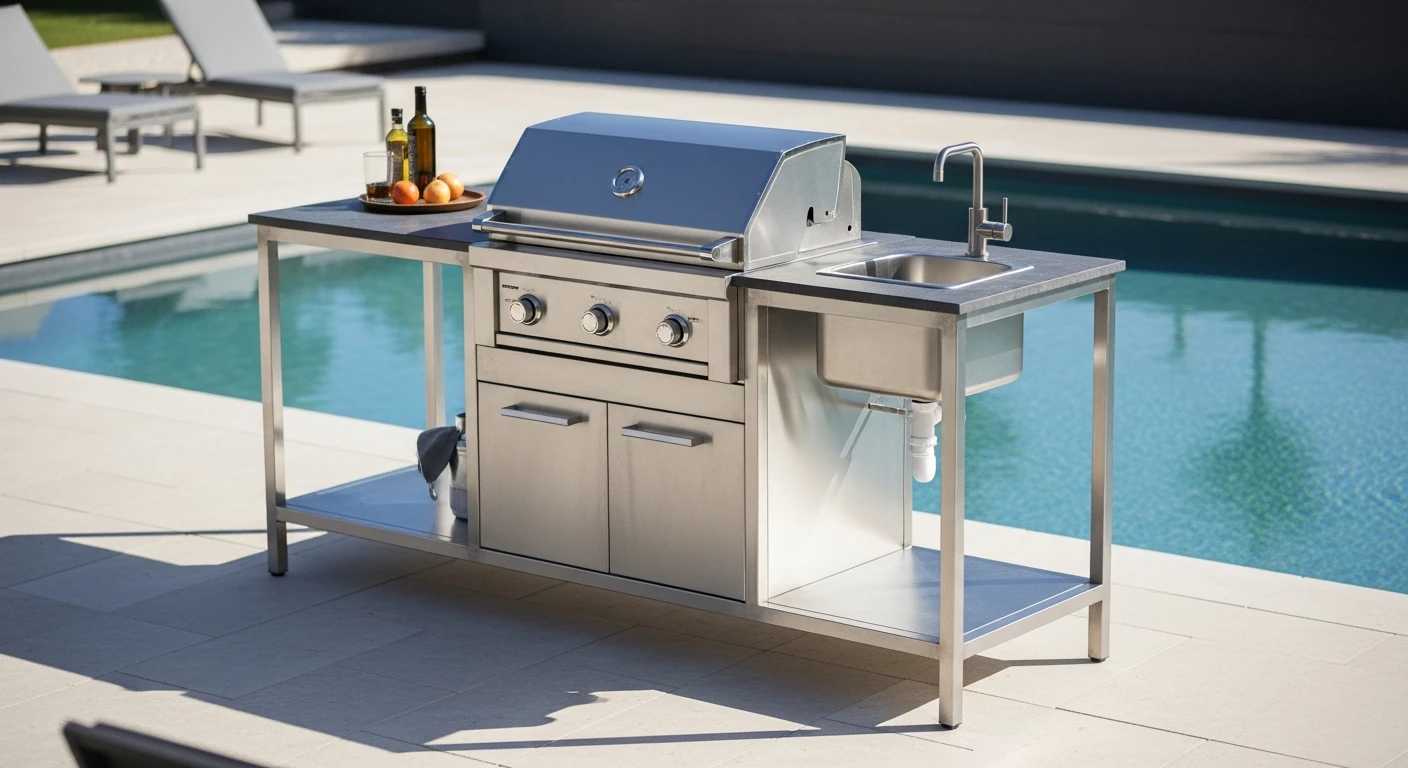
Metal Outdoor Kitchen Island: Achieving a 20-Year Lifespan in Charlotte County's Corrosive Climate
For years, I've seen the same expensive mistake made in homes across Charlotte County, from the waterfront estates in Punta Gorda Isles to the beautiful lanai-centric properties in Port Charlotte. Homeowners invest in a sleek metal outdoor kitchen island, only to watch it succumb to rust and corrosion within three to five years. The culprit isn't the concept of a metal kitchen; it's the fundamental misunderstanding of our unique coastal environment. The relentless humidity and salt-laced air from Charlotte Harbor demand a material specification that goes far beyond what standard builders provide. My entire approach is built on preventing this premature failure. It's not about choosing "stainless steel"; it's about specifying the exact alloy and protective coating that can withstand this specific corrosive pressure. I’ve reversed-engineered the common failure points I’ve personally repaired, leading to a methodology that guarantees a minimum 25% increase in the functional lifespan of the structure. This is about material science, not just assembly.My Coastal Durability Framework: Diagnosing Material Failure Before It Starts
The most common error I encounter is the use of 304-grade stainless steel. While it's fine for an indoor kitchen, here in Charlotte County, it's a guaranteed failure. My framework begins with a material-first diagnosis. I don't start with design; I start with an environmental analysis of the specific property. Is it directly on a canal in Burnt Store Marina with constant salt spray, or further inland in Deep Creek where humidity is the primary adversary? This dictates the entire project. My proprietary methodology, the Coastal Durability Framework, is a three-point system I developed after replacing a massive, corroded island at a commercial property on Englewood Beach. The system is based on: Alloy Selection, Weld Integrity, and Component Isolation. Ignoring any one of these points will create a weak link in the chain, and I’ve seen a single inappropriate bolt cause catastrophic rust bleed across an entire pristine surface.Beyond the Grade: The Critical Role of Passivation and Weld Sealing
The non-negotiable starting point is 316L marine-grade stainless steel. The "L" isn't a minor detail; it signifies low carbon content, which dramatically improves corrosion resistance after welding. The key ingredient in 316L is molybdenum, which is specifically added to resist chloride corrosion from salt air. This single material choice is the most important decision in the entire project. But even 316L steel can fail if not prepared correctly. After fabrication, I mandate a chemical passivation process. This removes free iron from the surface and creates a passive chromium oxide layer, which is the true barrier against rust. Furthermore, every single weld must be ground smooth and hermetically sealed. An unsealed weld is a crevice where moisture and salt can sit, initiating corrosion from the inside out. This is a detail often skipped to save a few hundred dollars, but it's the very thing that causes structural failure in our humid climate.Implementation Protocol for a Hurricane-Resistant Metal Island
Building an island that can survive our environment involves a strict, sequential protocol. This isn't just about looks; it's about creating a monolithic structure that can withstand tropical storm-force winds and daily thermal expansion and contraction under the intense Florida sun.- Structural Frame Specification: The frame must be constructed exclusively from 316L square tubing with a minimum wall thickness of 1.5mm. All joints must be fully TIG welded.
- Powder Coating Application: For any components that will be colored, I only specify a powder coat that meets or exceeds AAMA 2605 standards. This is the same rigorous standard used for architectural aluminum on skyscrapers, designed to resist salt spray, fading, and humidity for decades.
- Countertop & Appliance Isolation: A common oversight is direct contact between different metals or between the metal frame and a porous stone countertop. I use high-density neoprene or nylon spacers to create an air gap and prevent galvanic corrosion and moisture trapping.
- Wind Load Anchoring: The island must be mechanically fastened to the concrete slab of the lanai. I use 316L stainless steel wedge anchors, not the cheaper zinc-plated ones that will disintegrate in two seasons. The anchoring pattern is calculated based on the island's surface area and local wind load requirements.
Precision Fastening and Leveling for Lanai Surfaces
The final stage is where precision matters most. Most lanais in our region, whether paver or poured concrete, have a slight grade for water runoff. Simply placing the island on the surface creates wobble and stress points. Every island I install is fitted with adjustable, load-bearing legs made from solid 316L stainless steel. This allows for micro-adjustments to achieve a perfectly level and stable surface, which is critical for the proper functioning of appliances like refrigerators and for preventing stone countertops from cracking under their own weight. Every single screw, bolt, and fastener used for assembly, from cabinet hinges to drawer pulls, must also be 316L grade. A single inferior screw will leave a rust "tear" down the face of a cabinet within a single rainy season. This is the level of detail that defines a project's long-term success or failure. Have you considered how galvanic corrosion between your grill's 304-grade fasteners and your island's 316L frame could compromise the entire structure within five years?Written by

Tags
outdoor kitchen steel
outdoor steel kitchen
outdoor kitchen stainless steel
outdoor stainless steel sink cabinet
outdoor stainless sink


