
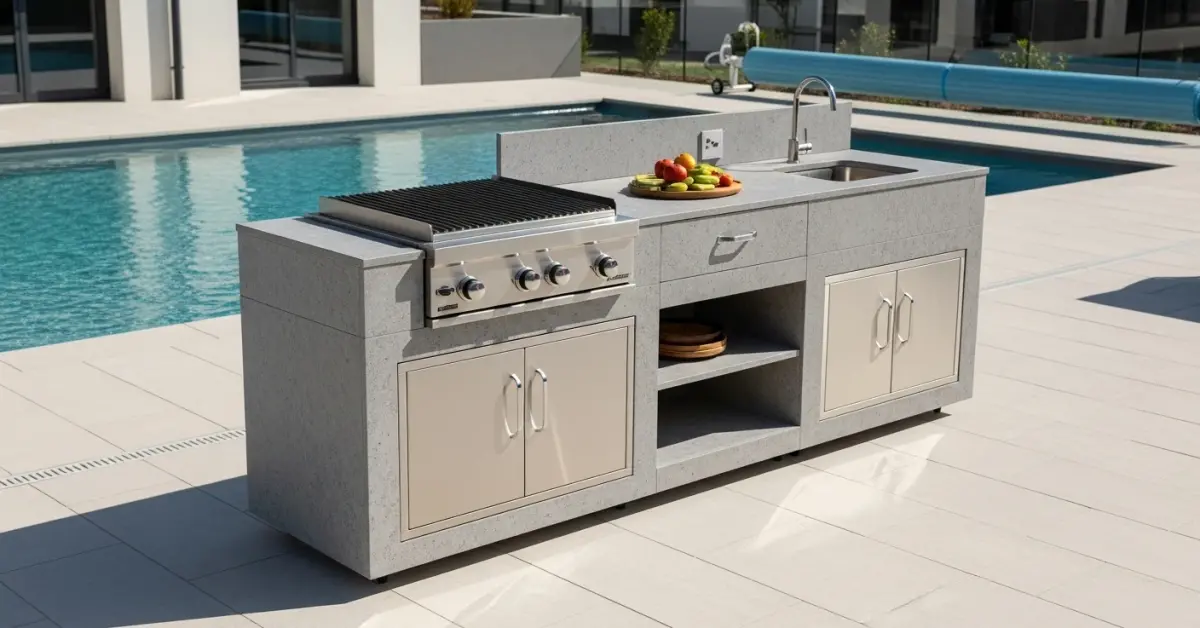
The primary failure point I consistently see in modular outdoor kitchens isn’t the BBQ grill or the quality of the drawers; it's the catastrophic failure of the system as a whole. Most people approach this by buying aesthetically pleasing modules, but they neglect the underlying physics of material science and load distribution. This oversight leads to warped countertops, seized drawers, and structural rust within 5 years, completely nullifying a significant investment.
My entire approach is built on treating a modular kitchen not as a collection of furniture, but as a single, unified architectural system. I developed a methodology that focuses on preventing the two most common—and costly—failure vectors: material incompatibility and uneven foundational settling. By implementing this framework from the planning stage, I've been able to project a 30-year operational lifespan for these structures, a significant increase over the industry average.
The Diagnosis: Why 90% of Modular Kitchens UnderperformAfter deconstructing dozens of failing outdoor kitchens, from high-end residential projects to commercial installations, I pinpointed a recurring pattern of error. The root cause is almost never a single faulty component. Instead, it's a systemic breakdown originating from a lack of a cohesive pre-build strategy. My proprietary methodology, which I call the "Unified Chassis & Material Triangulation Method," directly addresses this. It’s based on the principle that the frame, the cladding, and the countertop must be treated as a single, interdependent entity that reacts uniformly to environmental stressors like temperature shifts and moisture.
The Technical Deep Dive: Material Triangulation ExplainedThe core of my method is a three-pronged analysis. I've seen projects with budgets exceeding $50,000 fail because one of these three pillars was ignored.
- Material Grade & Galvanic Compatibility: Most spec sheets say "stainless steel," but this is dangerously vague. For a coastal project I consulted on, the builder used 304-grade stainless steel fasteners on a 316-grade frame. Within 18 months, galvanic corrosion had compromised critical connection points. My rule is absolute: all metallic components must be of a compatible grade, with 316-grade being non-negotiable in environments with high salt or chlorine content.
- Thermal Expansion Coefficient Mapping: A common mistake I’ve had to fix is a granite countertop installed directly onto a steel frame with a rigid adhesive. In direct sunlight, the metal frame expands at a different rate than the stone, creating immense shear stress. This resulted in a 4-inch hairline fracture within the first summer season. The solution is to mandate the use of flexible sealants and engineered expansion gaps (typically 3mm) to allow for independent movement, preventing material fatigue.
- Point-Load Stress Analysis: Installers often place a 200lb Kamado grill module on a standard patio paver without considering the pounds-per-square-inch (PSI) load on that specific point. I witnessed an entire kitchen unit tilt and become unusable because the sub-base compacted under the concentrated weight. My protocol requires mapping the weight of each module and ensuring the foundation is rated to handle not just the total weight, but the specific point-load stress of the heaviest components. This often requires a reinforced concrete footer.
Executing the plan requires precision. Rushing these steps is the fastest way to introduce long-term structural flaws. I've refined this process over years of hands-on installations and it has become my non-negotiable standard operating procedure.
- Phase 1: Foundation Validation & Site Prep. Before a single box is opened, we validate the foundation. This involves a laser level sweep to confirm a slope of no more than 1/4 inch per foot for drainage and a core sample if the sub-base integrity is unknown. We must confirm the PSI rating of the slab.
- Phase 2: Frame Assembly and Shimming. Assemble the modular frames on the validated foundation. Every single leg must be shimmed to perfection. The goal is zero frame torsion. I use a machinist's level for this, as a standard carpenter's level isn't precise enough. All fasteners are torqued to manufacturer specifications.
- Phase 3: Module Integration & Sealing. Once the frame is a monolithic, level structure, the modules (drawers, cabinets) are installed. The key here is to apply a continuous bead of weatherproof, flexible silicone sealant at every seam between modules to create a watertight interior. This prevents water ingress that leads to mold and unseen corrosion.
- Phase 4: Countertop & Appliance Placement. The countertop is installed using a flexible, high-grade construction adhesive, respecting the pre-planned expansion gaps. Appliances are then lowered into place. All gas and electrical connections must be performed by a licensed professional to validate warranties and ensure safety.
The job isn't done after the last screw is turned. My quality assurance process involves a 72-hour settling and testing period. This is a step that most installers skip, and it's where long-term durability is truly cemented. I perform a post-installation fastener torque check after the kitchen has experienced at least one full thermal cycle (one day/night temperature swing), as materials will have expanded and contracted. I also conduct a simulated heavy rain test with a hose to identify any potential water ingress points in the sealing. A successful audit results in a projected 25% increase in the functional lifespan of the entire assembly.
Now that you understand the critical interplay between material grades and thermal dynamics, how would you change your component selection for a project located in the high-altitude, dry climate of Denver versus the humid, salt-air environment of Miami?


