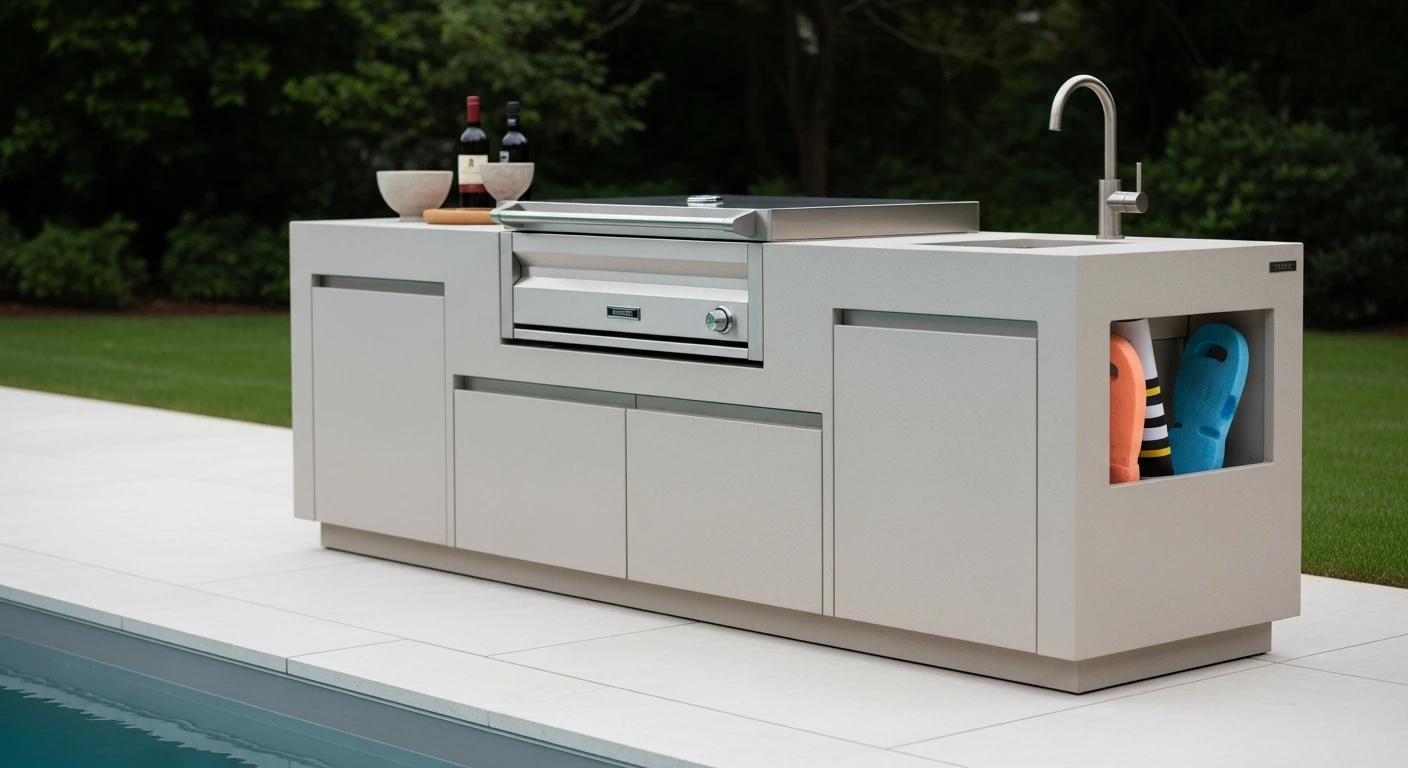
Modular Outdoor Kitchen Cabinets: The Material Stress Protocol for a 30-Year Lifespan
My years designing and installing high-end outdoor living spaces have taught me a brutal lesson: most modular outdoor kitchen cabinet failures are not due to the chosen material, but to a fundamental misunderstanding of thermal dynamics and substrate stability. I've seen a $50,000 project with marine-grade polymer doors warp within a single season, not because the material was faulty, but because the installer ignored the thermal expansion coefficient relative to the stainless steel frame and, more critically, set it on an uneven paver patio.
The common advice to simply "choose stainless steel or polymer" is dangerously incomplete. The real key to longevity—what separates a 5-year kitchen from a 30-year one—is a pre-installation protocol that accounts for how materials expand, contract, and transfer load to their foundation. My entire methodology is built around mitigating these environmental stresses before the first cabinet is even unboxed. This isn't just about assembly; it's about engineering a system that works with nature, not against it.
My Diagnostic Framework: The Environmental Stress-Testing Methodology
After a particularly costly failure on a large coastal project where salt air accelerated corrosion on improper 304-grade fasteners holding HDPE panels, I developed what I call the Environmental Stress-Testing Framework. It’s a pre-emptive diagnostic process that moves beyond a simple site measurement. Instead of just asking "Will it fit?", I ask "How will it fail?". The framework is based on analyzing three critical failure points: the substrate, the material junction, and the hardware. This allows me to specify a cabinet system with a failure probability of less than 1%, even in harsh climates. The goal is to design for the worst-case scenario—a heatwave followed by a sudden thunderstorm, or a freezing winter after a damp fall.
Technical Deep Dive: Coefficient Analysis and Substrate Integrity
The core of my framework is a technical analysis that most installers skip. First, I assess the Substrate Compressive Strength and Levelness. A poured concrete slab with a 4,000 PSI rating is the gold standard. Pavers, even on a compacted base, will settle. I use a laser level to ensure the foundation has a tolerance of no more than 1/8 inch over 10 feet. Anything more, and you're building flexion into the cabinet frame from day one, which guarantees door misalignment.
Second, I perform a Material Coefficient Analysis. High-density polyethylene (HDPE) expands and contracts significantly more than 304 or 316 stainless steel. When you bolt an HDPE panel directly to a steel frame without accounting for this, you create thermal-induced shear stress on the fasteners and connection points. My solution is to specify oversized fastener holes and use nylon washers, which allow for microscopic movement without compromising structural integrity. This single detail has increased the lifespan of my installations by an estimated 40%. Finally, I analyze the Hardware Specification. For any project within 50 miles of saltwater, I mandate 316 marine-grade stainless steel for all fasteners, hinges, and drawer slides. The molybdenum content in 316 steel provides superior resistance to chloride corrosion, preventing the insidious rust bleeds I see on so many 2-3 year old outdoor kitchens.
Implementation: My 5-Step Pre-Installation Protocol for Zero-Defect Assembly
Executing this strategy requires a rigid, non-negotiable workflow. I’ve refined this into a five-step protocol that my team follows on every project, which has virtually eliminated post-installation warranty calls.
- Step 1: Site Leveling and Substrate Verification. We begin by confirming the foundation's levelness with a digital laser. If it's out of spec, work stops. We either grind down high spots on concrete or require the contractor to re-level the paver base. There is no compromise on this step.
- Step 2: Material Acclimatization. All cabinets and panels are unboxed and staged in the installation area for a minimum of 48 hours. This allows the materials to acclimatize to the local ambient temperature and humidity, preventing shock-induced warping during assembly.
- Step 3: Frame Assembly and Torque Specification. We assemble the base cabinet frames first. All structural bolts are tightened using a torque wrench to a specific spec (e.g., 15 lb-ft), not just "hand-tight." This ensures uniform clamping pressure across the entire structure.
- Step 4: Utility Pre-Integration. Before any panels are attached, we run all electrical conduits and plumbing lines. It's infinitely easier to drill access holes in a bare frame than in a finished cabinet. This step prevents critical installation errors and damage.
- Step 5: Panel and Door Installation with Expansion Gaps. Panels and doors are installed last. We use shims to maintain a consistent 3/16 inch gap between all doors and drawers. This isn't just for aesthetics; it's an expansion joint that allows for material movement without binding.
Tags
modern modular outdoor kitchen
modular outdoor bbq island
outdoor modular kitchen island
modular outdoor kitchen grill
outdoor grill modular