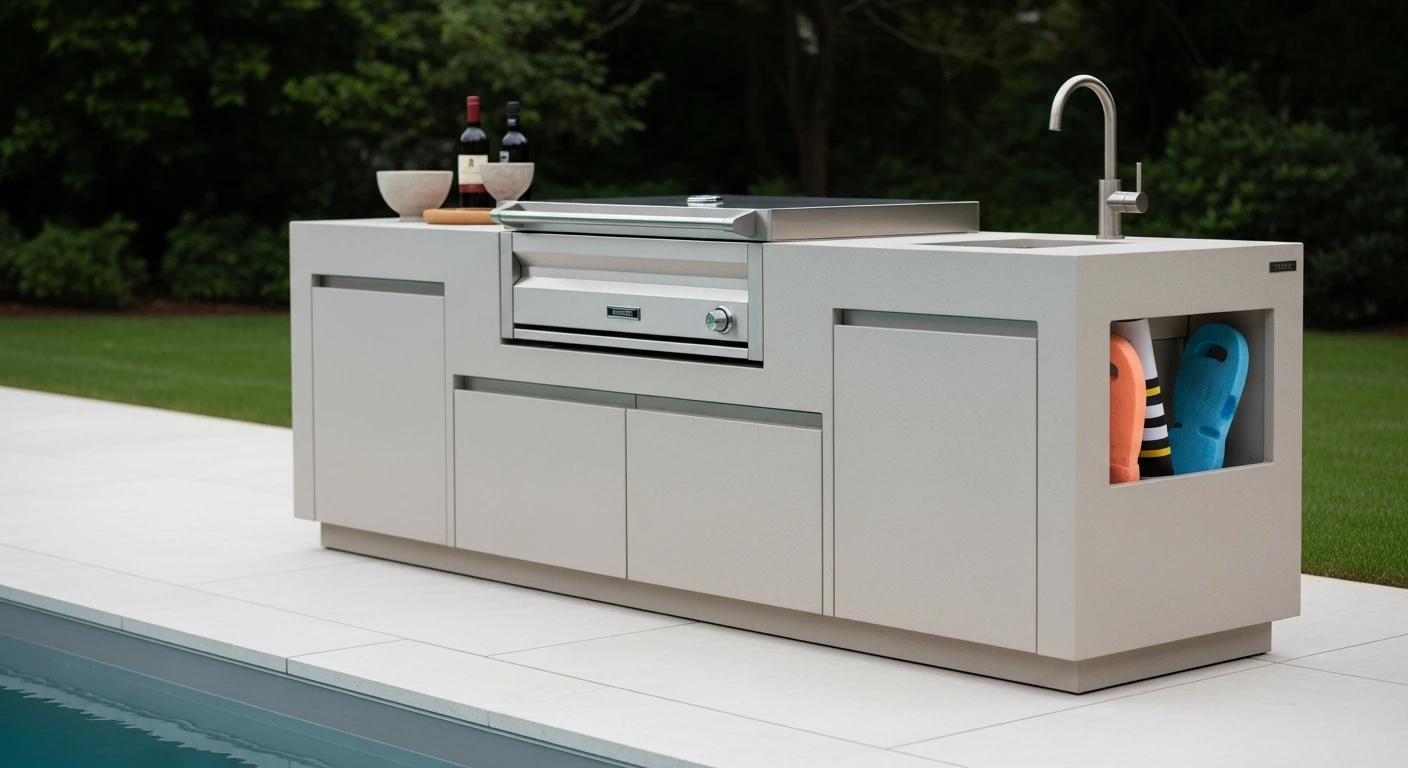
In my early years, I followed the industry-standard advice: use 304 stainless steel and sealed wood composites. The results were disastrous on a large coastal project. Within 18 months, we saw significant tea-staining on the steel and delamination on the panels, despite the manufacturer's "all-weather" guarantee. This costly error forced me to develop a diagnostic methodology to pinpoint failure vectors before they occur. I identified three primary culprits that account for the vast majority of cabinet degradation.
My proprietary methodology, the Environmental Stressor Audit, analyzes the project site against these three failure points. First is Chemical Exposure (salt spray, chlorine). Second is Thermal Cycling Stress (rapid expansion and contraction from sun exposure and cooling). Third, and most overlooked, is Bi-Metallic Component Failure, where incorrect fastener and hardware choices actively accelerate corrosion of the main cabinet body. Standard builds almost never account for all three, creating a ticking clock for structural failure.
Dissecting the Material Synergy Protocol: Steel Grades and Polymer DensityTo counter the Failure Matrix, my protocol relies on precise material matching. For steel components like frames and hardware, the choice between 304 stainless steel and 316L marine-grade steel is non-negotiable and depends entirely on the environment. For any project within 50 miles of a coastline or near a saltwater pool, 316L is the only acceptable option. Its molybdenum content provides superior resistance to chloride-induced corrosion, a factor that renders 304 steel vulnerable in these settings. For cabinetry panels and doors, I've moved almost exclusively to High-Density Polyethylene (HDPE). Unlike wood-plastic composites or PVC, HDPE is a solid, non-porous polymer that contains no organic material to rot or absorb moisture. Crucially, I specify an HDPE with integrated UV inhibitors to prevent the brittleness and color fade I’ve seen in lower-grade polymers. The final critical component is the hardware. All fasteners must be passivated stainless steel of the same grade as the frame (e.g., 316L screws for a 316L frame) to prevent galvanic corrosion, which can literally eat away at the connection points.
The Assembly Blueprint: A Step-by-Step Implementation GuideA perfect material selection is useless without a meticulous assembly process. Even a small error here can compromise the entire system. Over the years, I’ve refined my process into a clear, repeatable blueprint that my teams follow to the letter. This isn't just about putting boxes together; it's about building a monolithic structure engineered to withstand a decade of abuse.
- Step 1: Foundation and Leveling. We begin by ensuring the base is perfectly level and install a non-porous vapor barrier between the cabinet feet and the concrete or stone patio. This stops moisture from wicking up into the cabinet frame.
- Step 2: Frame Assembly. All connections are torqued to precise specifications using a calibrated torque wrench. This isn't about being "tight enough"; it's about applying the exact clamping force—typically 15-20 Nm for M6 fasteners—to prevent stress fractures without allowing for vibration-induced loosening over time.
- Step 3: Panel and Door Installation. We install every panel with a focus on gasket integrity. The seals around doors and drawers are the first line of defense against water intrusion. We also ensure all base cabinets have subtle, concealed drainage channels or weep holes to prevent any water that does get in from pooling.
- Step 4: Countertop and Appliance Integration. Where the countertop meets the cabinet base, we use a flexible, marine-grade polyurethane sealant, not standard silicone. This maintains a waterproof bond while absorbing the different thermal expansion rates of the stone and the cabinet material, preventing cracks and seal failure.
The job isn't done when the last screw is turned. I conduct a post-installation audit to validate the build quality and make micro-adjustments that have a major impact on long-term performance. First, I perform a controlled water ingress test, using a low-pressure hose to simulate driving rain. I check every single seal and joint for leaks. Second, I re-verify that the entire assembly is perfectly level. An unlevel installation puts uneven stress distribution on the frame and hardware, which can lead to door sag and frame warping within a year. Finally, for HDPE panels in high-UV environments, I mandate the application of a sacrificial UV-protectant coating. This simple wipe-on, wipe-off step, performed annually, can add an estimated 5-7 years to the vibrancy and structural integrity of the finish. Now that you understand the critical interplay between material science and assembly precision, how would you adjust your fastener selection and sealant protocol if your project was located in a desert climate with 100°F temperature swings versus a humid, coastal environment?