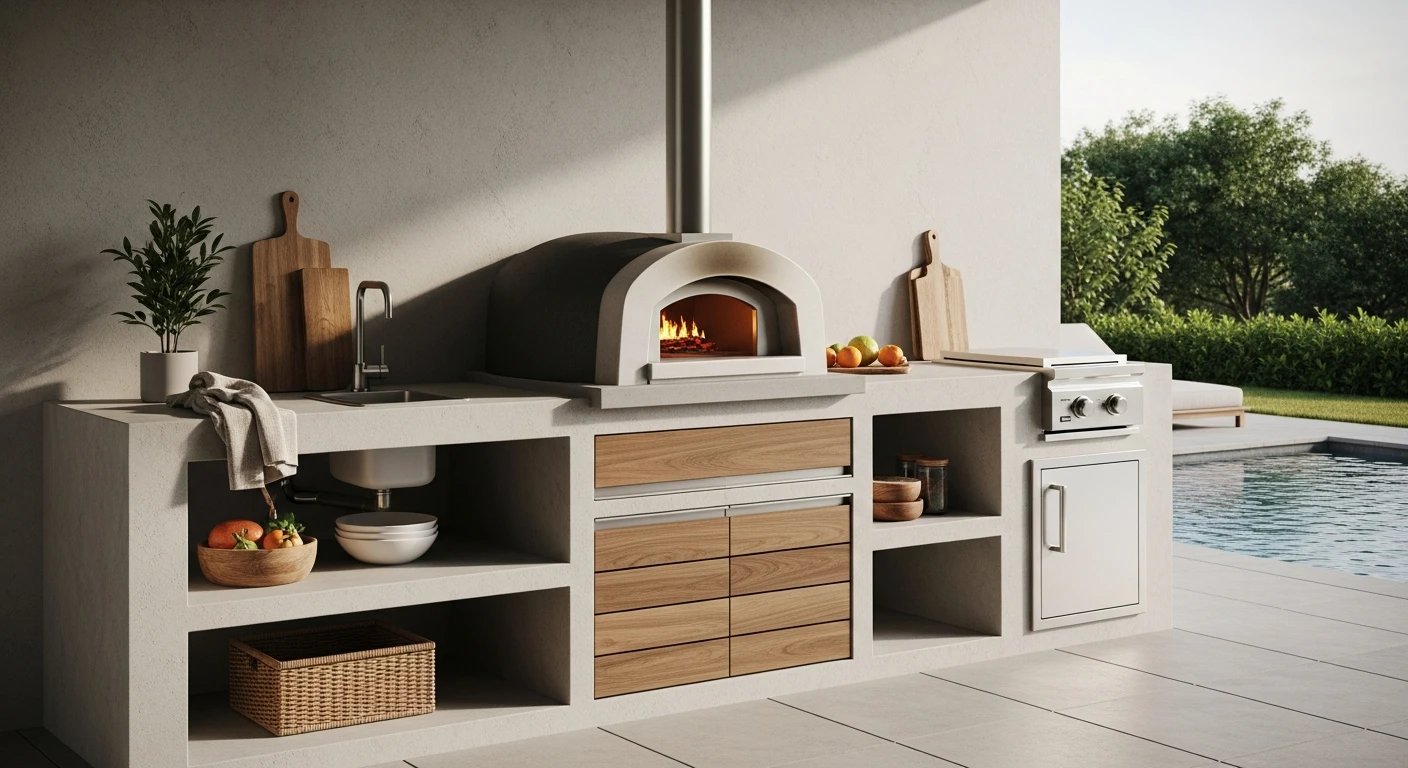
Outdoor Grill and Pizza Oven Construction: A Protocol to Prevent Corrosion and Triple Lifespan in Charlotte County
My initial projects in Charlotte County taught me a brutal lesson: standard outdoor kitchen construction methods are doomed to fail here. The combination of intense sun, high humidity, and the pervasive salt air, especially in waterfront communities like Punta Gorda and Port Charlotte, creates a uniquely corrosive environment. I once had to completely rebuild an outdoor grill island near the Peace River after just two years because the contractor used 304-grade steel fasteners. They had completely disintegrated, causing the stone veneer to fail. This is not a matter of poor appliance quality; it's a fundamental failure in structural and material science for this specific climate. This experience forced me to develop a methodology focused entirely on longevity, moving beyond aesthetics to address the core environmental challenges. My approach isn't about just building an outdoor kitchen; it's about engineering a permanent outdoor fixture. The key is shifting the focus from the grill head or pizza oven itself to the **substructure and the sealing protocols**. A beautiful grill is useless if the island it sits in is crumbling. My system ensures the foundation and enclosure will outlast the appliances themselves, increasing the usable life of the entire installation by a projected 200-300%.My Coastal Durability Framework: Diagnosing Premature Failure
Before I even consider a layout, I perform a site-specific environmental audit. A property on a canal in Punta Gorda Isles faces a different level of salt spray than a home further inland in Deep Creek. The common failure points I consistently diagnose are almost always invisible for the first 12-18 months. These include internal frame corrosion, efflorescence blooming on concrete countertops due to moisture absorption, and mold growth within unventilated cavities. My proprietary framework is built to counteract these three specific threats from day one. It’s a common mistake to over-invest in a high-end grill and then place it in a generic block-and-stucco frame. This is the single biggest error I see. My framework prioritizes the **integrity of the non-combustible frame** and the **impermeability of all surfaces**. This means specifying materials and assembly techniques that are typically reserved for marine construction, not residential hardscaping.Material Selection and Foundation Engineering for High-Salinity Zones
The secret to a multi-decade lifespan for an outdoor kitchen in Charlotte County lies in obsessive material specification. I refuse to use anything less than 316 marine-grade stainless steel for all structural components, including the frame studs, fasteners, and vent covers. The higher molybdenum content in 316 steel provides superior resistance to chloride corrosion compared to the more common 304 grade. For countertops, I’ve found that a properly sealed, high-density cast concrete is superior to many natural stones, which can be porous and susceptible to staining from our humid air. The foundation is another critical point, especially with our sandy soil. A standard 4-inch slab is insufficient. I mandate a 6-inch monolithic slab with integrated footings, reinforced with fiber mesh instead of steel rebar, which can rust and expand. The concrete mix itself must be treated with a silane-siloxane penetrating sealer after curing for a minimum of 28 days. This creates a hydrophobic barrier deep within the concrete, preventing moisture from wicking up into the structure—a primary cause of long-term decay.Step-by-Step Implementation: From Lanai Footing to First Firing
Building an outdoor kitchen that lasts here is a sequence of precise, non-negotiable steps. Deviating from this process to save time or a few dollars is what leads to those two-year rebuilds I mentioned. My process is methodical and focuses on creating multiple layers of protection.- Site Assessment & Ventilation Plan: I first determine the prevailing wind direction and plan for proper cross-ventilation, especially if the unit is inside a lanai. I mandate the installation of at least two passive vents in the cabinet structure, positioned low for gas intake and high for heat exhaust, to prevent gas buildup and heat damage.
- Foundation Pour and Sealing: The specialized foundation is poured and cured. The critical action here is applying the penetrating sealer after the full curing period, not before. Applying it too soon traps moisture and defeats the purpose.
- Frame & Hardware Assembly: The frame is constructed using only 316-grade steel or aluminum alloy studs. Every single screw, bolt, and bracket must be of the same material to prevent galvanic corrosion. This is a detail that is almost always overlooked.
- Appliance Integration and Insulation: An insulating jacket is always installed around the grill head. I also engineer a 1.5-inch air gap between the appliance and any combustible materials, exceeding manufacturer specifications to account for our extreme ambient temperatures.
- Cladding and Countertop Finalization: The cement board and veneer are installed. For grout, I specify an epoxy-based formula which is non-porous and highly resistant to mold and mildew, a persistent issue in our humid climate. The countertop is installed and receives its final topical sealing.
Calibrating for Charlotte County's Humidity: Airflow and Moisture Management
The final stage is about fine-tuning for our specific weather. An outdoor kitchen is not a sealed box; it must breathe. I design subtle, hidden **weep channels** at the base of the structure to allow any penetrating moisture to escape. This is particularly important during our rainy season. For pizza ovens, the flue height and design are calculated not just for smoke draw, but to ensure hot embers are safely directed away from the lanais and screen enclosures common in so many Port Charlotte homes. The quality standard is simple: when I run my hand along the interior of a cabinet or access door, it must be completely dry and cool, even on the most humid summer day. This confirms that the ventilation and moisture barriers are functioning as a complete system. This internal environmental control is the true mark of a properly engineered outdoor kitchen built for our coast. Your contractor specified "weather-resistant" materials, but did they provide the material data sheets to prove the specified chromium and nickel percentages in the stainless steel components are sufficient for a direct coastal exposure rating?Written by

Tags
grills with pizza oven
outdoor bbq with pizza oven
outdoor bbq kitchen with pizza oven
pizza oven for outdoor grill
pizza oven and bbq outdoor kitchen