Outdoor Grill Island Design for Seminole County: A Framework to Prevent 90% of Humidity-Related Failures
I've rebuilt more failed outdoor grill islands in Seminole County than I can count, from high-end homes in Lake Mary to established properties in Longwood. The common denominator isn't the grill brand or the countertop material; it's a fundamental misunderstanding of how our relentless Florida humidity attacks the island's core structure from the inside out. The standard building practices used elsewhere simply don't work here. My entire methodology is built around defeating moisture intrusion at the substrate level. Forget the fancy stone veneer for a moment. If the internal frame and backer board aren't specified and sealed correctly for our subtropical climate, you're building a beautiful, expensive box of mold and rot. This framework I developed focuses on creating a completely inert, waterproof core, which I've found extends the functional life of an outdoor kitchen by at least 15 years.My Core Philosophy: The Substrate is Everything
The single most catastrophic error I see is the use of improper sheathing and backer board. On a major project in Heathrow, I was called in to diagnose why a two-year-old, $30,000 grill island was literally crumbling. The builder had used a moisture-resistant drywall ("green board") inside the frame. In the constant humidity and heat trapped within the island, that board had delaminated and turned to mush, causing the stone veneer to detach. This is a complete tear-down scenario. My diagnostic process bypasses the surface aesthetics and goes straight to the core. I don't care if you have a stunning quartzite countertop if it's sitting on a compromised structure. The problem is that moisture vapor doesn't just come from rain; it wicks up from the concrete slab and gets trapped inside the island cavity, creating a perfect terrarium for decay. My proprietary approach neutralizes this threat before the first piece of stone is ever laid.The Triple-Seal Framework: From Cement Board to Final Grout
This is the technical heart of my process. It's a three-layer defense system that creates a monolithic, waterproof barrier.- Layer 1: The Right Foundation. I exclusively use a 1/2-inch cement board like `HardieBacker 500` or a comparable product rated for wet areas. It is dimensionally stable and completely inorganic, meaning mold has nothing to feed on. All seams are taped with alkaline-resistant mesh tape and filled with a polymer-modified thin-set mortar.
- Layer 2: The Impermeable Membrane. This is the step most builders in Seminole County skip. I apply a `liquid-applied waterproofing membrane`, like RedGard or AquaDefense, over the entire surface of the cement board assembly—inside and out. I apply two coats, creating a seamless, rubber-like barrier that is 100% waterproof and crack-resistant. This single step is the most critical factor in preventing internal moisture damage.
- Layer 3: The Final Armor. For setting the stone or tile veneer, I use a high-performance, polymer-modified mortar. But the real secret is the grout. I mandate the use of a 100% `epoxy grout` or a high-performance cementitious grout with a stain-proof sealer. Unlike traditional grout, epoxy is non-porous and will not absorb moisture or allow mildew to gain a foothold, which is a constant battle for homes near the Wekiva River basin.
Assembling Your Hurricane-Ready Grill Island
With the core protected, the assembly process must focus on durability and safety, specifically for our local conditions. A sudden Sanford thunderstorm or hurricane-force winds can turn a poorly built island into a liability.- Framing: Use a minimum of 20-gauge steel studs. I treat all fastener points and cuts with a `zinc-based cold galvanizing spray` to prevent rust, the silent killer of outdoor kitchen frames.
- Ventilation: This is a non-negotiable safety requirement. I mandate at least two sets of vents—one low for propane to escape (it's heavier than air) and one high for heat to exhaust. For a typical 36-inch grill, a minimum of `24 square inches of total ventilation` is required, split between the upper and lower vents.
- Appliance & Utility Sleeves: All plumbing and electrical conduits must be sealed with `marine-grade silicone sealant` where they penetrate the island structure to maintain the integrity of the waterproof membrane.
- Anchoring: For any island not structurally part of a lanai, it must be anchored to the concrete slab. I use `3/8-inch stainless steel wedge anchors` to secure the base track, ensuring the island can withstand our severe weather events without shifting.
Material & Appliance Specification for the Florida Sun
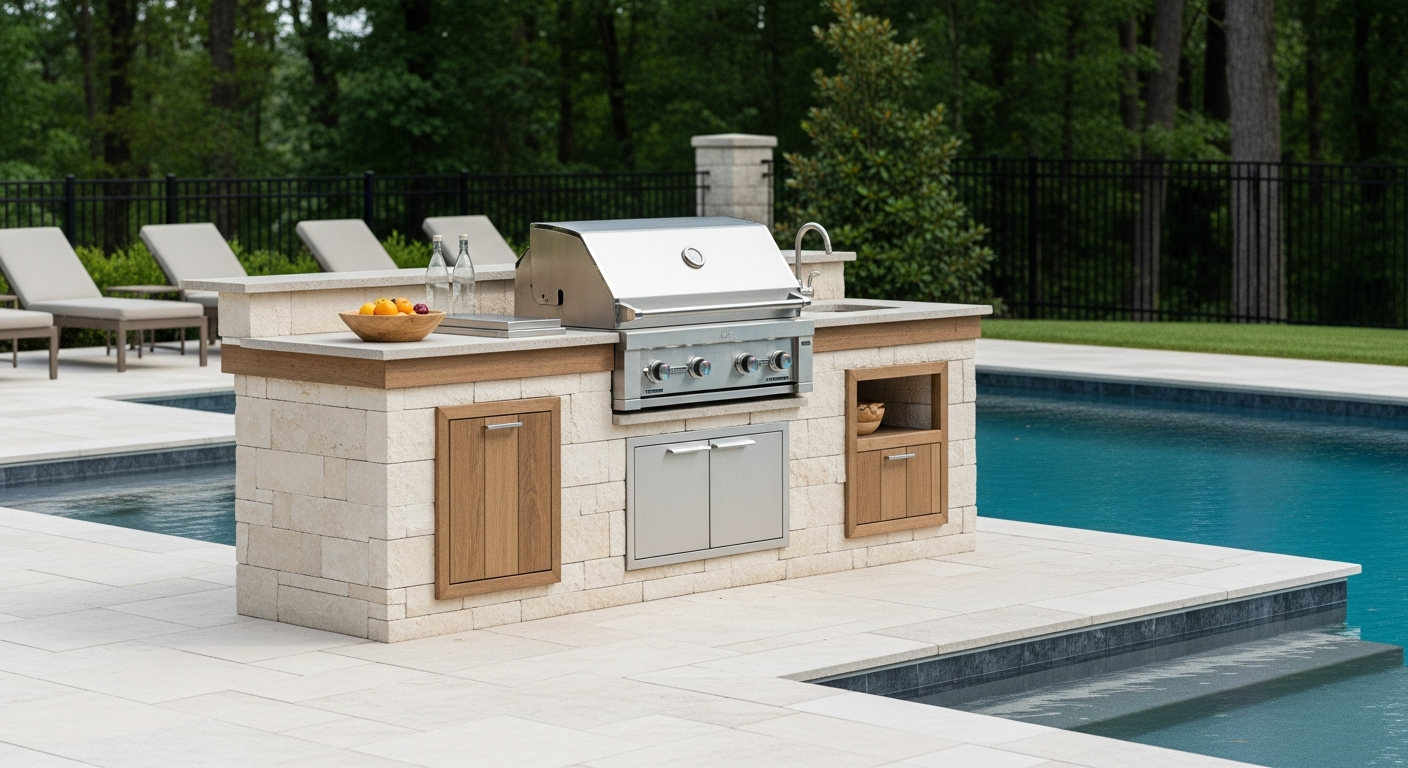
Your material choices must be informed by the intense UV radiation and heat. A dark granite countertop on a west-facing patio in an Altamonte Springs home will become dangerously hot and is more prone to thermal stress. I guide my clients toward lighter-colored, non-porous materials. `Quartzite` is a superior choice to many granites as it has lower porosity, resisting stains and mildew. For all hardware, doors, and access panels, `316L marine-grade stainless steel` is the only option I'll approve. The common 304 grade will show surface rust within a year in our humid, salt-tinged air. Proper material specification is the final piece of the puzzle for a truly resilient Seminole County outdoor kitchen. Now that you understand the critical nature of the substrate and waterproofing, how do you plan to manage the differential thermal expansion between your steel frame and your chosen stone veneer to prevent shear stress and cracking during our extreme temperature swings?Written by

Tags
prefabricated bbq islands
modular outdoor grill islands
prefab barbeque islands
prefabricated outdoor kitchen islands
outdoor kitchen island