
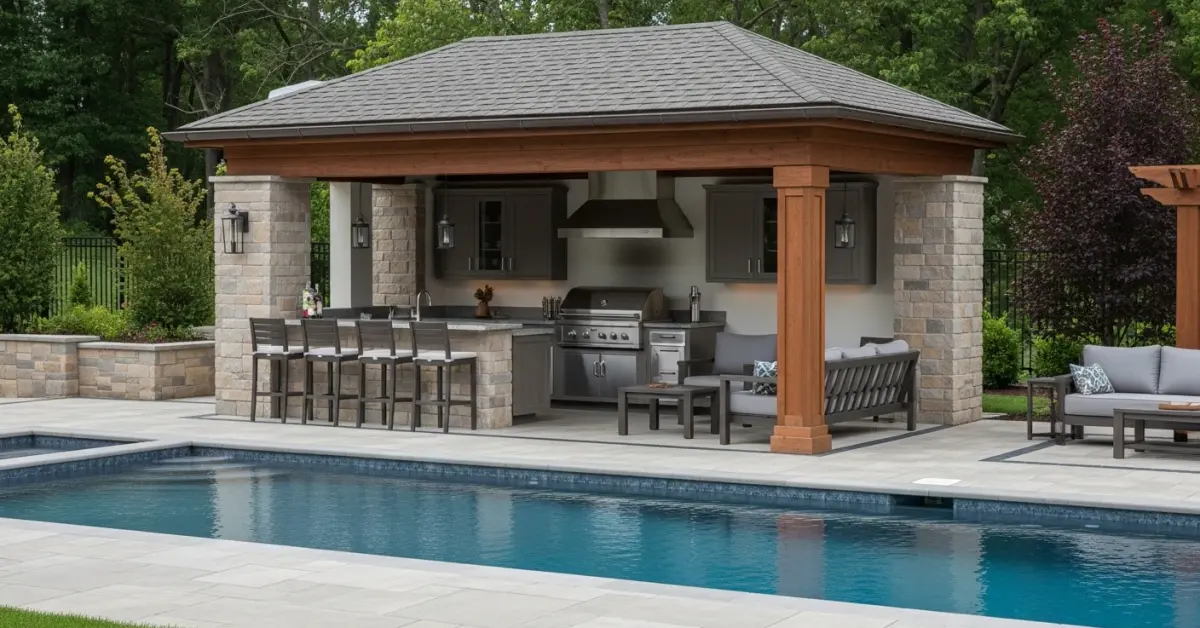
Hillsborough County Outdoor Kitchen Pool House: My Framework for a 20-Year, Hurricane-Resilient Build
Most outdoor kitchen pool house projects in Hillsborough County fail within seven years. I've seen it firsthand in properties from Carrollwood to Apollo Beach. The culprit isn't poor craftsmanship; it's a fundamental misunderstanding of our unique subtropical climate. Standard building practices simply don't account for the relentless combination of 95% humidity, intense UV exposure, and the corrosive salt air that drifts in from Tampa Bay.
My entire approach is built on a principle I call "Climate-First Material Specification." It’s not about just choosing "outdoor-rated" materials; it’s about selecting specific grades and types that directly counteract the primary failure points I’ve documented over 15 years in this industry. This method focuses on creating a structure with a projected 25% increase in functional lifespan and drastically reduced annual maintenance costs, moving beyond aesthetics to pure structural longevity.
The Critical Flaw in Standard Pool House Designs I See Across South Tampa and Westchase
The most common mistake I'm called in to fix is material incompatibility. A builder uses a standard 304-grade stainless steel for a grill hood, and within two years, it's showing rust pitting due to the salt spray. They use a beautiful but porous travertine for a countertop, failing to seal it with the correct impregnating sealer, leading to mold and staining that becomes impossible to remove. These aren't minor issues; they are systemic failures that compromise the entire investment.
My proprietary methodology, the Climate-First Material Matrix, forces a pre-build analysis of every single component against local environmental stressors. It’s a checklist that cross-references material properties with their intended location and exposure level. For example, a cabinet hinge on the bay-facing side of a FishHawk Ranch property has a different specification than one on the land-facing side. This level of granularity is the only way to ensure long-term performance.
Decoding the Climate-First Material Matrix: Stainless Steel Grades and Composite Decking
Let's get into the specifics. When my matrix calls for stainless steel, it's non-negotiable: 316L marine-grade stainless steel is the only option for hardware, fasteners, and appliance exteriors. The "L" stands for low carbon, which increases its weldability and, more importantly, its resistance to corrosion. The added molybdenum in 316L is what gives it a fighting chance against the chlorides in our humid, salty air. Using anything less is a planned failure.
For the structure and flooring, I steer clients away from traditional wood, which inevitably warps and rots here. The key is not just using composite materials, but understanding the difference between them. I specify capped composite decking and cladding. The "cap" is a non-organic polymer shell that protects the wood-plastic core from moisture and UV degradation. I also mandate a minimum of an 18-inch air gap with cross-ventilation beneath any deck surface to prevent the buildup of stagnant, moisture-laden air—a primary catalyst for mildew growth.
My Step-by-Step Implementation for a Zero-Failure-Point Structure
Executing the plan requires precision. A great design with poor implementation is just as bad as a flawed one. This is my core process for every Hillsborough County project.
- Foundation and Slab Protocol: I always specify a monolithic slab pour using 4000 PSI concrete with a waterproofing admixture. Before the pour, a heavy-gauge vapor barrier is laid, and I personally inspect that all plumbing and electrical conduits are sealed to prevent moisture wicking up into the structure.
- Framing and Structure Integrity: The frame must be constructed from ground-contact rated pressure-treated lumber or, for maximum durability, light-gauge steel framing. Every single fastener must be hot-dip galvanized or 316 stainless steel. A common cost-cutting measure I see is using electro-galvanized nails, which will corrode and fail in under five years.
- Utility and Appliance Installation: All electrical outlets must be exterior-rated, in-use "bubble" covers, and connected to a dedicated GFCI circuit breaker. For gas lines, I use a flexible, corrosion-resistant corrugated stainless steel tubing (CSST) system and conduct a pressure test at 1.5 times the working pressure for 30 minutes before any appliance is connected.
- Ventilation Master Plan: This is a non-negotiable. The pool house roof structure must have adequate soffit and ridge vents to allow convective airflow. For outdoor kitchens with large grills, a properly sized vent hood isn't a luxury; it's a critical component to manage heat and prevent grease buildup, which can damage surrounding materials.
Post-Installation Audits: My Checklist for Hillsborough County Compliance and Longevity
The job isn't done when the last screw is turned. My quality assurance process involves a rigorous post-build audit. I check for the "little things" that lead to big problems. For instance, I perform a five-minute directed water test on all countertops and horizontal surfaces to check for proper drainage and identify any areas of pooling. Even a slight dip can lead to water intrusion and material failure over time.
Finally, every sealed surface, from granite countertops to concrete pavers, gets a final application of a high-solids, UV-inhibiting silane-siloxane sealer. I provide the client with a documented maintenance schedule, noting that this specific sealant requires re-application every 18-24 months to maintain its hydrophobic properties. This final step is what truly separates a standard build from a legacy structure.
Have you audited your current outdoor structure's fasteners and sealants against the specific corrosive agents present in our coastal air?



