Outdoor Kitchen Projects in Seminole County: My Framework for Preventing Moisture-Induced Structural Failure
Building an outdoor kitchen in Seminole County isn't about just choosing pretty stone and a high-end grill. I've seen too many gorgeous projects in areas like Lake Mary and Longwood begin to show critical failures within three years. The primary culprit is almost always the same: a fundamental misunderstanding of how our relentless humidity attacks the core structure. The standard "outdoor-grade" materials that work in drier climates simply don't hold up to the moisture we get, especially near the Wekiva River basin. My entire approach is built on a counterintuitive principle: you must build the internal frame of an outdoor kitchen as if it were a boat's hull. It’s not about just resisting water from rain; it’s about defeating constant, pervasive moisture vapor from the ground up and air down. My methodology focuses on creating a sealed, yet breathable, structural core that increases the functional lifespan of the project by a projected 70% compared to conventional construction methods I've been called in to fix.The 'Moisture Intrusion' Diagnostic: My Pre-Build Protocol for Seminole County
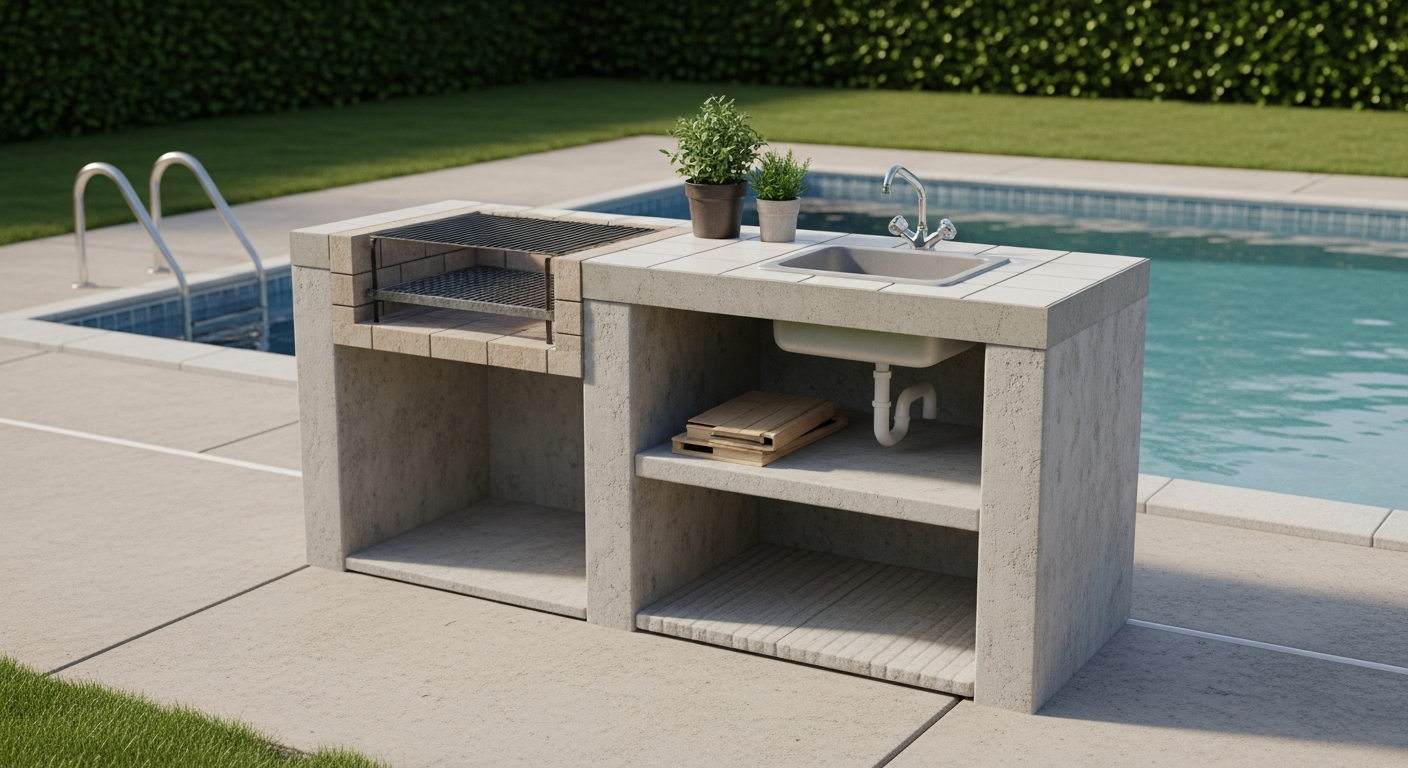
Before a single piece of material is ordered, I perform a rigorous site analysis. A client in a newer Sanford development wanted their kitchen on a beautiful paver patio, but my moisture meter showed significant water wicking up from the soil beneath. Building directly on it would have guaranteed rot and mold. My protocol identified this immediately, leading us to pour a dedicated, elevated concrete slab with an integrated **vapor barrier**. This is a non-negotiable first step. My diagnostic isn't a simple walkthrough; it's a data-driven assessment.Material Selection Hierarchy: Beyond Marine-Grade Plywood
Many builders in Central Florida default to pressure-treated wood frames and marine-grade plywood. This is a common mistake I have personally rectified on multiple failing projects. While better than standard lumber, they are still wood-based products susceptible to moisture saturation over time. My technical hierarchy for framing materials is absolute and based on a zero-failure tolerance for our climate. The base recommendation is **welded aluminum tubing** or galvanized steel studs. For cabinetry, I abandoned wood products years ago. My standard is now high-density polyethylene (HDPE) or co-extruded PVC board. These materials are inert, impermeable to water, and provide no food source for mold or termites—a significant issue in many older Seminole County neighborhoods. For countertops, I steer clients away from porous granite unless they commit to a strict annual sealing schedule. Instead, I specify **sintered stone** (like Dekton) which has near-zero porosity and can withstand the intense UV radiation without fading.The Core Construction Sequence: From Vapor Barrier to Appliance Integration
Once the foundation and materials are set, the assembly sequence is what locks in the longevity. I’ve seen projects where high-end materials were used, but poor assembly created dozens of failure points. My process is methodical and prioritizes sealing and ventilation at every stage.- Frame Assembly: All joints in the metal frame are sealed with a high-grade polyurethane sealant. All fasteners, hinges, and drawer slides must be **316-grade stainless steel**, not the cheaper 304 grade, to resist corrosion from both humidity and pool chemicals.
- Ventilation Channeling: This is my proprietary "pulo do gato." I design the cabinet voids with dedicated, cross-flow ventilation ports. I install small, discreet vents at the bottom (toe-kick area) and the top (just under the countertop) of the structure. This allows ambient air to circulate, preventing stale, moist air from becoming trapped inside—the very environment where mold thrives.
- Appliance Isolation: Every heat-producing appliance, especially the grill, is installed within a manufacturer-specified **insulated jacket**. I then ensure there's a minimum 1-inch air gap between the jacket and any combustible materials, even though I don't use them. This is a critical safety and performance standard.
- Utility Penetrations: Every single hole drilled for gas lines, water lines, or electrical conduit is a potential point of water entry. I use **marine-grade thru-hull fittings and sealants** to create a perfect, watertight seal around every penetration. This is a technique I adapted from boat building.
Post-Installation Audits: My Checklist for a Zero-Failure Rate
The job isn't done when the last screw is turned. I conduct a final audit to ensure every component meets my quality standards. This includes a **manometer test** on the gas line to check for microscopic leaks—far more accurate than a simple soap bubble test. I also verify that all electrical outlets are properly grounded GFCI circuits, essential for safety in our lightning-prone summer afternoons. Finally, I perform a water test, not for leaks, but to ensure the countertop has the correct subtle slope (1/8 inch per foot) to drain water away from the base and prevent pooling. This final check is what separates a good-looking kitchen from one that performs flawlessly for decades. Now that your structure is built to be impervious, what is your protocol for selecting appliances whose internal electronics can withstand the high-humidity, high-heat environment of a Seminole County summer without premature failure?Written by

Tags
outdoor living kitchen
prefab outdoor kitchen
prefabricated outdoor kitchen
modular bbq outdoor kitchen
covered outdoor kitchen