
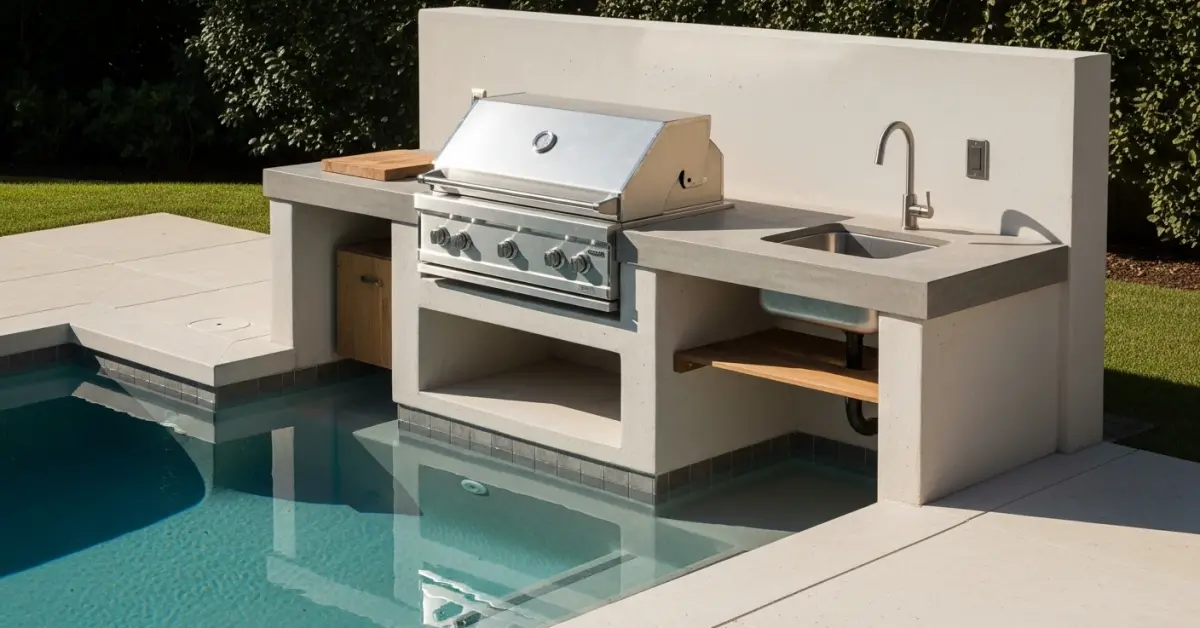
Custom Outdoor BBQ Kitchen in Lake County: My Material Selection Protocol for 30+ Year Weather Resistance
I’ve seen too many beautiful outdoor kitchens in Lake County start to fail within five years. The project I was called to fix in a Mount Dora historic district home was a classic case: the gorgeous granite countertop was fine, but the cabinet boxes, made from a "weather-resistant" composite, were swelling and delaminating. The client was told it was outdoor-grade, but it couldn't handle the relentless cycle of intense Florida sun and the deep humidity rolling in from the Harris Chain of Lakes. This is the single most expensive mistake I see homeowners make: they focus on the grill and the countertop stone, but neglect the substructure and material science that dictates longevity. My entire approach is built on preventing this exact scenario. I developed a methodology, the **Climate-Resilience Protocol**, specifically for the Central Florida environment. It’s not about just picking "outdoor" materials; it’s about creating a system where every component—from the framing screws to the cabinet polymer—is chosen based on its specific location on the property and its exposure to sun, rain, and humidity. This ensures the kitchen you build today looks just as good when your kids are off to college.My Diagnostic Framework for Lake County's Climate Challenge
Before a single design is sketched, my process begins with a site-specific **Environmental Exposure Audit**. I learned the hard way that a "one-size-fits-all" approach is a recipe for failure. A kitchen built on an open patio in the rolling hills of Clermont faces a different UV and moisture challenge than one tucked into a screened lanai in Tavares, which has to contend with higher ambient moisture from the lakes. The audit is my proprietary first step and focuses on mapping sun exposure throughout the day, identifying prevailing wind and rain patterns, and assessing drainage. This data directly informs the material selection. The biggest error I consistently diagnose is the use of **304-grade stainless steel** in applications that demand the superior corrosion resistance of **316-grade marine steel**, a costly oversight that reveals itself as surface rust within 24 months.Material Deep Dive: Beyond Contractor-Grade Standards
Once the audit is complete, I move to material specification. This is where my first-hand experience makes a tangible difference in the project's lifespan. Standard contractor-grade options are immediately discarded.- Cabinetry Construction: I exclusively use high-density polyethylene (HDPE) or marine-grade polymer sheets for all cabinet boxes. Unlike wood or even PVC composites, HDPE is non-porous and completely impervious to water. For clients wanting a metallic finish, I specify powder-coated **316 stainless steel** frames and doors, not the cheaper 304 grade.
- Countertop Selection: While granite is popular, many varieties are porous and require constant sealing to prevent staining and microbial growth in our humid climate. I often steer clients towards sintered stone, like **Dekton**, which has zero porosity and is completely UV stable, meaning the color won't fade under the intense Lake County sun.
- Hardware and Fasteners: This is a critical detail that is almost always overlooked. I mandate the use of **100% stainless steel fasteners**. Using zinc-plated or galvanized screws is a guaranteed point of failure; they will corrode and leave rust streaks running down your beautiful cabinetry within a year.
Implementation: A Phased Approach to Building for Longevity
Executing the build requires a level of precision that prevents moisture intrusion at every stage. My construction sequence is rigid and designed to eliminate weak points.- Phase 1: Foundation and Framing: The foundation must have adequate slope for drainage. The frame itself is constructed from welded **aluminum tubing** or steel studs, never wood. This creates a non-organic, rigid skeleton that will never rot, warp, or be targeted by termites.
- Phase 2: Utility Installation: All electrical wiring is run through **waterproof conduit**, and all outlets are specified as GFCI with "in-use" weatherproof covers. Gas lines are pressure-tested for a full 24 hours before any appliances are connected, a critical safety check I insist on.
- Phase 3: Cladding and Cabinet Install: The cement board or backer for any stone or brick cladding is installed with a **vapor barrier**. Cabinet boxes are then installed with ventilation channels at the top and bottom, promoting airflow and preventing stagnant, moist air from building up inside.
- Phase 4: Appliance and Countertop Integration: A high-CFM, **outdoor-rated vent hood** is non-negotiable, especially within a covered lanai. It's not just for smoke; it's essential for pulling moisture and grease-laden air out of the structure, preventing mold growth and deterioration. Countertops are installed with a flexible, waterproof silicone sealant, not a rigid grout.
Precision Tuning for Peak Performance and Safety
The final 5% of the project is where excellence is defined. After the main build, I perform a series of calibration and quality control checks. For the grill, I verify the gas pressure at the orifice to ensure it matches the manufacturer's specs for optimal heat output. For countertops, especially natural stone, I apply a high-grade **penetrating sealer** myself, ensuring full coverage. I’ve seen projects where a poorly applied sealer led to a permanent grease stain from the very first barbecue. It's these small, experience-driven details that protect the client's investment and deliver a truly finished product. Has your current builder detailed the specific grade of their stainless steel fasteners, or are you risking structural failure points hidden behind a beautiful facade?Written by

Tags
custom outdoor kitchen
custom outdoor kitchens near me
custom bbq island
custom outdoor grill
custom outdoor grill station
Custom Outdoor BBQ Kitchen in Lake FL FAQ
What materials are best for countertops and cabinets to withstand rain and sun?
Granite and quartzite are top choices for countertops as they are highly resistant to heat from grills and will not fade under intense sun exposure. For cabinetry, marine-grade polymers or stainless steel offer the best longevity, as they will not rot, warp, or rust like wood or standard powder-coated metal. While treated wood looks appealing initially, it requires annual sealing and is susceptible to insect damage and moisture rot within 5-7 years, making the initial savings a long-term liability. Always ensure any selected material is rated specifically for outdoor use and regional climate conditions, not just 'weather-resistant'.
Do I need special permits for building an outdoor kitchen with gas and water lines?
Yes, extending utility lines like natural gas, plumbing, and dedicated electrical circuits almost always requires a municipal permit and licensed professional installation. A licensed plumber must run and test the gas line to prevent dangerous leaks, and a licensed electrician must install GFCI-protected outlets to meet safety codes for wet environments. Attempting this work without a permit can result in fines, void your homeowner's insurance in case of an accident, and create significant safety hazards. The permit process ensures the installation is inspected and complies with local building and safety codes.
How much clearance do I need between my built-in grill and the structure?
You must use an insulated jacket specifically designed for your grill model if it is being installed into any combustible structure, such as a wood or composite frame. This non-negotiable safety device creates a protective air gap, preventing the high heat from igniting the surrounding materials. Even with the jacket, manufacturers typically require a minimum of 15 cm (6 inches) of clearance to any combustible side or back walls. Ignoring the insulated jacket requirement is a primary cause of outdoor kitchen fires and is often an explicit violation of both the grill's warranty and local fire codes.
Can I place my outdoor kitchen on my existing deck or patio?
An outdoor kitchen's structure, countertops, and appliances create a significant dead load, often exceeding 900 kilograms (2,000 pounds), which most standard decks are not built to support. Before construction, a structural engineer must assess your deck's foundation and framing to confirm it can handle the concentrated weight, potentially requiring new footings and joist reinforcement. A concrete patio slab must be at least 10 cm (4 inches) thick and crack-free to provide a stable foundation. Placing a heavy kitchen on an inadequate base will lead to dangerous structural failure or slab cracking over time.
What is the most common point of failure you see in custom outdoor kitchens?
The most frequent and costly failures stem from improper water management within the structure's core. When builders fail to install weep holes, drainage channels, and a proper moisture barrier behind the veneer, water gets trapped inside the frame. This leads to mold, rust-out of steel studs, and expansion damage during freeze-thaw cycles that can crack the entire structure from the inside out. A well-designed kitchen actively manages water, directing it away from electrical components and out of the structural cavity. Ask your builder specifically about their internal drainage plan.
Is a ventilation hood really necessary for an outdoor grill?
A ventilation hood is mandatory if your outdoor kitchen is located under any type of combustible overhead structure, like a pergola, covered patio, or roof overhang. Without a hood, intense heat, smoke, and grease accumulate, creating a serious fire hazard and causing permanent staining and damage to the ceiling. The hood must be specifically rated for outdoor use, constructed from stainless steel, and have a powerful enough fan (typically 1200 CFM or higher) to effectively capture the exhaust. Forgetting this component in a covered space is a critical design flaw that compromises both safety and structural integrity.


