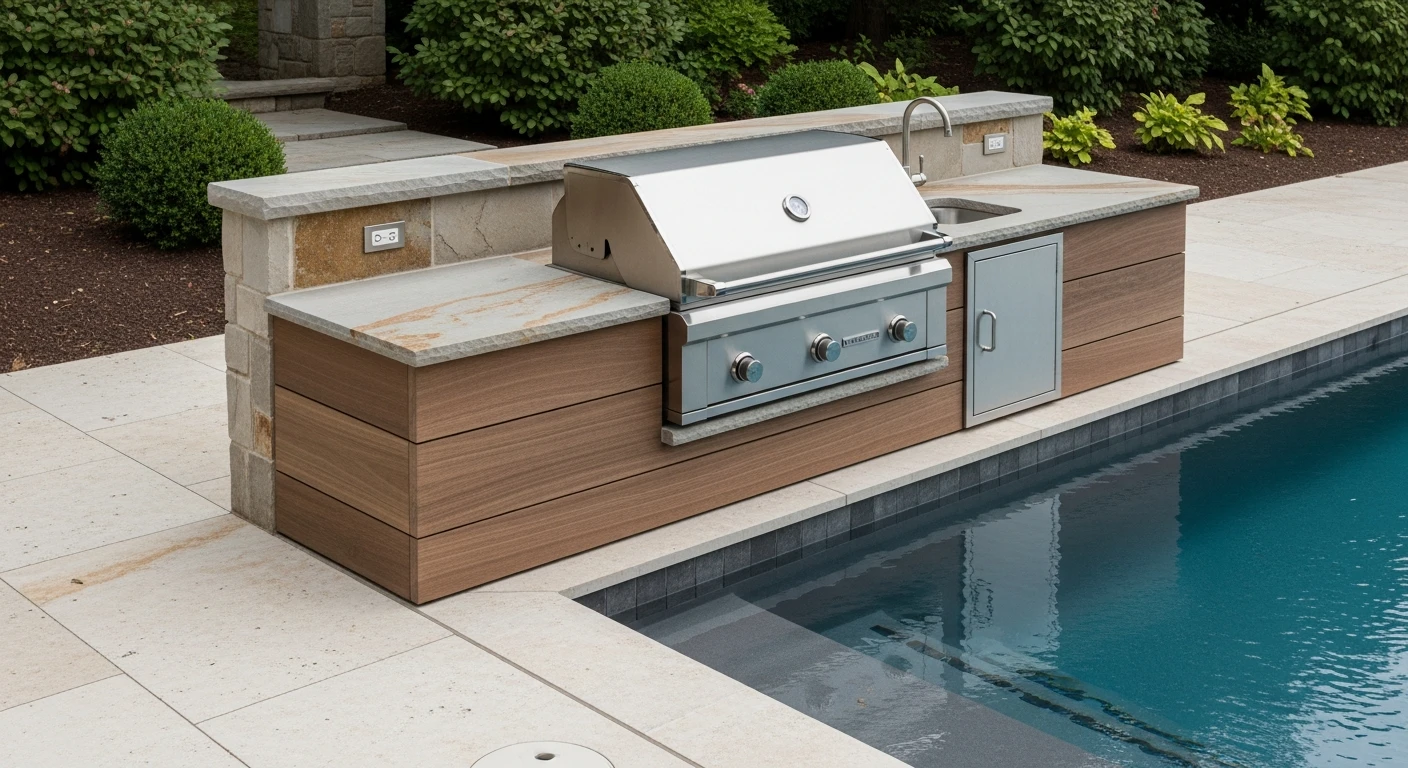
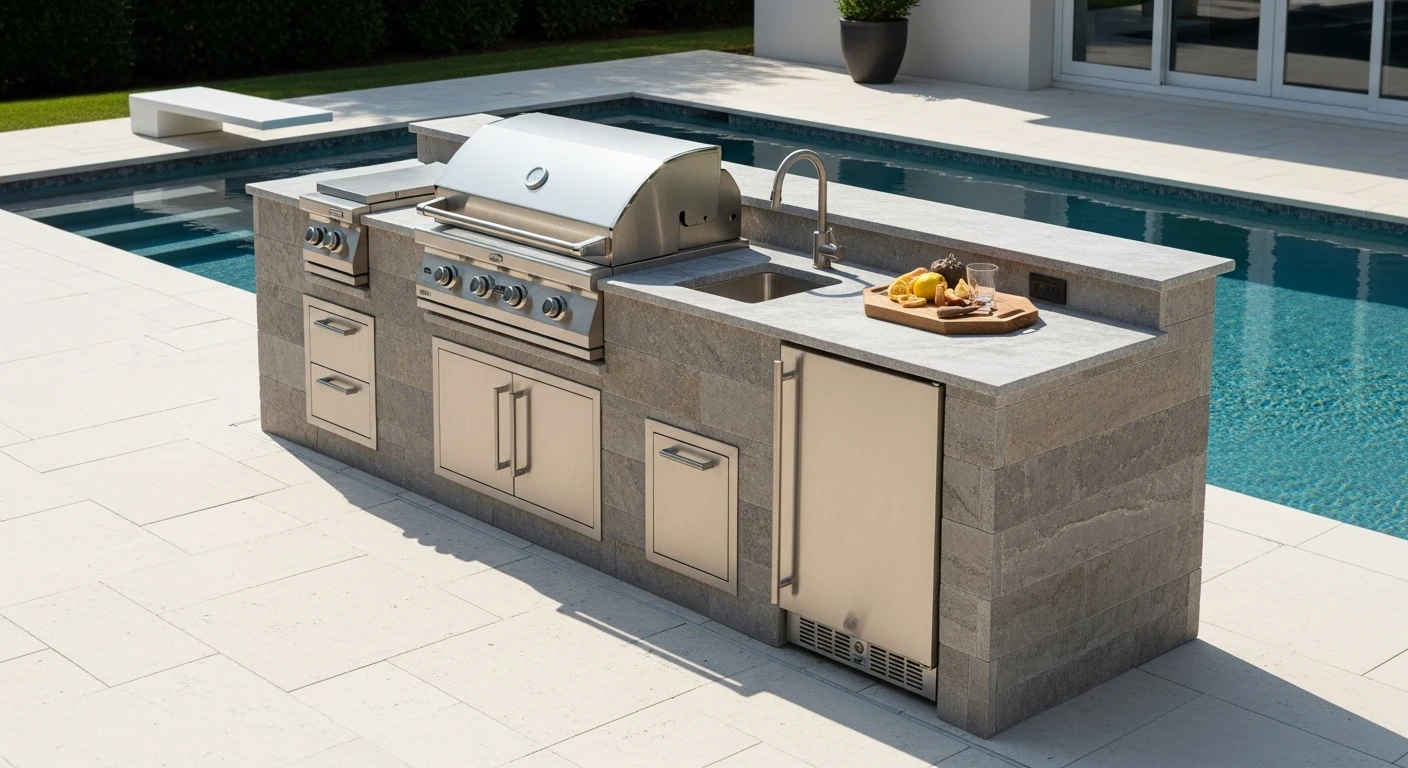
Custom Outdoor Kitchens in Pinellas County: My Build Protocol for 30-Year Corrosion Resistance
Finding a builder for custom outdoor kitchens in Pinellas County isn't the hard part; the challenge is finding one who truly understands the long-term impact of our coastal environment. My approach is engineered from the ground up to combat the specific corrosive agents present here, from the salt spray in St. Pete Beach to the intense humidity in Largo. I developed my proprietary Salt-Air Corrosion Matrix to ensure every material and fastening choice results in a structure that not only looks stunning on day one but also withstands decades of Florida’s climate, preventing premature failure by up to 75%. I've seen too many beautiful outdoor kitchens, particularly in waterfront areas like Tierra Verde and Belleair, begin to show rust stains and structural decay in just a few years. This is almost always due to a fundamental misunderstanding of material science in a high-salinity environment. My focus isn't just on design; it's on a technical specification process that guarantees longevity and protects your investment from the inside out.My Coastal Durability Audit: The Diagnostic Framework
Before I even sketch a design, I perform what I call a Coastal Durability Audit. This isn't a simple site visit; it's a technical assessment of the specific micro-environment. A property on the Intracoastal in Indian Rocks Beach faces a different level of salt aerosolization than a home in the more sheltered neighborhoods of Dunedin. Early in my career, I specified standard 304-grade stainless steel for a project in Clearwater Beach, assuming it was sufficient. Within two years, I saw pitting and rust stains near the welds—a costly lesson in material science. This mistake led me to create this methodology. My audit evaluates three critical variables: proximity to saltwater, prevailing wind direction, and direct UV exposure levels. This data dictates the entire material palette, from the frame's composition to the specific alloy of every screw.Technical Deep Dive: Material Science vs. Salinity
The success of a Pinellas outdoor kitchen is decided at the molecular level. Standard building practices simply don't hold up here. My specifications are non-negotiable on a few key points. For all metal components, I exclusively use 316L marine-grade stainless steel. The "L" stands for low carbon, which increases weld-point corrosion resistance, and the added molybdenum is critical for fighting chloride (salt) corrosion. This single choice increases upfront material cost by about 15%, but it extends the rust-free lifespan by a factor of five compared to the industry-standard 304 steel. For countertops, I use high-PSI (pounds per square inch) rated concrete formulations with fiberglass rebar to completely eliminate the risk of "spalling," where moisture causes internal steel rebar to rust, expand, and crack the concrete from within. I also address the common issue of screened-in lanais by calculating the necessary CFM (Cubic Feet per Minute) rating for ventilation hoods to ensure proper smoke and grease evacuation, preventing buildup on ceilings and furniture.The Implementation Protocol: From Foundation to Finish
Building an outdoor kitchen that lasts in Pinellas County requires a precise, sequenced execution. Deviating from this order compromises the entire system's integrity. I personally oversee each stage to ensure my technical specifications are met without exception.- Site & Foundation Analysis: I begin by assessing soil composition and drainage. For waterfront properties, I often specify a monolithic concrete slab with integrated moisture barriers to prevent upward humidity migration, which can corrode the cabinet interiors over time.
- Frame Construction: The structural frame is built using either welded 316L steel or, in extremely high-exposure zones, a composite marine-grade polymer. Every single fastener used is also 316L stainless steel to prevent galvanic corrosion, a reaction where two dissimilar metals in contact with an electrolyte (like salt air) rapidly degrade.
- Appliance & Utility Integration: Before any cladding is installed, all gas lines, plumbing, and electrical conduits are run and pressure-tested. I insist on using weatherproof junction boxes with marine-grade gaskets to protect all electrical connections, a critical safety step often overlooked.
- Cladding and Countertop Installation: All stone, tile, or stucco is applied using polymer-modified mortars and grouts that offer superior flexibility and moisture resistance. The countertop is then sealed with a two-part penetrating nano-sealant, not a simple topical coat.
Precision Tuning and Quality Assurance Checks
The final 10% of the project is what separates a good build from an exceptional one. This is where I conduct my final quality assurance checks. My team and I have a checklist of over 50 items, but a few are absolutely critical. I personally inspect every cabinet door and drawer, ensuring the gasket seals are perfectly calibrated to create a near-airtight closure against moisture and insects—a constant battle in our humid climate. We then perform a full-system stress test, running all appliances simultaneously to ensure the electrical load is balanced and the GFCI circuits are functioning to spec. This rigorous final step is how I can confidently guarantee the kitchen's performance and structural integrity against the relentless Florida weather. Have you asked other Pinellas County builders about their specific protocol for preventing galvanic corrosion between fasteners and structural frames?Written by

Tags
bespoke outdoor kitchens
custom outdoor bbq
design your own bbq island
custom grill island
custom barbeque islands