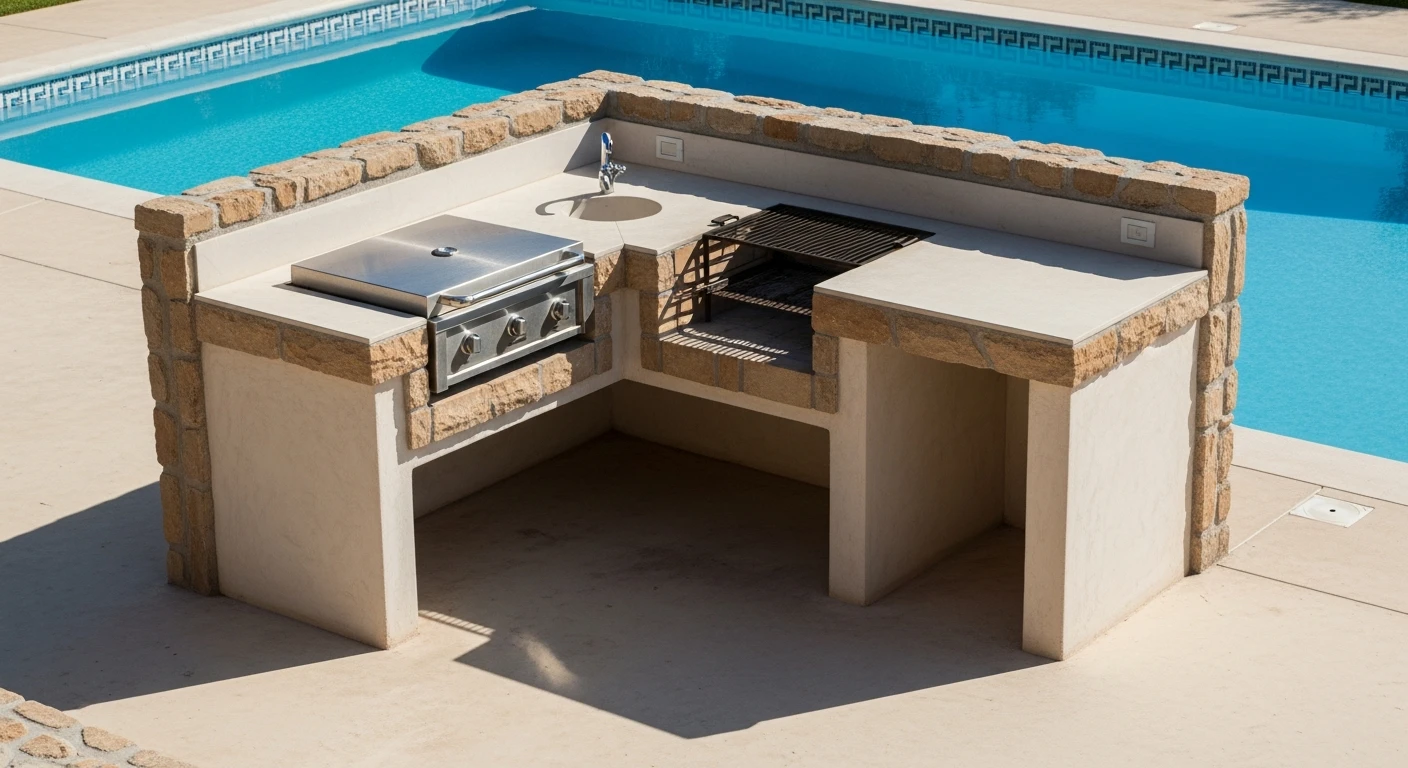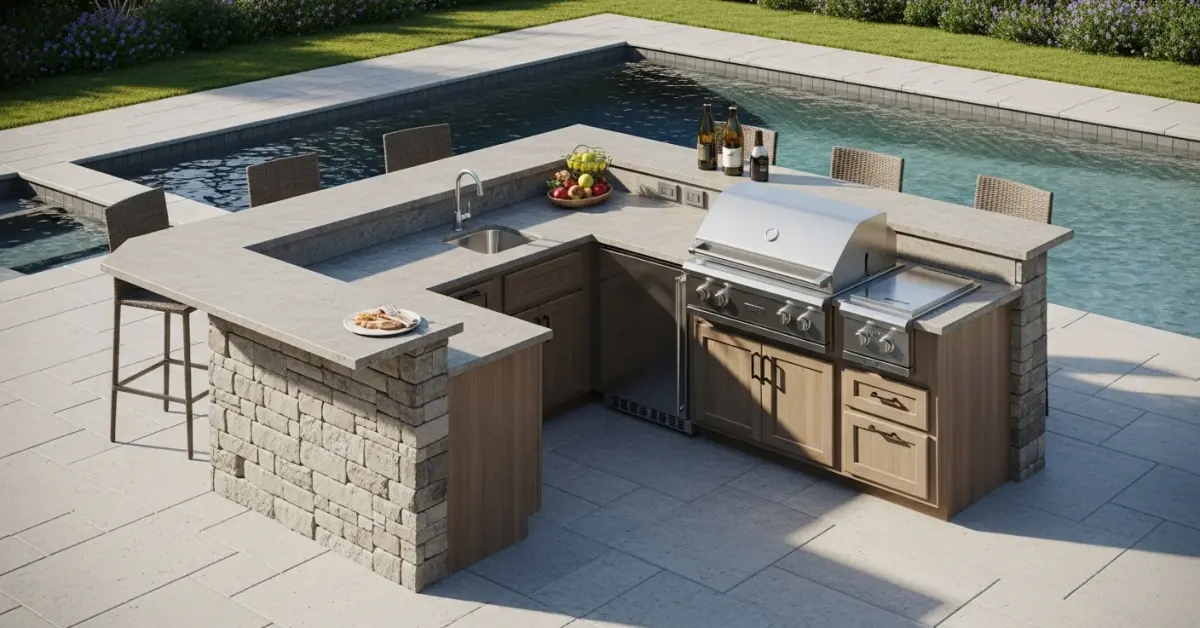
L Shaped Outdoor Kitchen with Bar: My Framework for 30-Year Durability in Polk County's Climate
Building an L-shaped outdoor kitchen with a bar in Polk County isn't just about aesthetics; it's a battle against humidity, intense UV radiation, and torrential downpours. I've seen far too many beautiful projects in Lakeland and Winter Haven degrade in under five years because they were designed with a generic, nationwide approach. The most common failure point I encounter is material selection—specifically, using porous stone countertops like standard granite that become a breeding ground for mildew or cabinetry that warps from the constant moisture. My entire methodology is built around creating a structure that thrives in our specific Central Florida environment, not just survives it. This isn't about over-engineering; it's about intelligent engineering. It’s about ensuring your investment provides a functional, beautiful entertainment space for decades, whether you're in a historic Bartow home or a new build near the Chain of Lakes. The key is a framework that prioritizes material science and micro-climate orientation from day one.The Polk County Durability Triangle: My Diagnostic Framework
After years of designing and troubleshooting outdoor kitchens across Polk County, I developed what I call the Durability Triangle. It’s a simple diagnostic framework I use for every project before a single drawing is made. It consists of three pillars: Material Immunity, Structural Orientation, and Moisture Management. Ignoring any one of these pillars is the primary reason I get called in for expensive repair work. For example, I once diagnosed a massive structural crack in a beautiful outdoor bar in a South Lakeland home, not because the foundation was bad, but because the orientation didn't account for the intense afternoon sun, causing extreme thermal expansion on one side that the materials couldn't handle.Material Selection Beyond the Obvious: Sintered Stone and Marine-Grade Polymers
The "stainless steel and granite" combo is a default for many, but it's a flawed one for our climate. My specification process is far more granular. For appliance and hardware materials, I specify nothing less than 316 marine-grade stainless steel. The common 304 grade will show pitting and rust spots within two seasons due to our high humidity. For countertops, I push my clients away from porous natural stones and towards non-porous materials like sintered stone (e.g., Dekton) or quartzite. These have near-zero water absorption, preventing mold and staining, and their UV resistance is dramatically higher, meaning the color won't fade under the relentless Florida sun. For cabinetry, I avoid wood entirely and use High-Density Polyethylene (HDPE) or marine-grade polymers, which are completely impervious to water and will not warp or delaminate.L-Shaped Layout Implementation: A Step-by-Step Protocol
Executing the L-shaped design requires a rigid protocol to ensure functionality and longevity. The "L" shape is fantastic for creating distinct zones for cooking and socializing, but a poor layout can create smoke-filled seating areas or an inefficient workflow.- Site the Primary Leg: I always begin by orienting the primary leg of the kitchen—the one with the grill—based on Polk County's prevailing wind direction. This ensures smoke is directed away from the bar seating and the entrance to the main house.
- Establish the Work Triangle: On the L-shape, the grill (hot zone), sink (wet zone), and refrigerator (cold zone) must form an efficient triangle. I aim for each leg of this triangle to be no more than 9 feet. The bar seating area must be explicitly outside this work triangle.
- Map Your Utility Runs First: Before pouring any concrete footing, I map and sleeve all gas, water, and electrical lines. It’s a rookie mistake to pour the slab and then try to figure out utilities. This pre-planning prevents costly trenching and ensures all hookups are clean and to code.
- Integrate Task and Ambient Lighting: Specify IP67-rated waterproof LED lighting. I place focused task lighting directly over the grill and prep areas and softer ambient lighting under the bar countertop to create a comfortable social atmosphere without glare.
Precision Tuning for the Florida Climate: Pitch and Ventilation Standards
Two small details make a massive difference in the long-term health of an outdoor kitchen here. First is countertop pitch. I mandate a subtle but critical 1/8-inch per foot slope on all countertop surfaces. This ensures our heavy afternoon rains sheet off immediately instead of pooling, which prevents water ingress and staining. The second is appliance ventilation. Every heat-producing appliance, like a grill or side burner, must be installed with a minimum 1-inch air gap from any combustible cabinet material and proper cross-ventilation cutouts in the cabinet island itself. This prevents premature failure of electronic igniters and control modules, a frequent issue I see in poorly planned projects during our hot summer months. Have you truly accounted for how your chosen cabinet material's thermal expansion coefficient will interact with your countertop fasteners during a Polk County summer heatwave?Written by

Tags
small l shaped outdoor kitchen
outdoor kitchen l shaped island
l shaped outdoor kitchen ideas
l shaped outdoor grill island
l shaped outdoor bbq kitchen
L Shaped Outdoor Kitchen with Bar in Polk FL FAQ
How far should an L-shaped outdoor kitchen with a bar be from the pool's edge?
Your L-shaped kitchen's bar seating should be at least 1.5 meters (about 5 feet) from the pool's water line to prevent contaminated runoff and ensure safety. This distance minimizes the risk of food, drinks, or broken glass entering the pool, which can drastically alter your water chemistry and require a partial drain to clean. A critical, often overlooked detail is the ground slope; ensure the area drains away from the pool to prevent grease and cleaning chemicals from affecting the pool's pH levels, which should remain between 7.2 and 7.6 to avoid corrosion of pool equipment.
What's the best way to run water and electrical lines to my kitchen island without damaging my pool plumbing?
Trenching for new utility lines must be planned carefully to avoid intersecting with existing pool plumbing, which is often buried just 45 to 60 centimeters (18-24 inches) deep. Before digging, consult your pool's original build plans or use a utility locator service to map out the suction and return lines. Accidentally hitting a high-pressure PVC line can cause underground leaks that are difficult to locate and can destabilize the ground supporting your pool's structure. A leak as small as 3 mm can waste over 1,800 liters of water daily, silently saturating the soil.
Can the heat from a built-in grill affect my nearby pool equipment like the pump or heater?
Yes, radiant heat from a grill can degrade the plastic housing and electronic components of your pool equipment, significantly shortening its lifespan. Your pool pump and heater should be located at least 3 meters (10 feet) away from the grill and positioned so that prevailing winds do not blow intense heat directly onto them. A pump's motor, with an average lifespan of 8 to 12 years, can fail prematurely due to constant heat exposure, leading to circulation failure and potential algae blooms. Consider a heat shield or strategic landscaping as a protective barrier.
My new kitchen's stone patio is getting slippery from pool splash-out. What's the safest surface?
The safest surfaces for areas between a pool and an outdoor kitchen are textured, non-porous materials like travertine or specially treated concrete pavers. Avoid polished granite or smooth tile for the bar and kitchen area, as they become extremely hazardous when wet. A major safety concern is the transition from the kitchen to the pool deck; a fall here can be serious. Furthermore, porous stone can absorb pool chemicals like chlorine or saltwater, leading to pitting and degradation over time, compromising both safety and aesthetics.
Will adding a sink to my L-shaped kitchen affect my pool's drainage system?
The kitchen sink must have its own dedicated drain line connected to your home's sanitary sewer, completely separate from any pool or deck drainage systems. Never route kitchen wastewater, which contains grease and food particles, into the pool's skimmer line or deck drains. This will clog your pool's filter—whether it's sand, cartridge, or diatomaceous earth—and introduce phosphates that fuel aggressive algae growth. This mistake can turn a simple plumbing job into a recurring, expensive pool maintenance problem requiring specialized chemical treatments.
We want to install bright lighting for our kitchen bar. Could this interfere with the pool's safety?
Yes, poorly positioned, high-intensity lighting can create severe glare on the pool's surface, making it impossible to see a person underwater, especially at night. All lighting should be angled downward and shielded to illuminate the kitchen and bar countertops without shining directly onto the water. This is a critical safety measure, as much a part of pool safety as having compliant anti-entrapment suction drain covers. Ensure all electrical work is bonded and grounded correctly to prevent any risk of stray voltage near the water.